Author name: Manyehlisa Lehohla

African basketball enthusiast, founder and editor of The Big Tip Off and a freelance writer.

Craig standing tall as road to Mercer awaits

Craig’s game blossomed in the spring

SOUTH African-born centre, David Craig has taken a gigantic leap in his playing career by committing himself to NCAA Division I University team, Mercer Bears in the United States.

While the ink has dried on the letter of intent Craig signed two weeks ago to join Georgia-based Bears, he reflected on a journey that brought its fair share of pain and disappointment.

Second Picture
David Craig during the signing of his letter of intent. Pictures: McCallie and Mercer

The 7ft1 former St Benedict’s pupil has lingering memories of a debilitating ailment on both knees which almost halted his progress in his early teens. Then there was also the disappointment of not making a junior NBA team and losing an inter-provincial final in South Africa. This was three years before he joined the all-boys McCallie School in Tennessee.

“Honestly, it’s almost like I have woken up from a very long sleep. It’s like you know what has happened, but you don’t feel it yet. I still remember being that kid who got cut from a junior NBA team. I remember it like it was yesterday playing for Gauteng in an inter-provincial in twenty-sixteen and losing to the Western Cape in the final,” said the colossal Craig, who hails from Ekurhuleni. “Those things are fresh in my head, but I just signed a division one letter of intent. It’s just a relieving feeling knowing that my parents can watch their child play in a division one school in America and not have to pay a single cent for it.”

Craig, who was 14-years-old when he experienced trouble with his knees, says it affected his mobility and relationship with food.

“I had this thing called Osgood Schlatter Syndrome. It meant that I had a lot of swelling around the joints of my knees. They were sensitive to the point that when I pressed my finger on either knee, it hurt,” continued Craig. “It was destructive and impacted everything I did, from the way I walked to the way I ran. Also, when I was not playing, I would sit at home and eat as a way of filling that need for stimulation.”

Following a consultation with a doctor, the prescribed treatment for Craig’s knees was rest. For the centre, the idea of waiting to heal did not sit well with him, and he embarked on a self-driven recovery program.

“My doctor told me the best way to fix this was if I rested, but I was not willing to do that. It took me quite a while to realise that I could conquer this and didn’t need to focus only on rest. I needed to work on my diet and my body. That was the beginning of all this, and truly understanding the meaning of hard work,” said Craig.

The work the big man put in to get his knees right and withstand the rigours of basketball paid off, and with the help of his parents, he earned a scholarship to attend McCallie.

“When I turned 15 and at about six foot seven, my parents saw that I was talented. I worked hard. I was ahead of other players in my age group at the time. So their thought process was, we do not want you to wait for an opportunity to come,” said Craig, who is in his final year at McCallie. “Coming from South Africa, the typical route to the US is through BWB (Basketball Without Borders). While BWB would be a great opportunity, I did not want to rely solely on it, so we started to apply to schools and luckily, I got the financial aid I needed… And here I am.”


View this post on Instagram


A post shared by David Craig (@dave2tall_)


While leaving home for a different country can be challenging from a cultural and mental aspect, Craig says the advice he received from his former coach, Nompumelelo Ramatsoga was affirming and helped put his mind at ease.

“My high school coach from South Africa, coach Mpumi gave me the best advice as she has made that transition before. Coach Mpumi told me I needed to ready myself, try to learn from everything, and not to see the situation as a loss. She reminded me I had what it took, that I was a good player, and everything would work itself out. She has been right so far,” said Craig, who already knew he could overcome difficult hurdles.

The McCallie environment suited Craig as he was afforded the space and time to adapt to the culture of the school and also be up to speed with the physical demands of basketball in America.

“When I came to McCallie, it was a huge learning curve. It’s a prestigious school and houses athletes in different sporting codes. There is also an emphasis on academics. There were a lot of things I needed to adjust, and I got help with that. The coaches stuck with me. I had a lot of growing to do. Growing into my body. Getting my strength and coordination up. The coaches there ultimately knew I would be an investment,” said Craig, who has high ambition for his final season.

“I worked hard and improved throughout the years. Midway through my sophomore year, I was starting to make an impact on the team. In my junior year, I made it to the all-regional team. This year I am looking to win Mr Basketball Tennessee, which would be a great thing. So I am thankful for how much the coaches have invested in me.”

Third Pic
David Craig signs his letter of intent to play college basketball for Mercer Bears

Craig pointed out that he was not high on the recruitment list of teams until his junior high school year. The outbreak of the Covid-19 pandemic also threw a spanner in the works.

“I had just finished playing my sophomore season and getting ready to play in the Amateur Athletic Union (basketball). Then Covid hit, everything got shut down and I had to come home,” said Craig. “I did not get noticed until my junior high school season. That’s when realised I had to turn things up a notch because I was going to have one spring season to play in AAU Basketball where all the college coaches go (for scouting).”

It was during the Spring season that Craig’s game blossomed. Coaches who had slept on him took a second look, and the number of college suitors increased. Ultimately, it was the Gary Gray coached Bears who won the race to sign Craig, as they were intentional about having him on board from the start.

“I would say I blew up. I was improving but was not getting that recognition. Once my play improved, coaches would come back to watch me play and started to realise how good I was,” said Craig, who was pursued by the likes of Purdue and Georgia Tech amongst other colleges. “Ultimately, the thing about Mercer was that they were consistent and did not drag their feet. They were straightforward in letting me know I had something they could use and be effective in their system. So, that’s why I signed with them as early as I did.”

With one part of the dream achieved, Craig wants to strive for more and has his sights on playing in the NBA. To him, it does not matter how he gets there.

“… As far as I can remember, it’s always been a dream of mine to play in the NBA. I am going to pursue that. If it means I play elsewhere professionally first, then so be it. But the NBA is my end goal,” said Craig, who wants to inspire future generations with this ambition. “There has not been a South African player in the NBA. I know that I can do that. And it’s something that pushes me every day. It’s constantly on my mind. Ten years down the line I want kids to say a South African played in the NBA. I want to hear them saying ‘I want to be like him.’ That would be priceless for me. I definitely want to play in the NBA.”

There is no doubt that South Africa can produce world class basketball players. Our eyes and ears should be on Craig as he pursues his dream of playing in the NBA. 

Craig standing tall as road to Mercer awaits Read More »

Swiss army knife Kennedy, the sharp point of Beira offence

Beira learnt lessons from loss to Tigers

BASKETBALL runs deep in Jermel Kennedy’s family. The influence of his kin is one of  the main reasons he plays the game.

Community also played its part in providing the fertile ground for the Canada-born player to grow, spread his wings and further his ambition in the sport.

“Growing up, where I am from, basketball is popular. It’s something I enjoy doing. The city of Malton has a huge basketball culture. In a way it propelled me to achieve my dreams,” said Kennedy. “Also, basketball runs in the family. My mom played in high school and my older sister played as well. In fact, my older sister’s influence was what encouraged me to take on the sport. I used to watch her high school games. She was pretty good.”

Second Picture
Jermel Kennedy believes lessons have been learnt from the loss against Tigers Pictures: The Big Tip Off

The 32-year-old forward would go on to chart his own path as he learnt the ropes at Lincoln Alexander Secondary School and refined his game in the American college system. With  a clear foundation laid and a physical growth spurt, the signs were there that he had the potential to be a good player.

“In my second year of high school, I grew taller and realised there was an opportunity there. I was probably one of  the tallest players in my area or team and decently athletic. I was slowly developing, and people recognised that I had certain attributes that translated well,” said Kennedy, who had spells with two junior colleges in the United States before joining Division II college team, Lander Bearcats.

Kennedy says while he enjoyed his time at the South Carolina school, where he also graduated, he was far from the polished player that he is now.

“I liked what Lander offered me. It was perfect for me, a good fit. It was different. Although, in the beginning, I was more like a four or five and did not shoot very well. I was more like a get-out, run and dunk the ball kind of player, but I still had most of the tools I use now although I was more of an inside than outside player,” said Kennedy.

The road to the pro-ranks saw Kennedy return home to the Canadian National Basketball League (NBL). Although he was a high draft pick for the NBL, he did not see himself playing on home turf, as the league was relatively new and painted in a negative light by players who had participated in it.

“I took a year off and played in tournaments or basketball leagues. Anything basketball-related, I immersed myself into. I also wanted to be a part of the NBL draft (in 2013). So, to get there, I went to the combine,” said Kennedy, who landed at the Moncton Miracles. “I ended up getting drafted sixth, but I had no intention of playing in the NBL. Some friends and players did not have good experiences playing in it. The league was new at the time, so how they handled players was not professional. I used my high draft value as a way of marketing myself and leveraging a move overseas.”

In addition to realising his dream of playing abroad, Kennedy has also been a bit of a journeyman. Spain (CB Clavijo Logrono), Britain (Worcester Wolves), Portugal (ADO Basquetbol SAD Overanse), Canada (Guelph Nighthawks and Hamilton Honeybadgers), Argentina (Ferrocarril Oeste) and France (AS Kaysersberg, Besancon BCD and Toulouse Basket Club) have all been home to the Canadian player.


View this post on Instagram


A post shared by Jermel Kennedy,BSc (@jermz30)

Mozambican club Ferroviario Da Beira, is where he now earns his keep. The Beira-based club is on a mission to qualify for the Basketball Africa League (BAL) and was in South Africa three weeks ago, where they successfully progressed to the Elite 16.

Beira won their first two games against Matero Magic of Zambia (81-51) and Roche-Bois Warriors of Mauritius (132-36) and crumbled in the final minutes against hosts, Cape Town Tigers (86-85) in a game the Mozambican’s dominated.

Reflecting on the qualifiers, especially in the final game, Kennedy says it was a good thing that they lost the game against the Tigers. In his opinion, it provided Beira with some teachable moments that will come in handy at the Elite 16 in December.

“I would say our biggest plus in that tournament was losing that game. It made us aware of certain things we had not noticed. We are not going to waltz into games and expect to win,” said Kennedy. “We were leading that game, and we were dominating. There were little things that we slept on. Little things like turnovers, not finishing easy plays, getting back on defence and rebounding. There are so many takeaways. It sucks when you have to understand that lesson through a loss. So, the loss provided those lessons.”

Despite the loss, Kennedy’s scoring feats for Beira was the highlight on the court during the regional qualifiers held at the University of Johannesburg Soweto Campus. In the opener against Matero, he dropped 16 points and in the second game against Warriors he again scored 16 points. In the loss to the Tigers, Kennedy did not disappoint as he notched double figures scoring 22 points. The Canadian has so far shown that he has a high basketball IQ in terms of scoring. His stats in the game against Tigers speak to this fact. He was 9/12 in field goals and was 4/5 from behind the arc.

Third Pic
Jermel Kennedy used his high NBL draft to leverage a move overseas.

Kennedy has shown that he is a proven scorer for Beira. He also sees himself as an all-around player and does what the team requires of him.

I am like a Swiss army knife. There are a lot of things I do on the court. I don’t do everything super amazing, but I do everything good. I am like the glue guy, but my role in this team is different. The coach expects me to be more aggressive, rebound, drive in, kick out and create for the team. I try to do that at a high level as much as possible,” concluded Kennedy.

On his experience with his new teammates, Kennedy says the process has been seamless as he has joined a good team with quality players that understand basketball. He feels this group of players will turn it up a level for the club when the Elite 16 tournament begins.

“It’s way easier than people make it out to be. These guys are smart players and easy to play with. Our system is not that difficult, it’s actually quite easy.” said the new Beira recruit. “We are definitely going to turn the intensity up this month as the Elite 16 approaches. Hopefully we are able to resolve the issues we have identified.” 

The Elite 16 will require a different attitude from Beira and Kennedy. There has been introspection, and moving forward, the Mozambican team will have to dot their i’s and cross their t’s, as the road to the BAL tournament will not get any easier. Beira will need Kennedy and his teammates to step up and play consistently at an elite level.

Swiss army knife Kennedy, the sharp point of Beira offence Read More »

Beira and Perry are a good fit for BAL quest

Beira’s ambition intrigued Perry

FOR most basketball players who ply their trade in overseas leagues, signing long-term contracts is a rarity. In most cases bouncing from one country to another is the norm for most ballers. While the scenario could be unsettling for some players, others choose to embrace the challenge.

The latter applies to American-born point guard William Perry, who now calls Mozambique where he plays for one of the Southern African country’s most famous club, Ferroviario Da Beira, home.

Before wearing the white and green striped vest of Ferroviario, Perry played for CB Zamora (Spain), ADO Basquetbal SAD Ovarense (Portugal) and Akademiks Bulteks 99 Plovdiv (Bulgaria). After another stint in Spain playing for CD Estela Cantabria, the African continent came calling.

Perry, who hails from North Carolina says he has enjoyed traversing Europe, as it has allowed him to experience different cultures.

“I enjoyed it. I like travelling, meeting new people and doing what is best for my career. If it means I experience a little anxiety in the summertime about my next move, it’s okay. I can deal with it,” said the 28-year-old, who goes by the shortened version of his name, Will. “I would say I enjoy that aspect of living out of a suitcase. Of course it’s not as comfortable as playing for a team for five years, but I would not have it any other way.”

Second Picture
Will Perry of Ferroviario Da Beira in action during the BAL Zonal qualifiers. Pictures: The BTO

The former Lenoir-Rhyne University player says having the chance to be away from home to pursue his basketball dreams helped him mature as a person.

“I have learnt a lot about myself as a person. I found myself and became a man since playing overseas. To live on my own, travelling, making my own decisions and all that stuff. There are some things I had already been doing during my college days, like living by myself,” said Perry. “It was little uncomfortable when you come to a new place on your own. I learnt who I am as a man, what I like to do and don’t like and how to work with others.”

In terms of achievement, Perry says that playing in Portugal and helping Ferroviario in their mission qualify for the Basketball Africa League (BAL) are some career highlights.

“I really joined my time in Portugal. In my second year over there, we made the final four. It was an amazing experience. I had a good season. That propelled my career,” said Perry. “It’s hard to only pick one highlight. I would say what I am doing now, trying to qualify for the BAL, to play in the Basketball Africa League would be the biggest highlight of my career.”


View this post on Instagram


A post shared by Will Perry (@willperry0)

Perry did have some questions before nailing his colours to the Beira mast. Is the club ambitious, and do they have the right pieces to make it to the BAL?

“My first thought was, do we have a chance to make it to the BAL? Is the club serious? Coming to Africa, you want the opportunity to play at the BAL. The moment I learnt the club was serious, I was on board,” said Perry.

Ferroviario made it to the Elite 16 of the BAL qualifiers after finishing second in the regional stages held at the University of Johannesburg, Soweto Campus, two weeks ago. Led by the playmaking of Perry, the Mozambican’s, finished with a 2-1 record, beating Matero Magic (Zambia) and Roche-Bois Warriors (Mauritius). They would lose a nail-biter against the Cape Town Tigers.

Perry was instrumental for Ferroviario in the opening game against Matero, scoring 12 points and making 10 assists as the Mozambican club strolled to an 81-51 victory. He was impactful in the final game against the Tigers scoring 18 points in Ferroviario’s 86-85 loss.

The experience of playing in the qualifiers was an enjoyable one for Perry, as he felt he fit in well with the Beira club’s setup.

“It was a great experience, I love my team, and I like my coach. In the qualifiers, we lost one game at the end, which was disappointing. I feel we should have won,” said Perry. “We qualified, which was our goal, and we have moved forward.”

Perry picked up some lessons from the qualifiers in Johannesburg and recognised that there were points in the final game where he could have done better. With the Elite 16 looming in December, it gives Perry ample time to rectify the issues he has identified.

Third Pic
Will Perry is working on his game ahead of the Elite 16.

“I think I need to do better with the clock management. Closer to the end of the game (against Tigers), I could have done better. I made some silly mistakes, took a bad shot or two. Those are the things I need to work on to get better,” said Perry. “As a team, I think we need to lock in at the end a little more. Do the little things better for us to win. I am confident in this team. We are good and we work well together.”

Perry believes he chose the best city and team to play his basketball on the continent. The floor general says he has already warmed up to the city and can feel a togetherness. He opined that the people of Beira are behind the club and its quest to clinch a spot in the BAL tournament. 

“If you ever go to Beira, you’ll see they are really supportive of the club. They are in a great city. The people love the club. They know basketball and love it. They are passionate and want to win,” said Perry. “Estamos Juntos is a great phrase to use. Hopefully, it catches on. It means we are together. Everyone, from players, coaches and fans. We are together.”

Beira and Perry are a good fit for BAL quest Read More »

Ntunja believes Tigers have a championship DNA

Tigers fine-tuning in key areas for Elite 16 

EXITING the O.R. Tambo international airport, one of the most noticeable features at this national asset is a billboard of the legendary point guard and Cape Town Tigers assistant coach, Vincent Ntunja.

Throughout his playing career, Gugulethu-born Ntunja has also dabbled in modelling and promoting brands. He has appeared on billboards, television advertisements and to top it all off, he is a brand ambassador for sports apparel company, Under Armour. This ability for Ntunja, a former basketball player in South Africa, to be marketable is a sign of the game’s infinite potential for growth. However, ongoing governance issues plaguing the sport in the country make it a far fetched dream for most players.

“We have to start by asking, who is managing the game? Who provides the guidelines for basketball from a business and branding perspective? Those are vital people to have within the administration of the game. Right now, along with other issues, basketball lacks in that department,” said the 40-year-old Ntunja. “Despite what’s happening with the game in the country, it has not stopped me from achieving my goals. Under Armour approached me and it was clear from our discussion, we had mutual interests. They understood my drive, my intention to not only be a basketball player but also to be marketable outside the game.


Second Picture
Cape Town Tigers coach Vincent Ntunja has made the most of his opportunities. Pictures: Big Tip Off

“So, if we fix the governance issues and place people in the right places in terms of administration, there will be a good product in South Africa. The pie is big enough for everybody to get a slice.”

The former national team player says appearing on the billboard that encourages and promotes tourism in the country is part of leaving a legacy.

“It’s massive! To appear on a billboard at OR Tambo is a milestone. Can you imagine how many people pass through the airport daily? Having your face planted there signals something. It’s a message to every child that it is possible.

“As I speak to you right now, I am at a shoot in Fish Hoek, and I am enjoying myself. It’s for a purpose and I don’t take these opportunities for granted. I can feed my family and have the chance to travel. I am grateful.”

On matters related to the basketball court, recently retired Ntunja and the new ‘it’ team in South African basketball, Tigers are riding a wave of success. Two weeks ago, the American-owned club qualified for the Elite 16 qualifiers of the Basketball Africa League. The Tigers left the preliminary qualifying tournament held at the University of Johannesburg’s Soweto Campus with a 3-0 record after beating Roche-Bois Warriors (Mauritius), Matero Magic (Zambia) and Ferroviario Da Beira (Mozambique).

Ntunja expressed his joy at the achievement of the Tigers and stressed that a lot went into getting the team where it is.

“We are elated because of what we achieved in a short space of time. We did not take any shortcuts in preparing ourselves and getting the players to be in tune with each other. Remember that these are guys from different backgrounds and attitudes,” said the former Western Cape Mountaineers player. “Certain feelings or emotions can come to the fore. That’s where we come in to help manage the situation. These are professional players. We appreciate their input and why they are here.”

Having taken a step closer to the BAL tournament, the Tigers are contributing to changing the attitude towards basketball in South Africa.


View this post on Instagram


A post shared by Vincent Ntunja® (@vincentntunja)

“We are changing the narrative about basketball in South Africa. We are changing how people in our city and the country see the game,” said Ntunja. As the Tigers prepare for the Elite 16, which tips off December, they will have to double their efforts.

“The team has been working hard to get ready for the Elite 16, because we do have reasonable expectations of ourselves. We will to take on each challenge as it comes. The team is in a good space, and we are not taking anything for granted. We will be back at the beach training and doing our skill sets on the court. We want to improve on our team chemistry and bonding as a unit.”

Going into the Elite 16, one of the areas where the Tigers need to be a cohesive unit is defence and players need to maintain their on court-discipline.  The preliminary qualifiers saw key players, Chris Gabriels and Billy Preston ejected, while team captain Pieter Prinsloo fouled-out.

Ntunja says as a coaching staff, they have communicated with the players about tightening up at the defensive end and learning how to manage themselves in tense situations.

“On the subject of discipline, we have been teaching the players self-mastery. Some of the guys may have been overwhelmed by the stage or even the intensity of African basketball. Those issues need to be addressed and players must understand the task at hand,” said the former Cape Peninsula University of Technology Alumni. “Our defence. We speak about it daily. The rebounding, we must not allow the opposition to get those second-chance looks. That will win us games. We need everybody to be on board at the defensive end.”

In terms of the Tigers play, Ntunja was impressed with the performances of seasoned campaigners Ben Uzoh, Pieter Prinsloo, Evans Ganapamo, and Billy Preston who stepped up for the team in the preliminary leg of the qualifiers. Worth noting as well, was their ability to knock down shots.

“I liked our shooting. It was decent. I must compliment our players ability to step up. Our captain Pieter had a great final game against Beira. Against Matero, Ben and Evans delivered for us, and Billy stepped up,” said Ntunja. “We have always asked the guys to take the lead on the court.  As their coaches, we have given them all the information. It’s up to them to apply it.”

Cape Town Tigers players celebrate winning the National Club Championships

The Tigers have made known their lofty ambitions to qualify for the BAL and their desire to be crowned champions of the prestigious tournament. To make their BAL dream a reality, they will have to contend with competition that harbours similar desires in the Elite 16.

“We will go back to the drawing board to correct some of the issues and improve on our strengths and we want to focus on the areas that allow us to do more than just participate in the tournament. We are going to the tournament to compete to be champions,” said Ntunja. “If you look at our record, we are unbeaten. Since the Tigers project began, we have not lost a game. So it tells you how much this means to us and how badly we want it. It’s been a good experience, and we will let our hard work speak for us.”

Ntunja believes Tigers have a championship DNA Read More »

Sithole feels Tigers have the right tools for BAL mission

Sithole has exceeded his expectations on the court

THE age of 26 is the middle of an athlete’s prime years. It’s where they develop a level of maturity in their craft and begin their pursuit for greatness or greener pastures.

Well, this is not the case for South African basketball player Thabo Sithole. The KwaZulu-Natal-born point guard is content with what he has achieved on the court at his young age. He has represented South Africa at the 2017 AfroBasket, co-hosted by Senegal and Tunisia and donned the colours of Lithuanian club, Zalgiris Kaunus. In South Africa, Sithole had stints with KZN Basketball National League (BNL) franchises Marlins and the now-defunct Duzi Royals.

“For myself, I have exceeded my expectations in basketball. I did not start as a basketball player. I  participated in athletics and played provincial rugby in primary school,” said the former Durban High School pupil. “When I became serious about basketball from grade eight, I never thought I would end up in Europe or represent the country in AfroBasket.”

Second Picture
Thabo Sithole is ready to help the Tigers achieve their BAL goal. Pictures: The Big Tip Off

The journey seems to be getting better for Sithole. He recently joined Mother City club Cape Town Tigers, who are on mission to qualify for the Basketball Africa League (BAL) tournament. Before heading to the Western Cape, Sithole was a part of Jozi Nuggets’ losing effort to qualify for the same tournament at the National Club Championships final in September. Now he sees being part of the Tigers as a way of helping South African basketball.  

“I joined Nuggets for two or three months. I came through on the weekends to play matches up here (Gauteng) and go back. After the finals, I felt that I should join the Tigers because you need your best eight South African players and the foreign players to represent the country,” said Sithole. “So, I am for South Africa first. It does not matter if I am wearing the colours of the Cape Town Tigers or Jozi Nuggets, I play basketball for the country.”

“I’m not focusing on the NBA or going back to Europe. I want the best for South Africa. It would be better to help develop basketball here rather than to go overseas, while things here are going nowhere.”

After his overseas sojourn, Sithole realised he needed to explore all avenues to secure his future. He took a break from basketball to focus on his studies. 

“When I came back from Lithuania, I realised I do not want to bounce around from country to country, which is the case with players overseas. Sometimes you can get injured. For example, if you hurt your knee, you could be out for a year or two. I did not want that for my life,” said Sithole, who is pursuing his masters in development studies at University of KwaZulu-Natal (UKZN). “So when I got back, I told myself, let me look for ways to better myself, so I paused a bit on basketball. It’s difficult to strike that balance, but we are more than just athletes.”

Having played in the BAL qualifiers in 2019 for Jozi Nuggets, Sithole highlighted why the Gauteng side could not progress in their first attempt and why Tigers have a better chance.

“It was tough playing in 2019 because there were some issues. The BNL did not want to release players to help Nuggets. So we only had a few players who could play at that level,” said the UKZN player. “This time around, the team (Tigers) is much stronger. Good players have joined this club. It’s going to be tough, but I think we will manage.

“In this team, there are guys who have played in the NBA. Guys like myself who played for top clubs in Europe and at the AfroBasket. I know the kinds of challenges that might come. There will not be any nerves or panic, because I have experienced such situations before.”


Sithole is part of a basketball club trying to rock the landscape of South African basketball on the court. Unfortunately, the Tigers’ arrival coincides with a long-time unstable political basketball climate off the court. This is a situation Sithole is both familiar with and has been outspoken about.

“There are people who have been running basketball at national and BNL level. They have been running basketball for a long time. Their treatment of players has not been the best, and there have been many issues,” said Sithole. “I remember coming back from national team duty, they (Basketball South Africa management) took our kits, and the reason given was, ‘there are no funds’, but we found out that the Lotto had given BSA money. Other issues include things not being done on time and if you get injured, it is not clear that there is insurance to cover players.

“It’s unfortunate that those individuals are still in charge. So, when I tweeted to the minister to do something, I was saying somebody from above needs to act. In terms action being taken, things like making sure forensic audits are done and basic good governance would go a long way to remedy the situation. If that does not happen basketball will continue to be in a dark place. ” 

Second Picture
Thabo Sithole in action for Jozi Nuggets at the National Club Championships.

Are the Tigers that catalyst for change in South African basketball? Sithole pointed out that South African-owned teams have struggled to attract investment, which has not been an issue for American-backed Tigers.  If the newly formed club progress beyond the BAL qualifiers, Sithole hopes both business and government will look at basketball differently.

“What the Tigers are trying to do is a good thing but other clubs are struggling. Tigers are an American-owned team who did not get funding from local banks or mobile telecommunications companies. Maybe this team can help the private sector and government see things differently by qualifying for the BAL,” concluded Sithole.

BAL QUALIFIERS GROUP F 

VENUE: UJ SOWETO CAMPUS

FIXTURES:

DAY 1: Thursday

12pm Ferroviario da Beira (MOZ) vs Matero Magic (ZAM)

3pm: Cape Town Tigers (RSA) vs Roche-Bois Warriors (MRI)

DAY 2: Friday

12pm: Roche-Bois Warriors vs Ferroviario da Beira

3pm: Matero Magic vs Cape Town Tigers

Day 3: Saturday

12pm: Matero Magic vs Roche-Bois Warriors

3pm: Cape Town Tigers vs Ferroviario da Beira

Sithole feels Tigers have the right tools for BAL mission Read More »

Tigers ready to earn their stripes in BAL qualifiers

BAL a chance for players to become super stars

FOR Cape Town Tigers big man Pieter Prinsloo, South Africa is where his heart has always been. His allegiance and patriotism run deep, skin deep.

Embellished on the Tigers captain’s right arm are tattoos of the national flag and the big five (lion, leopard, rhino, elephant and buffalo), elements that celebrate his South African roots.

Prinsloo always held the ambition of representing South Africa through the Proteas cricket team, but his life took a different turn when he moved to the United States, where he picked up basketball. Despite living most of his life in the US and playing professionally in different parts of the world, Prinsloo never forgot the country of his birth.

“As a kid growing up here, I always thought I would play for the SA national cricket team. It did not work out that way because I left for the States. For me, this (South Africa) is my home. It’s where I am from, and I will never forget that,” said 29-year old Prinsloo. “Soon as I got out of the house and was allowed to do my own thing, the first thing I did was to get a tattoo of the South African flag.

“For me, that’s my heritage. I also have tattoos of the big five. The tattoos on my right arm are a celebration of my heritage. So wherever I am in the world, and people take note of the tattoos, I let them know this is my representation of home.”

Second Picture
Cape Tigers get ready to receive the National Club Championship trophy. Pictures: The Big Tip Off

Prinsloo knows all about representing South Africa at the highest level. He has donned the green and gold vest at the 2017 AfroBasket co-hosted by Senegal and Tunisia. Now he will have another opportunity to represent his country, but this time in the colours of the Tigers, who beat Jozi Nuggets 76-70 in September to become the new National Men’s club champions.

The Cape-based club will take on four Southern African teams in the Zone VI Basketball Africa League (BAL) qualifiers from 19- 24 October in Johannesburg at the University of Johannesburg Campus in Soweto.

Pretoria-West born Prinsloo believes hosting the games and hopefully qualifying for the BAL presents an opportunity for Tigers to help raise basketball’s profile in the country and for players to make a name for themselves.

For us, it’s great! It’s an opportunity for guys to become superstars. Some of the guys realise that. When they walk in the street, they will be recognisable. It also means long-term security. It means guys can change their lives and futures,” said Prinsloo, who experienced his bit of the limelight. “I have experienced that playing in countries overseas, where somebody would say ‘hey Prinsloo can I get a picture.’ So, for me, it’s normal to be on a poster because something is going here or there.”

“For South Africa… it’s probably the richest and most talked about country in Africa, but in sport, we ain’t doing sh*t. Our rugby is up and down. Cricket has its scandals. Soccer has not been relevant in, who knows for how long? So we know by what we are doing, we can become a big-time face in this country.”


View this post on Instagram


A post shared by Pieter Prinsloo (@pieter_p34)

Unfortunately for Tigers, they will not host the BAL qualifiers in their home city, and according to Prinsloo this is a missed opportunity for the club and its fans. He also felt the tournament organisers made it impossible for the Tigers to host the event.

“We would have loved to have the games here. We are the SA champs, and we are from Cape Town, but the organisers made it a complicated process in trying to host it here. They had a lot of requirements that we felt were excessive, but they have their rules, so we left it at that,” said Prinsloo. “We would have preferred to have it in Cape Town. Our fanbase is here. It also could have helped us with our branding, marketing of the game, and we could grow our support even more.

“We do have a fanbase in Johannesburg because of the growth of the game, and people see the work we have done.”

The issue of where games should held, has not been a distraction for the Tigers players, as they have continued preparing  for the BAL qualifying tournament. They have also added some quality players to help them reach their objective. The only stumbling block could be the lack of meaningful competition since being crowned national champions.  

“Training wise, things have been going good. We have incorporated a couple more pieces. Jared (Harrington) is included again after missing out on the championships because of paperwork. We have also filled our African slot with Evans (Ganapamo) and Ben Uzoh, who played with us at the championships. Billy Preston from the States has also joined the team,” said Prinsloo, a former Marist Red Foxes player.

“We have not had many practice games, but in training, things are coming together. The talents we have brought in are starting to click with the rest of the team. There is good chemistry. Guys are starting to understand each other.

“It’s been hard to find competitive scrimmages. We get better runs going five-on-five in the team at training because of the size and skill. It’s been hard to find a similar kind of talent that we will face in Joburg.”

Third Picture
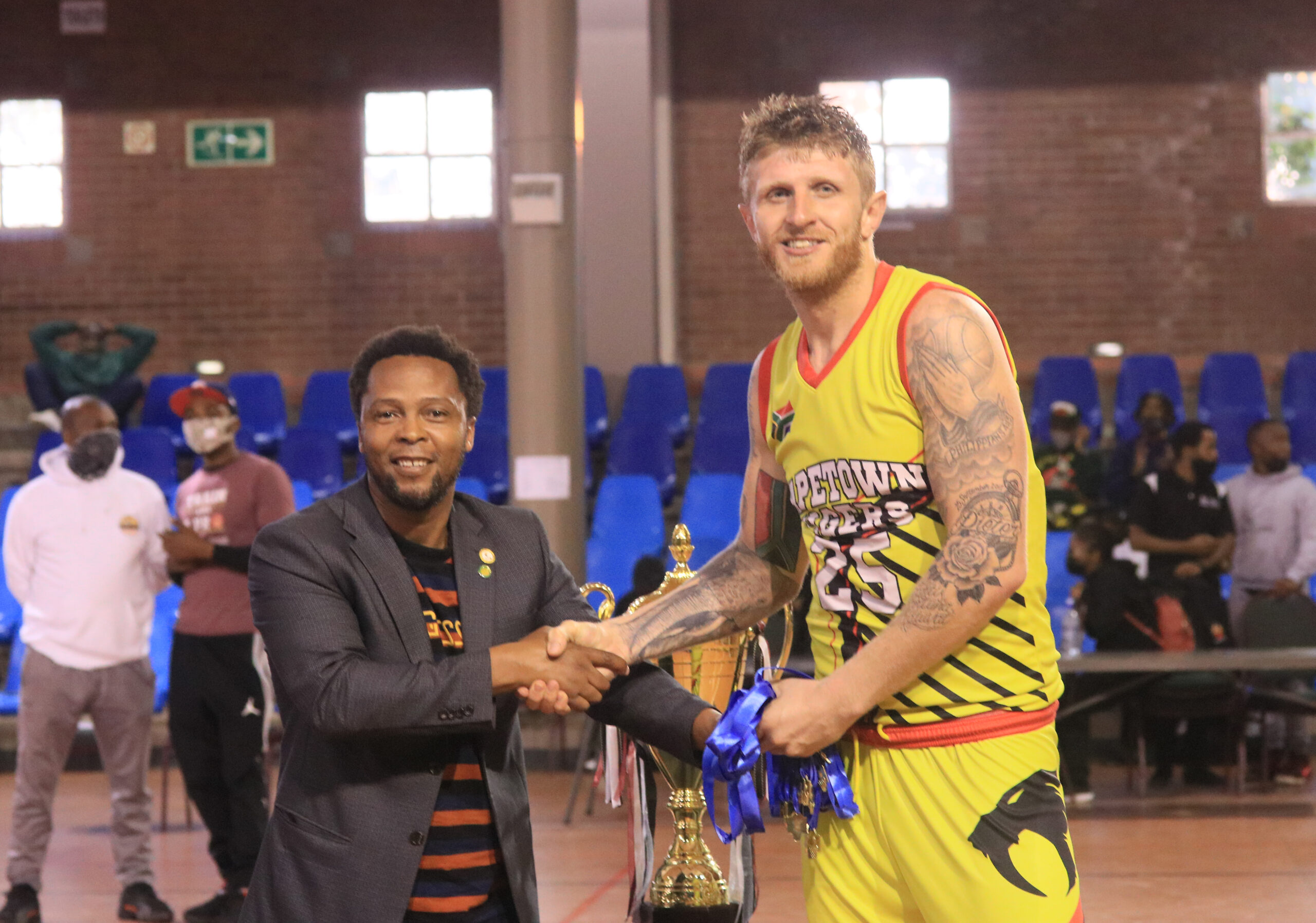
Cape Tigers captain Pieter Prinsloo receives the medals from BSA secretary general Victor Bergman.

The talent that lies in wait for the Tigers comes in the form of Ferroviario da Beira (Mozambique), Matero Magic (Zambia), Mercenaries (Zimbabwe) and Roche Bois Warriors (Mauritius).

Prinsloo is familiar with Beira, having had a stint with the club. He also provided some insight into what the Mercenaries and Matero will bring to the table.

“Beira is a team that likes to press. They play at a fast tempo. So teams that press don’t handle it very well because they don’t want that pressure. I know some of the guys from Zim. They might have some guys who play here and there in SA. The Zambians play with a quicker small team,” said the former Universidad de Concepcion player.

“I don’t see it causing complications for us. We have a balanced team; we can go big or small at any time. There is size and skill in every position. A guy like me can play small forward, power forward and centre. We have a team that can go quicker or slower. We don’t want to play the opposition’s game. We want to play our game.”

While the qualifying process is still a long one, Prinsloo who has won championships in El Salvador and Nigeria feels that winning the BAL would add another feather on the cap.

“For me, on top of what I have accomplished in my career… I have played in champions league in South America and competed against some the best players in the world. So, winning BAL would add another championship to my resume. To bring that trophy back home and to Cape Town, that would be crazy. It would be an honour,” concluded Prinsloo.

Tigers ready to earn their stripes in BAL qualifiers Read More »

Koranga and the Lionesses will have a competitive edge

Award winning season for Koranga

FELMAS Koranga does not mince her words when she says basketball was not her preferred choice of sport. To her, participating in basketball and other sporting codes were a form of escape and having fun.

“I tried different sports to figure where I fit in best. Note, this was for FUN! There was no intention from my side on building my future through sport,” said the 25-year-old. “I was the type of person who did not want to tire because of physical activity. I would cry a lot when instructed to put up shots and get fit.

“No. I did not want any of that. It was something to look forward to after class. Something refreshing.”

The influence of her older brother Ariel Okall Koranga, who plays for the Kenya Morans, also proved to be the turning point for Felmas.

Second Picture
Felmas Koranga in action against Rwanda in AfroBasket Zone IV qualifiers. Pictures: FIBA

“I was introduced to basketball by my older brother Ariel. Well, he insisted that I take it up and I am here because of that,” said the power forward.

There’s a twist of irony in Koranga’s journey, as what turned out to be a leisure activity has seen her achieve excellence for her country and university team.

Koranga, the first Kenyan to play in the NCAA tournament has had a stellar season for Troy University in Alabama. Her performance for Troy was so good she won the Sun Belt Newcomer of the year and was named the All-Sun Belt Second team. She was part of the Trojans team that made the NCAA tournament, although they fell to Texas A&M in the first round.

Initially, Koranga struggled to adjust in her new environment but eventually knuckled down and was able to settle.

“I have to say it was not easy at first. Having to cope and gel in the system was not easy. It took me some time. I think in late January till March, I began to settle and be comfortable with the style of play,” said the former Tyler Junior College player.

Despite her achievements, Koranga was not overly excited about her success. To her, the awards are a sign that the behind the scenes work on her game have paid off and helped contribute to the team.

I know it’s a big platform and stuff, but I don’t get carried away with things like that. It’s just a title and a name. To me it’s just like any other game,” said Koranga, who took a similar tone on her individual achievements. “When you put in work it’s sometimes possible to predict that something big is going to happen. Also, the work I put in was not for individual accolades but for the success of the team.”

She also carried her form to Kenya’s Lionesses for the FIBA Zone V AfroBasket qualifiers. In the process, she also continued a proud family legacy of representing the East African nation in international competitions.

Her father, Elijah Koranga, who played for Kenya’s Harambee Stars in the 1992 Africa Cup of Nations, set the benchmark. Ariel matched the feat as he recently helped the Morans end a 27-year absence from international basketball by qualifying for this year’s men’s AfroBasket in Rwanda (24 August to 5 September).

Now, Felmas has written herself into Kenya’s sporting lore as she helped lead the Lionesses to qualify for the women’s competition (AfroBasket) in Cameroon (17-26 September).

Nakuru-born Felmas explains that the battle for bragging rights within the family is friendly. She points that it used to be her father who held the mantle for a long time. Now Ariel and herself are perched next to the Koranga patriarch in terms of sporting success.

“It is a little competition that we have going on. Dad used to say he is the only one who has competed on a higher platform. Ariel also used to say: ‘dad is not the only person that can speak in the house’. But now I’m the main person,” quipped Koranga.


View this post on Instagram


A post shared by Felmas Koranga (@felikoranga2)

Koranga and the Lionesses made hard work of their qualifying route to Cameroon. Round robin losses to hosts Rwanda (77-44) and Egypt (107-106) and the one win over South Sudan (66-48) sandwiched in between last month saw the Kenyans having to dig deep.

What they found going into the semi-final and final was self-belief. So galvanised were the Lionesses, they swept aside Rwanda (79-52) and Egypt (99-83) to stamp their ticket to the women’s showpiece tournament.

“We did not expect it, but we had a measure of hope. Also, we wanted to prove a point. Some people did not believe in us,” said Koranga, who was named the power forward of the qualifying tournament.

Kenya will expect more award-winning performances from Koranga in the 12-team tournament. The Lionesses are Group A with the hosts Cameroon and Cape Verde.

Third Pic
Felmas Koranga poses with her individual trophy.

Koranga acknowledges that competing in the tournament will present a different kind of challenge for the Lionesses.

“It’s going to be tough for all the teams. It’s a different level of competition. We have to practice like we are going to face people playing in the WNBA. That’s the attitude everybody should have. We are not overconfident, but we are coming there to compete,” said Koranga, who was non-committal about how far the team would go.

“Somebody asked me the same question. Honestly, I never have an answer to such a question. All I will say is we will compete. Hopefully, we will get somewhere.”

Looking at Kenya’s record at this competition, what stands out is that the Lionesses finished fifth in 1986, second in 1993 and fourth in 1997. Since then, there was nothing to write home about in the last three AfroBaskets they participated in.

While they are far from the upward ascent of those early years, Koranga intimated that the ball is rolling in trying to get the team back on track. She says there have been challenges in the rebuilding process.

“You won’t believe this, but before we went to Rwanda, we had been together for only ten days. You could tell from our first game that the chemistry was not there,” said Koranga. “There is an ongoing process of rebuilding the team. I feel we have talent. The right things need to be put in place so that the team well prepared.”

Koranga and the Lionesses will have a competitive edge Read More »

Barros hopes AfroBasket can unlock new doors

Cape Verde to put on a show for their fans

PLAYING on the big stage in sport can open new doors for competing athletes. Cape Verde point guard Alexia Barros harbours the hope that a good performance at the women’s AfroBasket will be the key to unlocking new opportunities for herself.

The 26-year-old hopes playing the lights out in the tournament which Cameroon will host (from 17-26 September) will help her achieve her dream of playing in the WNBA.

Another added advantage for the United States-born Barros is that she recently joined the New England Trailblazers, a team that competes in the Women’s American Basketball Association (WABA). Both situations give the 5ft8 guard an advantage in her quest to fulfil her ambition of playing in the elite women’s league.

Second Picture
Lexi Barros believes Cape Verde can do big things at this year’s AfroBasket. Pictures: FIBA

The floor general believes she is within touching distance of achieving her goal and is hopeful that the work she has put in will yield a positive outcome.

“My dream is to play in the WNBA. I feel I am close to getting to my dream. I have to keep working hard. Work on the little things that will help my game progress,” said the former Community College of Rhode Island player.

She also relishes playing for club and country. “It’s fulfilling to play for both teams. I can’t wait to see what playing for them will do for my basketball career. The doors it can open and the new people I am going to meet. I am excited at the prospect of seeing new opportunities come alive. It feels good. I feel like something is coming.”

With the groundwork laid to work towards her aspirations, the AfroBasket tournament looms for Barros and Cape Verde.

A look-back to their route to qualifying for the women’s tournament, a stand-out feature is that the islanders had to overcome difficult odds against Guinea, Conakry in a two-legged Fiba Africa Zone 2 qualifier in June.

Both legs took place in Conakry at the Stade 28 Septembre indoor venue, in front of a raucous and passionate home crowd. Cape Verde fought courageously but lost a close first leg by a single digit (65-64). A day later, Barros and her teammates took the battle to Guinea and valiantly triumphed by a 9-point margin (68-59) to qualify for the continental showpiece.

Reflecting on the qualifiers, Barros says playing as a unit against their much taller opponents led to Cape Verde securing their ticket to Cameroon.

“That experience was marvellous, especially playing there. Guinea was a tough team and a lot bigger than us, but we managed to hold our own. We did not have our fans. We had to rely on each other and stay together. I am proud of my teammates and what we achieved,” said Barros. “Their fans were a little wild. It was a small gym, and when they scored, you heard it. There was a lot of banging and loud horns. From an objective perspective, it was a beautiful atmosphere.

“We wanted to win and show the world that we are here. What we now need is support, and we also need to keep working hard, especially for this next tournament.”

View this post on Instagram

A post shared by Lex 🦂 (@lexibarros1)

On the subject of support, Barros, who will participate in her second AfroBasket, hopes the national federation can equally support the women’s team as they do the men. Barros believes she and her teammates are keeping their end by preparing themselves for the upcoming tournament.

“We have some players in the States and most of our players in Cape Verde, and we need to come together to build the team chemistry,” said Barros. “We work our butts off, everyone from the coach, assistants, even the people in the federation help us a lot, but it’s little things that we need.

The same treatment and profile that the boys get should also be accorded to us as well. It’s starting to change a little bit, but it can be better.”

Third Pic
Lexi Barros says playing for Cape Verde has helped her personal growth.

On Cape Verde’s chances at the 12-team tournament, Barros spoke with confidence that they can outduel any opponent. She also emphasised the need for teamwork if they are to make an impression in Cameroon.

“We need to play together. I feel we can beat any team. We have a lot of good shooters. We are a guard-heavy team and rely a lot on our speed for fastbreaks. There is a lot of experience in our group and some new players as well,” said Barros. “We want to do big things this year. We want to put on a show for our fans.”

Barros also appreciates donning the Cape Verde vest, what it has done to advance her basketball career, and is using her platform as an international player to be an example for the younger generation.

“I want to go far with this team. I want to play for as many years as possible. Playing for Cape Verde has been the most amazing thing in my life,” said Barros. “The fans there really support us, and the kids look up to us.

“That’s the one thing I like the most, having the chance to be a role model here at home in the US and in Cape Verde.”

Barros hopes AfroBasket can unlock new doors Read More »

Can Gabriel and the Tigers shake up SA basketball?

Gabriel unearths hidden talent

CHRISTOPHER Gabriel has come full circle in his basketball career. The journey for the 32-year-old began in his home city, Cape Town, where he picked up the game that would change his life.

Gabriel was still a rough diamond but was fortunate to be blessed with the right attributes, which opened a world of opportunity for him. The United States was where he would hone his playing skills, from high school right until college.

When he joined the professional ranks, the 6ft10 big man traversed different parts of the world and countries in the continents of Europe, South America, Asia were places he would call home.

Now his journey has brought him back home where it all began. Gabriel reflected on his journey, which saw him depart South Africa as a teenager to pursue his dream.

“I played with the Montana Vikings here in Cape Town under coach John Goliath and at the same time I was scouted by the Seed Academy, now based in Senegal,” said Gabriel, who left South Africa in 2004 for The Patterson School in North Carolina on a scholarship.

Christopher Gabriel wants to win with the Tigers. Pictures: The Big Tip Off

The experience of those early years in America was a shock to the system for Gabriel. From that point on he was far from being polished as a player. He was also frank in his self-assessment of where he was and where he needed to be.

“I had my fifteenth birthday in the States. I told myself I am going to make a difference, but I got a reality check,” said Gabriel. “When I got there, I was the worst player at the school. I had to work harder than everybody else. To get up to speed, I watched a lot of games to understand how the game was played there.”

While he worked on improving himself as a player, Gabriel also had to navigate the cultural nuances of America, which was an easier process for him.

There is the cultural aspect as well. For guys who came through grassroot programs, the only way to catch up on the culture of America or anywhere in the world was to throw yourself in it,” explained Gabriel. “Luckily, I fit in well because of the things I was into, like sneakers. Also, the fact I was from an English speaking country was an advantage.

“From a basketball perspective, I knew I was not athletic. I knew I had to be more technical, like having a better jump shot and knowing how to dribble using my left and right hand.”

During his college career, Gabriel became comfortable in his skin as a player. He understood his role on the court, and the work he put in also came with its rewards. He also got to share the court with players who are household names in the NBA today.

“College was a huge learning period. Once you find yourself and you accept the type of player you are, what your skill level and athleticism level is, then you can work on other things,” said the former New Mexico State and University of San Diego player.

He also reflected on his time in college and some of the highlights. “It’s hard to sum it up. Being from South Africa and All American were accomplishments. I played in an AAU team with Brandon Jennings, James Harden and Kevin Love,” said Gabriel.


After a fruitful college experience, Gabriel continued his career overseas, where he played in Slovenia, Georgia, Uruguay, Thailand, Spain and Iran.

The South African international player had some career highlights, especially in Iran. He lit up the stats board while playing for Shahdari Qazvin in the Persian state.

“In Iran, where I was the only import in the team, there was a game where I scored 49 points. I was averaging double digits in points and rebounds. It was a good year for me,” said Gabriel, who had to leave Iran last year because of both political uncertainties and Covid-19.

He returned home, and has since adjusted well in Cape Town, including a resumption of his basketball career with the American funded Cape Town Tigers.

Gabriel, who is co-captain of the team, has so far been ecstatic to play for the Tigers and has enjoyed the comforts of being at home.

“Man, it’s been amazing, getting the opportunity to play professionally in your hometown. There is a different level of motivation I can tap into because I am at home. I am comfortable,” said Gabriel. “I love being home. After every season overseas, I came home. In a foreign country, you feel like you are not from there. No matter how long you have lived or played there.”

Gabriel believes the introduction of the Tigers on the South African basketball scene will bring professionalism and a change to the game.

“As a team, we want to be champions, no matter where we play. CTBL or BAL, we want to be champions. We also want to change the culture of basketball. It’s not where it needs to be,” said Gabriel. “The people in the front offices need to take the game seriously than we are. We are playing the game. Players should not be arguing about salaries. That is something that should be taken care of by your agent and front office.

Third Pic
Christopher Gabriel in action during the 2017 FIBA AfroBasket. Picture: FIBA

“Your job is to be a basketball player. So our job from Raphael, myself and coach Relton and everybody involved in the team is to change the culture of the game.”

Off the court, Gabriel has also unearthed a hidden talent. He has dabbled into the acting scene, and it could be something he looks into after his playing days.

“Yeah, it’s something I have just started. I did a commercial for Samsung. I am on a TV show called Raised by Wolves on HBO. I’m just a big guy. I play Billy, an android robot that fights in a gladiator-style theme. It’s been epic,” concluded Gabriel.

Since returning to South Africa, Gabriel’s star seems to be on the ascendancy. It seems we can expect to experience the best of him both on and off the court.

Can Gabriel and the Tigers shake up SA basketball? Read More »

Tigers plan on being the face of basketball in Africa

Getting the balance right is key for the Tigers

WHO are the Cape Town Tigers? It was a big question in South African basketball circles recently. The team in question gave a glimpse of who they are, a fortnight ago in a three-day friendly exhibition in Johannesburg.

With the bevvy of talent at their disposal, the Tigers, formed in 2019, left the city of gold unbeaten and begging the question: is this super team going to shake up the basketball landscape in the country?

The answer is yes and if the words of Raphael Edwards are anything to go by. The Tigers plan on becoming the face of basketball on the continent. 

I told the president of the BAL (Amadou Gallo Fall) this. We plan on being the face of the Basketball Africa League and the gold standard on how to be a professional team,” said Edwards, who is part of the Tigers ownership. That’s through philanthropy, marketing of ourselves and how we play on the court.”

To achieve the goal of being a big brand and a dominant force on the continent, Tigers have recruited notable players who played for the South African national team at the Afrobasket.

Second Picture
Christopher Gabriel is part of the on court leadership of the Tigers. Pictures: The BTO

Christopher Gabriel, who played college basketball for the University of San Diego and represented South Africa at three continental tournaments (2009, 2011 and 2017), is part of the on-court leadership of the Tigers.

Cape Town born Gabriel comes with vast experience having played in countries like Slovenia, Denmark, Uruguay, Spain, Georgia and Iran.

Gabriel, a centre, will co-captain the team with a player who comes with his own wealth of experience in Pieter Prinsloo. The Pretoria-West born power forward was also part of the South African team that played in the 2017 Afrobasket.

He also cut his teeth in the American college system, where he suited up for Marist University.

Enticing Gabriel and Prinsloo to come and play in the country of their birth was not hard for Edwards. He pitched the idea that their collective experience would add value to the team and its ambitions.

“Pieter Prinsloo and Chris Gabriel, who are our captains. I told them, ‘you guys put in the work’, so why don’t you want to reap the benefits now? You have put your country on the map. With the BAL now here on the continent, don’t you want to be a part of that?” explained the 45-year-old New Yorker. “You deserve to be part of that, and you deserve to lead the way.”

The Tigers’ roster also has three other prominent players who played on the BNLSA scene in centre Somusa Mthembu , forward Miguel Ferrao and guard Lebogang Mofokeng.

Mthembu is a three-time BNLSA champion  with the Tshwane Suns, while Ferrao is also a four-time league champion with Egoli Magic. Former Soweto Panthers player Mofokeng was part of the Egoli team’s championship run last year.

Edwards’ plan is to ensure that the players coming in develop on and off the court. Having experienced what it was like overseas, he feels there was a missing component to his development. The focus was more on him as a player and less on his individual growth.

“Talking to the guys, my selling point was that I would be present. I want to invest in them becoming better players, better men and better leaders,” said Edwards, who played for East Carolina University. “When I played for ten years overseas, and nobody cared about those other aspects when I was playing. All that mattered was me scoring the basketball.

“I want them to understand that I am going to contribute to them being better all around.”

To get the team to be a cohesive unit, the Tigers have employed Relton Booysen and Vincent Ntunja, a legend in South Africa and Cape Town basketball, as coaches of the team.

Booysen and Ntunja are from  Cape Town, which is a plus for Tigers. The two know the lay of the land and have good working chemistry, which bodes well for the team.

“The two coaches that we hired are connected to the community of Cape Town. They bleed for Cape Town,” said Edwards. “They are like fire and ice. Vince is as cool as a fan, and Relton is the fire.

“I believe in balance. Everything in life is about balance. Those two are like yin and yang. I told somebody in an interview a couple of days ago: ‘every time they talk about the city and about giving back, it’s intense and filled with passion.’ I believe my partners, the team and I have given them the platform to do that, with no restraints or any holds barred.”

Third Pic
Pieter Prinsloo, left, will lead the Tigers this season.

The Tigers will have to earn their stripes the hard way. Their journey to being the best on the continent will not be immediate. They have to navigate their way through the Cape Town Basketball League’s second division.

Right now, we are in the second division. As far as preparation goes, we have to work hard, and pay attention to detail. Every single day we have to get better,” said Edwards. We are going to make sure that we handle all our compliance aspects well.”

“We plan on being here and being the best team in Africa.”

The Mother City is the appropriate birthplace for the ambitious Tigers, who must scratch and claw their way up the ranks. The question they have to answer is; can make South Africa and the rest of the continent feel their roar? Only time will tell.

Tigers plan on being the face of basketball in Africa Read More »

×