

WHEN Aliou Diarra patrolled the paint last season, the question of defensive supremacy in the Basketball Africa League felt almost predetermined. His absence in 2026 has opened up the race for a new name to claim the Dikembe Mutombo Defensive Player of the Year trophy.
Rim Protection and Rebounding Dominance
Start with the boards, because that is where defensive control is still most visibly won.
Mangok Mathiang produced one of the most statistically overwhelming defensive seasons the BAL has seen from a big man. His 16.0 rebounds per game in 33.1 minutes did not just lead the competition; it was bending it. Every missed shot became a dead possession for the opposition. Shot selection tightened, second-chance opportunities disappeared, and entire offensive structures had to adjust before the shot even went up. That dominance was not theoretical either. At one point, Mathiang pulled down 23 rebounds in a single game, finishing just two shy of the BAL record currently held by Nkosinathi Sibanyoni.
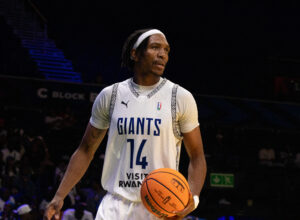
Nkosinathi Sibanyoni remains one of the most quietly complete defensive bigs in the competition. His 12.6 rebounds, 1.4 blocks, and 0.8 steals across 31.4 minutes reflect a player who consistently impacts possessions without needing dominance in a single statistical category. His 3.8 assists per game add another layer, not just ending possessions, but immediately converting them into transition value. That ability to turn defence into initiation is part of his defensive identity, not separate from it.
Jo Lual Acuil anchors his case through pure rim protection and presence. His 2.4 blocks per game led the conversation in deterrence, but his 12.0 rebounds ensured he wasn’t simply a help-side shot blocker waiting for opportunities. He was an active paint presence who made the restricted area functionally closed for long stretches.
Mouhamadou Diagne offers perhaps the most intriguing efficiency profile in the group. In just 24.8 minutes per game, he produced 2.8 blocks and 10.4 rebounds, alongside 1.4 steals, which point to defensive mobility beyond traditional rim protection. His impact is amplified when adjusted for minutes; a defender whose impact on a per-minute basis rivals anyone in the league.
The Guards and Forwards
The defence this season was also shaped by multiple guards who turned defensive pressure into a structural advantage.
Milton Valente led the entire competition with 2.6 steals per game, producing that output in just 20.0 minutes per game. That makes him the most efficient possession disruptor in the league by a margin. However, his defensive value is not limited to steals alone, he adds rebounds and occasional rim contests, forming a more complete defensive footprint than his role suggests. His impact is immediate: when he’s active, possessions don’t develop cleanly.
Childe Dundão brings a different kind of perimeter pressure. His 2.2 steals per game reflect constant anticipation and disruption, but his real value lies in rhythm distortion. He forces early decisions, breaks entry timing, and accelerates possessions into mistakes. Even when he doesn’t directly generate turnovers, he influences how they occur.
Ehab Amin represents the more controlled defensive archetype. The Egyptian’s 2.2 steals per game, combined with 4.2 rebounds from the guard position, reflect a defender who operates within structure rather than chaos. He removes options rather than gambling on outcomes, which makes his defensive value stable and repeatable across high-pressure possessions.
Chris Crawford remains the most unconventional profile in the entire conversation. His 7.6 rebounds per game as a guard are an outlier that fundamentally changes how his defensive impact is evaluated. While his steals numbers are modest relative to the leaders, his ability to consistently end possessions on the glass adds a different defensive dimension rooted in completion rather than disruption.
Mohamed Sadi further strengthens the perimeter argument as a guard who blends activity with structural discipline. His 7.6 rebounds per game and 1.0 steals reflect a player heavily involved in rotations, second efforts, and defensive containment. He may not dominate defensive moments in the highlight reel, but he consistently contributes to possession control.
The 2026 BAL All-Defensive Team
After weighing rebounding dominance, rim protection, steals, efficiency, and total possession impact, the 2026 All-Defensive Team takes shape as:
- Mangok Mathiang (RSSB Tigers)
- Nkosinathi Sibanyoni (Joburg Giants)
- Mouhamadou Diagne (FUS Rabat)
- Childe Dundao (Petro de Luanda)
- Milton Valente (Petro de Luanda)

Mathiang and Sibanyoni anchor the frontcourt through control, consistency, and possession-ending dominance. Diagne earns his place through efficiency and defensive ceiling. Dundao and Valente give Petro de Luanda arguably the most disruptive perimeter defensive pairing in the competition, shaping possessions before offences can even fully settle.
Jo Lual Acuil, Ehab Amin, Chris Crawford, and Mohamed Sadi remain strong omissions in an unusually tight defensive field, each offering a distinct version of impact that could easily translate into selection in another season.
Defensive Player of the Year: Mangok Mathiang
In a season without a single, uncontested defensive identity, the DPOY conversation ultimately comes down to one question: who controlled possessions most consistently from start to finish? This is where Mangok Mathiang distinguishes himself.
Sixteen rebounds per game is not just statistical dominance but is also structural control in the high-stakes BAL environment. It removes second chances before they can develop into anything meaningful. His 23-rebound performance earlier in the season came within just two boards of the BAL record held by Sibanyoni, a reminder that his statistical ceiling is not theoretical, but historic in proximity.

Sign up for our monthly newsletter for all the latest feature stories and previews of events on the African continent.


