
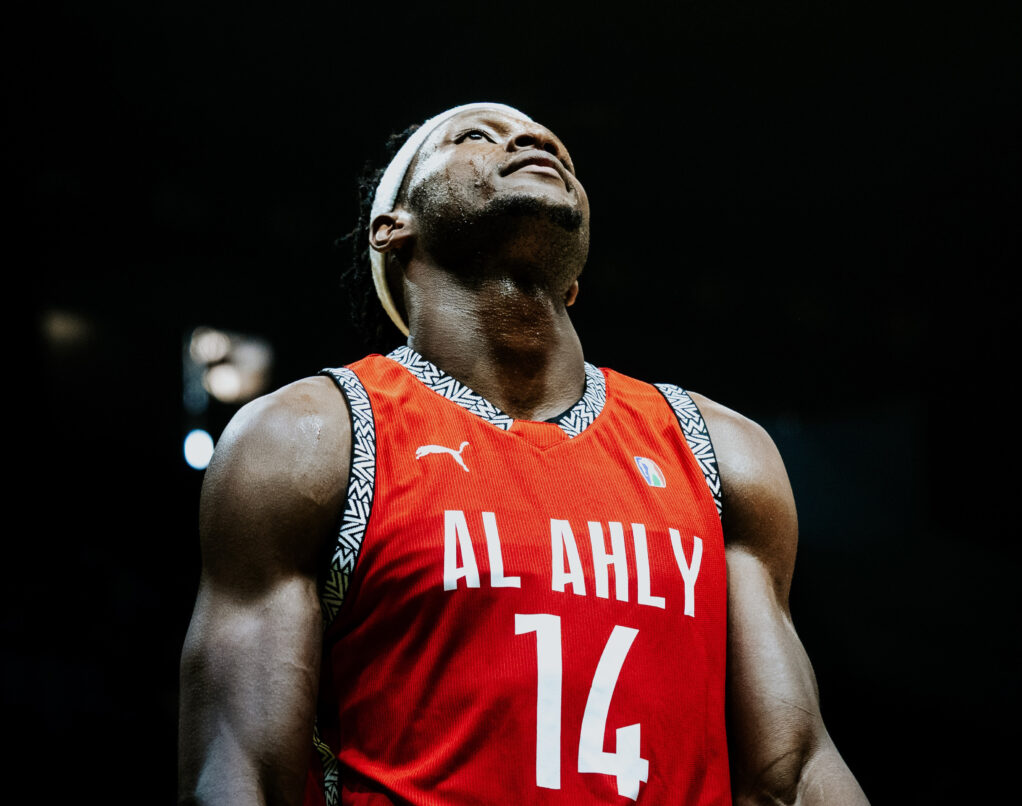
AS the Basketball Africa League (BAL) switches gears from conference play to the Playoffs in Kigali, it is no surprise that one of the eight teams that have punched their ticket to the heart of Africa is Al Ahly Egypt.
On a roster built around experience, continuity, and championship ambition sits a player whose journey began at the opposite end of the continent: Osayimwen Osifo.
The South African forward, part of the Austin Spurs, the developmental affiliate of the San Antonio Spurs, entered the Basketball Africa League this season through the league’s collaboration with the NBA’s development pipeline. In a tournament defined by condensed schedules and immediate expectations, Osifo carved out a role built on impact rather than volume, finishing as the Egyptian side’s leading rebounder at 6.6 rebounds per game, alongside 7.8 points and 1.6 blocks across the Sahara Conference.
His most complete performance came against the Maktown Flyers: 20 points, eight rebounds, two blocks, an outing that highlighted his ability to influence both ends of the floor within a system that prioritises efficiency and discipline.
In an interview with The Big Tip Off, Osifo discussed his introduction to basketball, his experience with the Austin Spurs, and his introduction and impressions of the BAL.

The Sport That Found Him
Growing up in South Africa, the sporting ambitions of most boys pointed in a very specific direction. “You want to be good at soccer, cricket, rugby and track,” Osifo says. “Those are the things that are going to give you clout.” He was no different. At Potchefstroom Boys High School, he had found genuine traction in athletics and rugby, competing at a national level, his afternoons accounted for. Then a finger injury sidelined him mid-season, leaving a gap in his schedule to fill.
The school had one basketball court, old, built around 1960, fitted with a single hoop. With one arm still in a cast, he went out there. He played against the boys who typically occupied the court, and something clicked, not through effort, but through ease. “I noticed, like a natural instinct, I was better than most of the guys I was playing with.” For a young man who had worked hard for every breakthrough in athletics and rugby, finding something that came naturally felt like a different kind of gift.
Once the cast came off, he found himself falling in love with the game. He started to experience a significant growth spurt, quickly becoming the tallest boy in his class and eventually the tallest in the entire school. This transformation came just in time for a visit from his uncle from Dallas, a man who saw his nephew and recognised the potential that the South African system was ill-equipped to nurture. Within months, Osifo developed a plan: finish tenth grade, move to Texas, and explore the possibilities that basketball could offer him.
The conversation at home
It is worth pausing on what that conversation must have looked like at home. African parents carry a particular reputation when it comes to their children’s futures. The script usually reads: medicine, law, or engineering, and deviating from it requires either remarkable courage or remarkable evidence. Osifo is measured about it. “My parents have always supported me,” he says. “Going to the States, I think they knew that in what I wanted to do, there was a big opportunity.” But something is telling in how quickly he adds what came next: “I really wanted it for myself, to make something out of the opportunity I was given.”
The acknowledgement that the opportunity had to be earned, not just given, suggests he understood what was at stake for the people who had backed him. He left in December 2015. In January 2016, he was suiting up for Junior Varsity at McKinney Boyd High School in Dallas, which gave him a taste of humility. “I thought I was really confident,” he says. “But when I came to the States, I definitely got humbled, just having to learn the basics and going from streetball to organised basketball.”
What followed were hours after school, patience from coaches, and the slow work of converting instinct into technical fluency. By the following year, he was on varsity. “It’s always been a learning process,” he says. “Even when you watch my games, I’m still making mistakes.”

Building inside the Spurs system
After college, Osifo entered the NBA’s development ecosystem through the Austin Spurs, widely regarded as one of the most aligned pipelines in the G League. The environment offered exposure to NBA-level coaching, high-density talent pools, and a culture built around incremental improvement. “It’s one of the best organisations in the world,” he says. His time in the system included playoff runs, summer league appearances, and training camp exposure, one season culminating in a franchise-high win total. Osifo has since become co-captain, and even now, he still resists framing any of it as finished.
All eyes on Al Ahly
Since graduating from college, Osifo had wanted to play in the Basketball Africa League. An earlier opportunity with a South African team had come and gone without materialising, interest from the Cape Town Tigers in the league’s early days that never quite aligned. However, the pathway remained open, particularly through the G League’s integration with BAL rosters, and this season, through Al Ahly, everything converged.
The process is not entirely within a player’s hands. The G League makes the pool known to eligible teams. Players whose domestic seasons have concluded can enter their names, and clubs select based on fit, timing, and mutual interest. Several teams across both conferences expressed interest in Osifo, but contracts had to align, and the timing had to work. “The last team to reach out to me was Al Ahly,” he shared. “I spoke with the coaches. The staff is great. And the championship mentality they have, that’s something I wanted to be a part of.” He signed within a week of the deadline and was on his way to join the North African side.
What Osifo found when he arrived was not what development basketball had prepared him for. The BAL is not a league particularly built around patience with young players. It is built around professionals, men with international résumés, years of competitive repetition, and very little interest in waiting for anyone to find their feet. “In this league, 30 is a very young age,” Osifo says. “You’re playing against vets. You can’t teach experience.”
His role inside Al Ahly’s system reflected that reality. This was not about developmental upside or long-term projection; it was about functional contribution, immediately. Defensive presence, rebounding, energy off the bench or from the start, whatever the game demanded. “It’s requiring a certain level of professionalism,” he shared. Preparation had been deliberate even before the conference began: a training camp in Egypt where time was treated as a scarce resource. “We were really intentional: meals together, video sessions, everything.” Al Ahly’s objective was clear from the get-go. “Championship.”

Into the water
His introduction to the Sahara Conference play came against Club Africain, and it announced him in the way that matters most at this level, physically. A powerful dunk early in the game rippled across broadcast and social platforms, the kind of moment that tells a league you are here. But the result was a narrow loss, and Osifo is honest about what that first game actually was. “It was really just throwing us into the water,” he says. “Testing us.”
The response was what separated Al Ahly from a team still assembling itself. Adjustments were made quickly, defensive structure tightened, communication became sharper, and roles became clearer. “We’re learning each other on the fly,” he says. By the time the conference concluded, the work had translated into results: a playoff berth secured, Kigali confirmed, Al Ahly’s position as one of the tournament’s genuine contenders intact.
If you can make it out here
Osifo had followed the league from a distance for years. He had wanted to be part of it since college. And now that he is inside it, the verdict is unambiguous. “It’s blown it out of the water,” he says. “The competition level, the professionalism, the fans, it feels like playoffs every night.”
There is something about the BAL’s intensity that is difficult to prepare for without experiencing it. The margins are thin. The format leaves no room for gradual warming up. And the visibility, within Africa and increasingly beyond it, is real in a way that changes how the games feel. “If you can make it out here,” Osifo says, “you can make it anywhere.”
When asked what he is most proud of, Osifo does not reach for statistics or milestones but instead points to something which carried him from his earliest days. “The resilience,” he says. “And the support I had from back home.” The school, the friends, the family that kept him tethered to where he started, even as the distance grew. “If not for the support of family, different people from different walks of life, it’s all about togetherness. That’s something I learned from back home.”
From Potchefstroom to Texas, from the G League to the BAL playoffs, the journey has not followed a single system. It was a series of crossings, each one demanding a different kind of adaptation, highlighting that where you start is not a limitation on how far you can go.

Sign up for our monthly newsletter for all the latest feature stories and previews of events on the African continent.


