Basketball Africa League

Putney to bring intensity for Hoopers in playoffs homecoming

THE gruelling conference stages of the Basketball Africa League (BAL) are done and dusted, and the teams to battle it out in the playoffs in Tshwane, South Africa (6-14 June) have been decided. One player looking forward to reconnecting with South Africa is forward Raphiael Putney, who has been preparing himself for the upcoming and intense duels of the playoff stages, the latter which will determine the team that will claim the coveted BAL baobab-shaped trophy. 

Putney’s Nigerian club, Rivers Hoopers, secured its ticket to Tshwane last month at the Kalahari Conference in Morocco… So he and Hoopers will await their playoff opponent from either the Nile Conference, the Sahara Conference or a team from the Kalahari Conference.

American player Putney, currently in Houston, Texas, is a familiar face in South African basketball, having first tasted the game on the continent as a Cape Town Tigers player. The Virginia-born Putney led the Tigers to a second national championship in 2022 and successfully helped them qualify for the 2023 BAL, which he disappointingly did not play in.

“For me, this is like a homecoming. I made a lot of friends while I was playing for the Tigers. I am looking forward to showing up for the team (Hoopers) and doing my best,” said Putney. “It’s something I am looking forward to…. Coming to South Africa… It’s one of the countries that gave me a chance to continue my career. I wish I could have played with them (the Tigers), but certain circumstances did not allow me to.”

Putney continued: “I said this two years ago, ‘I want to come back and play in South Africa’… It’s going to happen soon. It’s for a different team, but I am going to showcase my talents to people who believed in me while I was there.”

Raphiael Putney Rivers Hoopers
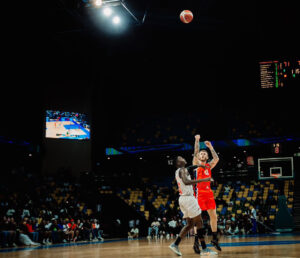
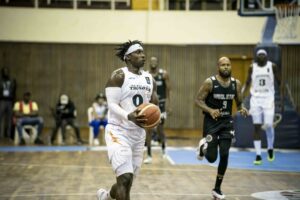
Raphiael Putney led the BAL in blocks at the end of the Kalahari Conference. Pictures: The BAL and Rivers Hoopers

Having navigated the Kalahari Conference with a 4-2 record, how did Putney feel about playing in his first BAL tournament?

“I loved it. It’s been a great experience. A lot better than what I expected,” said Putney. “There were great teams in Morocco. We faced challenges (in the conference) early on, but the team we had was able to do something special.

“We have a good group of guys willing to work hard to win. I bring my veteran leadership. We want to do better than last year’s third place finish. We want to win the championship.”

If Hoopers want to have a shot at the BAL title, Putney, who averaged 13.5 points per game, 1.3 assists per game and 5.5 rebounds per game, says the Kingsmen have to figure out their style of play.

“We need to find our identity. We’re a strong defensive team, though we occasionally have lapses,” said Putney. “During the Kalahari Conference we had leads in games and thought it was a wrap, so we need to put pressure on teams.”


View this post on Instagram


A post shared by Basketball Africa League (@thebal)

He also pointed out what he needed to work on to contribute to the success of the Hoopers in the playoffs. Putney had to immediately join the Kingsmen for their BAL campaign, which gave him little time to recover from intense competition in Mexico’s Pacific Coast Basketball Circuit playoffs for Pioneros de Delicias.

“I had some fatigue after playing back-to-back games in the playoffs in Mexico. But it was not to a point where I was not effective for my team (Hoopers). So I have to stay focused, hit my jump shots and be aggressive,” said Putney. “I feel like I am a mismatch on the floor. So, I can be a playmaker and do certain things to help my team win games.

“Most importantly, I bring defensive intensity. I think I’ll continue to lead the league in blocked shots. That’s my goal, everywhere I go I’ve led in blocked shots and want continue that in the league,” said Putney.

Six-foot-ten (2.08m) Putney, who averaged 1.7 blocks per game, has since dropped down the rankings in blocked shots to joint fifth, so a lot of work is ahead of him in trying to dislodge current No. 1 Aliou Diarra of Rwandan club APR.

Raphiael Putney, The BAL and Rivers Hoopers
Raphiael Putney says the Hoopers are aiming for the BAL trophy.

The forward has a couple of weeks to fine-tune his game to help the Hoopers achieve their goals. The 35-year-old says he’s used his time off productively to stay ready for the playoffs, like waking up early to go through his paces.

“When I got here, I knew we had a month off. So, I planned my schedule around this month until I get back for the playoffs,” said Putney. “I have a program that I follow. I wake up at five in the morning to do my workouts. It’s cardio and hooping so that I stay prepared and in game shape. So, I have not taken any time off,” said Putney.

The well-travelled Putney sounds confident of what Hoopers will be able to do come the playoffs. He’s also finally gotten his shot at showing what he can do in the BAL. As Hoopers take another step towards their goal, they will be like a raging river swallowing everything standing in its way.

Putney to bring intensity for Hoopers in playoffs homecoming Read More »

Vincent and Prinsloo get real about reason for MBB’s failures

SOUTH African basketball is rich in potential but trapped in a cycle of dysfunction. Despite having excellent infrastructure, South Africa lags due to deep-rooted leadership issues within basketball.  These problems were evident during the 2024 BAL Nile Conference, where Johannesburg-based Made By Basketball (MBB) finished with a 2-4 record, missing the playoffs and raising familiar questions about the country’s readiness to compete at the highest level.

Head coach Sam Vincent, a former NBA player and seasoned coach, did not hold back in assessing the situation in the post-game presser.

“We came into camp a little late. We were still adding players, we don’t have a formal league in South Africa to give four or five months of development and playing together as a team to prepare for this competition,” said the former Nigeria national women’s team coach.

Vincent pointed out the lack of consistent, competitive basketball in the country. Even in the country’s national league, the BNL, an entity no longer recognised by Basketball South Africa, undermines growth at every level.

“I saw the schedule for the BNL league, and there are maybe three games for the season. It’s just not enough competition. If South African players are going to improve and get better, they need to play regularly,” he stated.

Sam Vincent MBB Basketball Africa League
Sam Vincent laments the state of South African basketball. Pictures: The BAL

Vincent’s counterpart from Al Ahli Tripoli, Coach Fouad Abou Chacra, whose team defeated MBB twice in the tournament, offered a moment of camaraderie. While praising South Africa’s raw talent, he highlighted the disconnect between potential and preparation.

“The team needs to be more organised, I know many of these players and they can perform well. But the coach is the pilot; he needs more time to bring the plane up and down safely,” said Abou Chacra.

He emphasised the importance of cultural awareness and long-term commitment when building a national basketball program

“I didn’t bring my program and impose it in Libya. I studied the culture… You can’t make generals into soldiers. Coaches need to adapt their philosophy to fit the people.”

No League, No Rhythm

MBB’s Pieter Prinsloo provided a frank assessment of the situation, pointing directly at the federation’s failure to establish a functioning professional league. “We need our federation to have a real, competitive league so we can prepare. Every other team in this competition will be playing in a league from October to November until April and May.”

He noted that countries like Egypt produce BAL-calibre teams because their players consistently stay in rhythm and compete in a professional league.

“Al Ittihad just reached the finals in Egypt, and US Monastir just played the finals with Club Africain. All these countries have a pro league, these players are in rhythm and playing the whole year,” said Prinsloo. “South Africa, unfortunately, is stuck in a situation where there are too many complications, and we don’t have a pro league that works.”


View this post on Instagram


A post shared by Basketball Africa League (@thebal)

Once MBB took to the floor, they looked a step slower than the opposition in the games they lost. South Africa’s representatives entered the tournament undercooked, having only completed a six-week training camp.

“We’re coming in off a six-week training camp and expected to put it all together, and it’s hard,” Prinsloo admitted.

However, it wasn’t just a lack of structure, it was a lack of cohesion. Prinsloo pointed out that teams like Tripoli displayed fluid, cohesive basketball because their players played together consistently.

“A team like Tripoli play incredible team basketball because they’ve been together throughout the whole year, some for multiple years,” said Prinsloo. “I arrived a week and a half before. Some of the guys arrived just four days before we flew here,” Prinsloo said.

The net result was that iTeam Yase Dladleni was still trying to find its rhythm while already in competition. “There were many moments where we didn’t play well, and you could tell that we were still a group of individuals coming together.”

A Window of Opportunity

Vincent believes the way forward is clear, but it won’t be easy. He insists that a long-term national league is essential, stating it must run for at least five to six months and provide 20 to 25 games per season if talent is to develop. “There has to be a more formal national league, consistent play is how you grow a program,” said Vincent.

Pieter Prinsloo, MBB, Basketball Africa League
Pieter Prinsloo took aim at Basketball South Africa for not producing a competitive national league.

He also called for better cooperation within the basketball community, from administrators to club owners and federation officials, to build sustainable systems rather than isolated efforts. Despite MBB’s early exit, Vincent remains optimistic. With the BAL Playoffs coming to Pretoria, South Africa’s capital, he encouraged fans to show up, engage with the sport, and experience world-class basketball on home soil.

“It’s amazing basketball. It’s a great competition. The entertainment and the arenas are NBA-style. You won’t get an NBA-style experience in Africa unless you attend a BAL event.”

South Africa does not lack talent. It lacks time on the court, structure off of it, and alignment among those driving the game forward. Until these gaps are closed, the country will continue to fall behind, not for lack of ability but for lack of preparation.

The BAL is bringing Africa’s best to Pretoria. The hope is that it can also inspire a sense of urgency because the window for South African basketball to catch up is still open, but won’t be open forever.

Vincent and Prinsloo get real about reason for MBB’s failures Read More »

iTeam Yase Dladleni closing in on a playoff spot

(Kigali) MBB is beginning to find its rhythm in the Basketball Africa League’s (BAL) Nile Conference, after registering a stunning upset over APR inside a nearly sold-out BK Arena on Thursday night. The team is growing, adapting, and earning its place in the Nile Conference. After a rocky start, the 94-88 win over the Rwandan club is a potential signal of growth, trust, and a team finally clicking into gear.

With renewed chemistry, sharper execution, and a commitment to fight for every possession, iTeam Yase Dladleni is no longer chasing rhythm. They’re playing in it. From the opening tip, the Blue Soldiers set the tone. They controlled the boards, dominated the paint, and showed a cohesion that had been missing in their earlier matchups. Without Aliou Diarra, who didn’t suit up for APR, MBB capitalised, using physicality and energy to disrupt their hosts.

“This win means a lot,” said team captain Lebesa Selepe after the game. “Dane Miller didn’t suit up, and Aliou Diarra didn’t suit up. We made some tough shots down the stretch, and we just threw it all out on the street and took the W. That’s just what we do.”

Lebesa Selepe iTeam Yase Dladleni MBB
Lebesa Selepe feels iTeam Yase Dladleni is on course for a BAL playoffs spot in Tshwane, South Africa. Pictures: Cheick Haidara and the BAL

Selepe also revealed that they put impetus on taking care of the third quarter, which had been their Achilles heel in previous games.

“We had a strong first half, but we really concentrated on the third,” he said. “We said in the locker room, ‘We have to win the third quarter’.  Something we hadn’t done that before today. And you know in basketball, they say if you win the third, you put yourself in a strong position to win the game,” said Selepe.

MBB did just that. Coming out of halftime, they tightened up defensively, limited APR’s opportunities, and decisively swung the momentum in their favour by dropping 29 points in the third quarter. Their most explosive period of the game was holding APR to just 19, a ten-point swing that completely changed the tone of the contest. For a team still forming its identity, that kind of execution was no small feat.

Rwandan domestic champions APR, on the other hand, seemed deflated after suffering another loss in their home arena after first losing to Al Ahli Tripoli. The Army club from the capital city, Kigali, struggled again to find the right combinations and answer MBB’s physical play.

For coach Sam Vincent, the turnaround is no mystery. It’s a result of time, chemistry, and trust. “When you bring new guys together, even when they’re talented, it takes time to build chemistry,” he said. “Now, they’re playing and joking together, bonding. And we can see it, guys are communicating, covering for each other, looking for each other. That’s making us stronger.”

The former NBA champion and MBB coach Sam Vincent, who arrived in South Africa 25 years ago, has leaned on his experience to steer this new group.  That belief carries into how he views players like David Craig, who played a key role in the win.

“David’s eager and motivated,” Vincent said. “He really helped us on the offensive boards, boxed out, defended, and scored. He was just shy of a double-double with nine points and ten rebounds. If we can get that consistently from him, he’s going to help this team a lot.”


View this post on Instagram


A post shared by Road To BAL (@roadtobal)

Selepe echoed that sentiment, calling the presence of the 7 ft 3 (2.13m) Craig on the floor a game-changer. “He’s a baller,” Selepe shared. “Seven-foot-three, the biggest player in the BAL right now. We expect him to do those things. Like coach said, he was one point shy of a double-double. The future’s bright.”

The chemistry alluded to by MBB’s coach and captain is becoming more visible. Selepe intimated that it stems from open dialogue and learning each other’s character on and off the court.

“We keep talking,” he said. “The more time we spend together, the more we understand each other and everything that happens around us. That’s it.”

With two more games remaining, the message is clear: one more win and MBB could clinch a spot in the playoffs – something that felt far-fetched at the start of the conference.

“There’s nothing else, we just want to win,” Selepe said. “We know it’s going to be tough. We’ve played teams like The Nairobi City Thunder before, they beat us by 38 at the Road to BAL. But the other night, we only beat them by one, right at the death. So they’re going to come out and punch first, but we’ve got to fight. That’s the essence of basketball in Africa, you go out there and fight.”

David Craig iTeam Yase Dladleni MBB
David Craig is an advantage for MBB in the pain in both defence and offence.

Following their slow start, two wins in a row will have lifted the mood of South African hoop fans, allowing them to continue dreaming of seeing the Blue Soldiers compete in South Africa’s capital city, Tshwane, in June. iTeam Yase Dladleni has proven they belong on the continental stage. Whether it’s David Craig owning the paint or Selepe leading with urgency, the pieces are falling into place. As they chase a playoff berth, the Blue Soldiers are doing more than rewriting their tournament. They are reshaping the expectations of South African basketball on the continental stage.

iTeam Yase Dladleni closing in on a playoff spot Read More »

MBB’s Pfachi to break new ground for Zimbabwe at the BAL

THE Made By Ball Club’s players were grinding and breaking a sweat on Monday afternoon at Mandeville Sports Complex. The scrimmage between the club’s first and second units was so intense and physical that it came as no surprise that there were a few bumps and bruises ahead of their historic Basketball Africa League (BAL) debut on Saturday in Kigali, Rwanda.

One of the players who felt the tough end of the scrimmage was floor general Dyvonne Pfachi. The Zimbabwean guard took a knock to the forehead, leading to his exit in the second half and him sitting out for the rest of the scrimmage, which was overseen by American assistant coach Dean Murray.

During his interview with The Big Tip Off, the 30-year-old seemed to have shaken off the after-effects of the hit to the head, intimating that it’s all par for the course.

“I feel great. We are playing well and coming together as a team,” said Pfachi. “Physically. I am feeling strong.

“Every practice is getting tougher and tougher. We are getting ready for the games this weekend. If you get knocked down you have to get back up and play hard.”

Dyvonne Pfachi of MBB
Dyvonne Pfachi and MBB will make their debut at the BAL’ Nile Conference. Pictures: The BTO and FIBA Africa.

Made By Ball, popularly known as MBB, will need Pfachi’s tough-as-nails attitude going into the Nile Conference leg of the BAL. Host club APR, Libya’s Al Ahli Tripoli and Kenya’s Nairobi City Thunder will test the mettle of iTeam yase dladleni in the conference.

As the Johannesburg-based club makes its much-awaited first appearance at the continental tournament, the Zimbabwean will also achieve a first. He’ll become the first player from his country to compete at the BAL.

While looking forward to playing the continental stage, he recollected the pain of previous attempts with home clubs Mercenaries and JBC and the lessons he learnt.

“I learnt I had to be mentally and physically strong,” said Pfachi. “We don’t often get the kind of competition locally where you know you are going to take hits and that there are no easy lay ups.”

He expressed his excitement at the feat of representing his homeland.

“It feels great. It’s a lot of weight. Everyone in Zimbabwe will be looking at me like I am that guy. They will say I want to be like that guy,” said Pfachi. So, it is a great opportunity for me to be an ambassador for my country at the BAL.”


View this post on Instagram


A post shared by Road To BAL (@roadtobal)

Part of their preparation for the BAL was playing the American team Rise & Grind. Pfachi says the two friendlies against their visitors last week were an indication of where their strengths were and where their weaknesses lay.

“We are ready for the games. The two matches helped us identify where we are strong and what we need to work on,” said Pfachi. “We won our first game and lost our second. I think that loss came because we did not play good team defence.

“So part of the scrimmage today was designed for us to learn how to play good team defence.”

To ensure a strong performance in Rwanda, MBB strengthened its roster by signing Ugandan shooting guard Robinson Opong, who competed in the inaugural BAL with Nigerian club Rivers Hoopers and played last season with his home club, the City Oilers.

Experienced South African big man Pieter Prinsloo, part of last year’s national championship-winning team, has also re-joined MBB from Rwandan club REG. Tennessee Tech giant centre David Craig, also from South Africa, will add more depth at the frontcourt with his potential to divert, block shots and score.

Dyvonne Pfachi of MBB
Dyvonne Pfachi says playing in continental competition requires a certain level of toughness.

Despite being with the team for a limited time, Pfachi says the newcomers are adjusting well. He also pointed out that they bring much-needed quality to the team.

“They have come in, and I think they understand the system we are trying to play. They are great additions to the team. We have shooters outside and guys that can play inside,” said Pfachi. “So, looking at the team overall, we have what it takes to come home to Pretoria and compete in the playoffs.”

As Pfachi and MBB prepare for the trip to Rwanda on Wednesday, the journey to Kigali will afford both player and team the opportunity to bask in their achievements, because as soon as they land, the reality of top-level competition will set in.

MBB’s Pfachi to break new ground for Zimbabwe at the BAL Read More »

Sané happy to be in Senegal and flying with Monastir

RETURNING to the Basketball Africa League (BAL) this season, Babacar Sané is experiencing a full-circle moment. The 21-year-old small forward, a former Dakar Université Club (DUC) player and an ever-present in the Senegal senior national team… has found himself on familiar ground, battling for continental honours in the colours of Tunisia’s US Monastir this time around.

For Sané, stepping back onto the BAL stage carries deep personal significance. “I feel good to be back playing in the BAL, where everything started. I feel like this is where part of my career started,” he shared. “Even though I’m not representing a club from my home country, it feels good to be playing in Senegal. Playing in the BAL is something huge for me. I don’t take it for granted.”

A product of NBA Academy Africa, Sané made an early impact internationally, including representing the NBA G League Ignite at the 2023 FIBA Intercontinental Cup. Most recently, he spent the 2024–25 G League season with the Salt Lake City Stars and the Iowa Wolves, respective affiliates of NBA franchises Utah Jazz and Minnesota Timberwolves.

G-League player, who averaged 8.7 points and 3.9 rebounds per game, feels that experience sharpened his game for the BAL stage, facilitated by the BAL x G-League program, a unique initiative allowing G-League players to enter a selection pool for competing teams to choose from. If selected, the players join the teams competing in the BAL, and the league covers their compensation.

“When I heard about the program, I put my name in and I had a conversation with Amadou Gallo Fall, who allowed me to play the BAL,” Sané explained. “Since my season ended, things have been quiet…  So it was a really good thing to come and compete in the BAL.”

Reflecting on his journey, Sané noted the growth in his game and mindset since his first BAL appearance through the Elevate program.

“I was younger back then, so it was a lot of pressure, playing against grown men and other pros,” he recalled. “Now, there’s a big difference. I feel really good, comfortable, more confident around the fans and doing my thing out there.”

Babacar Sane and US Monastir
Babacar Sané understands that the 2022 BAL champions, US Monastir, are an ambitious club. Pictures: The BAL

Bouncing Back with Character

US Monastir experienced an early setback on opening night, losing 67–70 to ASC Ville de Dakar, the host team. However, they quickly moved on and responded with a convincing 87–73 victory over the defending BAL champions, Petro de Luanda, on Sunday night.

The battles between Monastir and Petro are well-documented, with the Blue Empire emerging victorious in every BAL matchup. Sunday’s win reinforced that dominance.

Sané played a key role in the victory, scoring a game-high 24 points and showcasing his athleticism and scoring ability at all levels. A former standout at the Academy, Sané proved to be unstoppable, continuously punishing Petro’s defence throughout the game. The Angolan champions struggled to contain his dynamic offensive skills.

“I just always stay ready and follow the coach’s game plan. The first game, I didn’t play a lot, but I knew my time was coming,” said Sané. “I made sure I stayed ready whenever the coach put me in. Champions don’t lose two games in a row. In that game, we showed character and got the job done.”

Monastir showcased its impressive offensive firepower, successfully landing 17 of 28 three-pointers, highlighting Petro’s struggle to defend against perimeter shots. Notably, Monastir made more shots from beyond the arc than inside, with a shooting percentage of 15 out of 28 for two-point attempts. This disparity was a significant factor in Petro’s defeat.


View this post on Instagram


A post shared by Basketball Africa League (@thebal)

A Competitive Sahara Conference

With each team in the Sahara Conference already securing a win, the margins for error are slim. Sané emphasised the importance of bouncing back immediately after their opening loss. “Right now, every team out here is really strong,” he noted. “Getting that first win made us feel good, more confident, and ready for the upcoming games.”

Despite the ongoing narrative surrounding Monastir’s unbeaten (3-0) record against Petro, Sané admitted that he did not focus much on the history leading up to the game. “This is my first time playing for Monastir against Petro,” he shared. “I hadn’t heard much about it before the game.”

Learning from Experience and Eyeing Growth

His comeback to the BAL and playing for Monastir means he shares the floor with veteran Radhouane Slimane, a legend in African basketball, which is an invaluable learning opportunity for Sané. How does he feel about being able to tap into Sekka’s wealth of knowledge?

“He’s a really good person. Being alongside someone like him, who’s been playing the game for years and has so much experience… That’s big for me,” shared Sané. “I want to learn a little bit of everything; the way he moves, how he prepares, his routines. That’s going to help me a lot.”

Babacar Sane playing for DUC
Babacar Sane made his BAL debut in the 2022 season.

As for personal goals this season, Sané is focused on showcasing his complete game and contributing to winning basketball. “I want to show my skills. I want to show what I can do to help teams win, and contribute to winning,” said Sane, who scored 13 points in an 88-72 win over Cape Verde’s Kriol Star on Tuesday. “That’s what I’m here for, to help the team win.”

With every game, his confidence will grow. It also helps that he is playing next to an accomplished veteran who will guide him through the rigours of the tournament. Knowing that Monastir, holders of a 2-1 record in the Sahara Conference, is a team accustomed to success and eager to stamp their ticket to Pretoria, Sané will push to make his homecoming one to remember. 

Sané happy to be in Senegal and flying with Monastir Read More »

Perry, ASC bank on home comforts to inspire deep BAL run

SATURDAY marks a historic moment for ASC Ville de Dakar as they debut in the Basketball Africa League (BAL), stepping into the spotlight on home soil at the Dakar Arena. Representing Senegal in the Sahara Conference, the team enters with the advantage of the home crowd and playing in an arena they know well.

But their journey starts against formidable opposition. Drawn into a competitive group, ASC will face Kriol Stars (Cape Verde), another BAL debutant hungry to prove itself, Petro de Luanda (Angola), reigning champions from Season 4, and US Monastir (Tunisia), the 2022 titleholders. It’s a difficult path, but also one filled with opportunity.

Will Perry, a veteran guard pursuing his first BAL title, is at the forefront of ASC’s campaign. Known for his steady production and calm under pressure, Perry also brings invaluable experience that could be key to powering ASC on a deep run in the competition.

A Step Up: ASC Ville de Dakar’s Organisation

Perry’s experience playing across various African teams has given him a unique perspective on what it takes for a team to succeed. Having played for Rivers Hoopers in Nigeria, Patriots BBC in Rwanda, and Ferroviario da Beira in Mozambique, he’s seen the different levels of African basketball. However, ASC Ville de Dakar stands out for its strong organisational framework.

“ASC is one of the best structures I’ve seen. It’s a big club with a lot of sports under its umbrella,” Perry said, noting that what truly sets the club apart is its attention to detail. “They’re very attentive to the players, which I think is critical. In Africa, you don’t always see that, but here, they really focus on making sure everything is in place for us to succeed.”

Will Perry ASC
ASC’s Will Perry has his eyes on a bigger prize. Pictures: The BAL

For him, a team’s success doesn’t just rely on talent – the environment and support systems surrounding the players are also key. He stresses that proper accommodation, access to nutrition, gym facilities, and recovery support are all crucial for athletes to perform at their best.

“If you’re going to bring foreign players in, they need to feel comfortable. You need to take care of them off the court so that they can focus on the game. That’s the foundation of a winning team,” said Perry.

Building a Winning Team: Strategy and Talent

With additions like Ater Majok, Devine Eke, Makhtar Gueye, and Abdoulaye Harouna, the ASC Ville de Dakar roster has grown in depth and talent. Perry believes the team is physically tough and has a solid mix of shooting and versatility.

“We’ve got great shooters in the backcourt, and we can adapt to different styles of play. We’re capable of playing a defensive game or a high-scoring run-and-gun game. I think we’ve got the tools to win in multiple ways.”

With Perry anchoring the backcourt, ASC can significantly elevate its offensive identity. His experience and strong leadership qualities bring a sense of composure to a team filled with dynamic threats. His ability to effectively manage the floor will be crucial as he coordinates the fast-paced style that the team embraces.

Alongside sharpshooter Abdoulaye Harouna, known for his accurate perimeter shooting, Perry will be instrumental in stretching opposing defences in transition. ASC’s strength will lie in hunting for early three-point shots, capitalising on quick breaks to maintain a high tempo and aggressive scoring opportunities.

“We’ve been practising well, and the guys are coming together. Hopefully, we can show that on the court in the games.”

Preparing for Success: The Importance of Discipline and Player Development

Perry arrived in Dakar after a stellar season with Rivers Hoopers in Nigeria, where he averaged 17.2 points and 5.4 assists per game, earning All-BAL First Team honours and his second BAL Sportsmanship Award. His consistent production and leadership played a crucial role in guiding the Hoopers to their best-ever BAL finish – third place – and now, he’s bringing that same pedigree to a team aiming even higher.

“It’s really cool to play for a home team in the BAL. I always wanted to do that, and this was my chance,” said Perry.

His elite-level production, no matter the team or country, is a testament to his unwavering commitment to consistency and discipline. Adapting to different systems, coaching styles, and playing conditions can be challenging, but Perry ensures his physical and mental preparation remains steady wherever he goes.

“Staying disciplined with your body is essential. Eating healthy, sleeping well, and getting in your workouts are non-negotiable,” said Perry. “Mentally, I just focus on taking it step by step. It’s about staying present and not worrying too much about the future.”

A Global Perspective: The Growth of African Basketball

Perry’s experience on the has given him a front-row seat to the continent’s basketball evolution. From Nigeria to Rwanda to Mozambique, the point guard witnessed firsthand how each country brings its own identity to the game, but the common thread is clear: African basketball is on the rise.

“Playing in different countries has deepened my understanding of the game here,” Perry says. “It’s been great to build relationships and see how different places approach basketball. The ecosystem is growing and improving every year.”

These diverse experiences have also shaped him off the court. Navigating new cultures, coaching philosophies, and team dynamics has helped him develop as a player and a person.

“When you play in so many places, with different teammates and coaches, you learn a lot about yourself,” he reflects. “You discover your strengths, weaknesses, and how to adapt to new systems.”

Will Perry and ASC
Will Perry has reunited with former Ferroviário da Beira teammate Makhtar Gueye.

Personal Goals and the Bigger Picture

After finishing third with the Rivers Hoopers last season and securing his second consecutive Sportsmanship Award, he’s focused on the playoffs and helping the team achieve its ultimate goal.

“The first goal is to qualify for the playoffs. We’ve got a tough group, but we’re going to give it everything we’ve got. I’m not concerned with individual awards – if it happens, great. But my focus is on what we can accomplish as a team.”

The road will not be easy, especially in a group with a sprinkle of champions and a dash of rising challengers. But with a home-court advantage and a clear sense of purpose, ASC Ville de Dakar has every reason to believe this debut season could be the start of something special.

Perry, ASC bank on home comforts to inspire deep BAL run Read More »

Al Ittihad emerge as frontrunners of the Kalahari Conference

THE Basketball Africa League’s Kalahari Conference has hit the halfway point, and the contenders for playoff spots are beginning to emerge. In this breakdown, The Big Tip Off examines each team’s strengths, weaknesses, and prospects as they head into the final stretch of conference play. 

Al Ittihad: Deep, Balanced, and Unbeaten

Current Form: 3–0

Strengths: Depth, balance, consistent bench production

Weaknesses: Can be turnover-prone in transition

Al Ittihad remains undefeated and sits at the top of the standings after decisively defeating Rivers Hoopers in the first round. The Egyptian powerhouse is not just participating in the competition; they are determined to win the title.

What makes them particularly dangerous is their rotating cast of contributors. Majok Deng has been a consistent force, averaging 16.3 points and 6.7 rebounds per game. Meanwhile, players like Kyle Vinales and Ahmed Khalaf provide steady scoring and leadership.

Their bench averages 36.7 points per game, the highest in the conference, which allows them to maintain their tempo and intensity throughout all four quarters. Al Ittihad is methodical and versatile; they can adapt their style of play, whether it’s a grind-it-out game or a high-tempo matchup, depending on their opponent.

Outlook:

With a playoff spot within reach, Al Ittihad is a club built for the long haul. Their depth, discipline, and unpredictability make them a strong title contender in Season 5 of the BAL.

Rivers Hoopers Kalahari Conference
Rivers Hoopers have a strong starting five but questions have been asked about their bench. Pictures: The BAL

Rivers Hoopers: Adaptive and Talented, But Need More Contributions From Their Bench

Current Form: 2–1

Strengths: Adaptability, veteran leadership, top-end talent

Weaknesses: Foul trouble, free-throw shooting, limited bench scoring

Rivers Hoopers entered the Kalahari Conference with confidence and quickly established themselves as serious contenders. However, a recent loss to Al Ittihad revealed some weaknesses.

Kelvin Amayo, the driving force of this team, is averaging 18.7 points, six assists, and 2.7 steals per game. He also leads the conference in terms of usage rate and minutes played. Alongside him, Madut Akec stands out, averaging 19.7 points, eight rebounds, 4.3 assists, and two steals per game.

The addition of Raphiel Putney has enhanced their offence and improved rim protection. His length gives Hoopers an advantage on both ends of the court, allowing them to disrupt opponents’ rhythm and create space with his perimeter shooting.

The Hoopers are particularly effective at adjusting their strategy mid-game, making intelligent counters in response to their opponents. However, foul trouble has been a persistent issue, often limiting the availability of key players during crucial moments. Additionally, they struggle at the free-throw line, with a conversion rate of just 56.1%, and receive limited contributions from their bench, averaging only 13 points per game.

Outlook:

The Rivers Hoopers are battle-tested, but they must stay disciplined and deepen their bench production if they hope to secure a playoff spot outright—third place is not a safe place to be in this conference.

FUS Rabat Kalahari Conference
After a slow start, FUS Rabat got its campaign back on track.

FUS de Rabat: Back to Form, But Can They Sustain It?

Current Form: 1–2

Strengths: Offensive rhythm, ball movement, strong starting five

Weaknesses: Lack of consistency, closing games

FUS de Rabat finally found their rhythm with a dominant performance against Stade Malien, reminiscent of their best moments from Season 4. Ayoub Nouhi set the tone with high energy, which roused the entire squad. His resurgence brought back a sense of urgency and identity to the team.

FUS thrived on off-ball movement and floor spacing, successfully knocking down deep shots while creating lanes for finishes in the paint. It’s the version of FUS that impressed fans in the past, featuring multiple players scoring in double figures and a free-flowing offence that puts pressure on any defence. Nisre Zouzoua is a reliable scoring threat, averaging 18.3 points and 4.3 assists per game. However, FUS’s potential depends on consistency in execution and defensive focus.

Outlook:

FUS de Rabat’s win keeps their playoff hopes alive, but they’ll need another strong performance to avoid relying on a third-place finish. Establishing rhythm early and staying disciplined on defence can be key to pulling off an upset against the current favourites of the Kalahari Conference.

Cartier Diarra Stade Malien
Cartier Diarra has helped to carry the load for Stade Malien.

Stade Malien: Winless but can still make a final push

Current Form: 0-3

Strengths: Paint scoring, pick-and-roll execution, individual talent

Weaknesses: Perimeter defence, inconsistent shooting, late-game execution

Stade Malien remains winless, but their performances have shown promise. Their pick-and-roll offence is effective, and when they attack the paint, they can create quality scoring opportunities. However, their outside shooting has been inconsistent, and defensive lapses on the perimeter have hurt them in critical moments.

Mohamed Doumbya leads the team with an average of 14 points, seven rebounds, and 2.7 steals per game. Cartier Diarra contributes 13.7 points, while Mahamane Coulibaly adds 12.3 points, five rebounds, and 2.7 assists per game. This trio has carried most of the scoring load – the game against FUS revealed more depth than previously shown.

The team’s shortcomings lie in the details – turnovers in crunch time and a lack of defensive awareness along the three-point line. These small mistakes have made the difference between winning and losing in the Kalahari Conference.

Outlook:

It’s not over yet. Stade Malien can still mathematically force their way into playoff contention, but they must play their best basketball now. Improved focus, fewer mistakes, and execution will be the keys to a turnaround.

Al Ittihad emerge as frontrunners of the Kalahari Conference Read More »

Prinsloo beginning to light up in the colours of REG

SOUTH African-born baller Pieter Prinsloo needed to be near his country of birth, even if it meant being airborne for a couple of hours. So when the Rwandan club REG tabled a good offer for his services, the big man did not have to think twice about signing on the dotted line and jetting off to the land of a thousand hills with his family in tow.

Prinsloo, who had been in South Africa early this year after a stint in Chile, signed a short-term regular-season contract with REG. The deal also allows him to join a team competing in this season’s Basketball Africa League (BAL). The move to the Rwanda Basketball League has meant getting competitive basketball for Prinsloo. With REG being a contender for the RBL title, Prinsloo could be in line for a contract renewal with the three-time champions.

Prinsloo has played in big competitions such as the AfroBasket, South America’s Basketball Champions League and the BAL, and his presence enhances any team’s competitive advantage.

“They know who I am. That’s why the offer came so quickly. The agent I’m working with told them I’m available and interested in playing, so they jumped at the opportunity,” said Prinsloo, who is to rejoin South Africa’s MBB for this season’s BAL. “I also know about their league, having played a lot on this continent in the BAL.

“At a personal level, I also wanted to be in this part of the world. Be closer to home. It was easy to bring my wife and daughter with me. It’s a quick flight, three hours and 50 minutes from Joburg to Kigali. Those factors played a big part.”

Pieter Prinsloo in REG colours
Pieter Prinsloo says he is enjoying playing in Rwanda. Pictures: Supplied

Prinsloo, 33, understands there are high expectations at REG to win a fourth championship and qualify for continental basketball. “They have the expectation of winning the league and returning to the BAL. That’s why they brought me in, to help them achieve that. They have been there twice. Their goal is to win and get back there again,” said the former Cape Town Tigers captain.

Having been in Rwanda for two months, how has Prinsloo experienced playing for a successful club like REG and competing against clubs like APR and the Patriots?

“It’s good. There are a bunch of guys on the team who I know from competing against in the BAL. Being one of the stronger teams, you understand that there are expectations,” said Prinsloo. “It’s nice to be on a team that competes for championships and playing against top-level competition while you are doing it.”

Apart from strong teams, Prinsloo mentioned that according to league rules, a foreign player’s status changes after spending a certain period in the country.

“They have an intriguing rule here. If an import plays for more than three seasons, they don’t count as an import anymore. So a guy like Adonis Filer, who you have seen play in the BAL or my teammate Cleveland Thomas Jr are no longer seen as foreign players because of the years they spent here. The league allows for two foreigners, so myself and Jean Jacques Boissy have been able to fill those spots,” said Prinsloo. “Also, players born outside the country but are connected to Rwanda through family have been brought in. So all those things have added to the quality and strength of the league.”


View this post on Instagram


A post shared by Sezibera Manzi Moise (@zemoi__se4)

Prinsloo took time to find his feet at REG, but in his last game against the Patriots, he got going, posting 11 points, six rebounds and three blocks in a 79-77 victory a week ago. He pointed to the reason he struggled to adjust to the REG setup.

“It was not as easy as it used to be. In some countries, you get thrown in to play 30 to 40 minutes every night. It took me a couple of weeks to get integrated, but recently, I have put in some good shifts. The coaching staff have figured how I fit into the rotation,” said Prinsloo.

Recalling the clash against the Patriots, he says it was a see-saw battle which eventually tilted in their favour: “It was a real tough game, a lot of back-and-forth. Eventually, a buzzer-beater from Boissy sealed it for us,” said Prinsloo.

Pieter Prinsloo loves the competitive element of the Rwanda Basketball League.

Things seem to be going well for Prinsloo and second-placed REG, holders of an 8-2 record in the RBL. As things steady on the court how, has he experienced playing for one of the most supported teams in Rwanda?

“The fans here are absolutely amazing. They love the sports here. At REG, we have our superfans. They are at every game supporting us. Then we have fans who come to the arena because they love the sport in general,” said Prinsloo. “At the last game against Patriots, you had one half the arena against you. Booing you while you were shooting free throws with two minutes remaining,” said Prinsloo. “I love it. It’s one of the places where I love the fans.”

Prinsloo has warmed up to his new surroundings, but his time in Rwanda will be short. His aim should be to use the opportunity and arrive in the best shape possible for MBB ahead of the BAL. A great showing in continental basketball can win him a contract renewal with REG or attract new suitors.

Prinsloo beginning to light up in the colours of REG Read More »

Ogechi, Thunder ready to put on a show for Kenya at the BAL

DERRICK Ogechi has experienced the upsides and downsides of basketball on the continent. Late last year, he and his Nairobi City Thunder teammates were celebrated like kings for scaling new heights in Kenya’s basketball. Sadly, the table turned when he donned the national team jersey. He and the Morans experienced a baptism of fire in the recent AfroBasket qualifiers.

Last month, to be exact, Ogechi and the Morans experienced an abysmal final window of the 2025 AfroBasket qualifying campaign, losing all their matches, one by forfeit due to their late arrival in Libya. Their 0-3 run in North Africa meant they could not match the qualification feats of 2021. Following the disappointment with the Morans, Ogechi’s attention is now on the Basketball Africa League (BAL), a tournament he helped the Thunder qualify for last year on home soil. The BAL qualification was a historic first for a club from the East African nation.

The former Midwestern State University Mustangs player told The Big Tip Off he and his Thunder teammates, who made up the bulk of the Morans team, will use the BAL to avenge the misery of the AfroBasket qualifiers.

“How we finished was disappointing. I think it was a wake-up call for us. [The] opportunity to play in the AfroBasket qualifiers [was incredible]. Experiencing the physicality and everything [invigorates]. When we lost, we took it personally. We are regrouping and getting ready for the next continental stage,” said Ogechi. “So Thunder are preparing to show Kenya our ability… I don’t think we played to the best of our ability in the AfroBasket qualifiers.”

Derrick Ogechi Kenya Morans
Derrick Ogechi feels the Morans did not bring the best version of themselves to the AfroBasket qualifiers. Pictures: FIBA

Small forward Ogechi, who joined the Thunder in their successful Road to BAL adventure last year, was always confident when he moved to the club that they would make it as far as they have.

“Seeing that the Thunder finished as league champions, I knew they were poised to make a good run at the Road to BAL. They knew, and I knew,” said 26-year-old Ogechi. “I met with the management, and at the end of the discussion, they felt I would be a good piece. I wanted to be part of history – part of the first team from Kenya to make it to the BAL.

“So when it happened… I was excited.”

Ogechi, who was playing professionally in Spain for Cordoba CB before his move to the Thunder, says he could have opted for other offers overseas, but being in Kenya and playing in the BAL was more enticing.

“I did hear that there were offers for my services elsewhere, but I wanted to play here at home and play in a team with a whole bunch of my friends,” said Ogechi.

So far, Ogechi has enjoyed himself in his new surroundings. He’s also loving the journey of impacting basketball in Kenya with the Thunder in Kenya.

“It’s definitely been great. It’s a change in scenery and pace, but it’s been nice,” said Ogechi. “Basketball is starting to grow here in Kenya… To be on a team that is changing basketball here has been amazing.

“Seeing the fans and community come out in their numbers to support the game has been great. And a lot of people mentioning your name when you walk the street has also been nice.”

He felt that the level of professionalism has also moved up a notch since the Thunder entered the domestic fray.

“During the Elite 16 (Division East) qualifiers, a lot of people attended the games because they were here in Kenya, which was great for us. Speaking to some of them – they told me they were attending basketball matches for the first time. So, for Thunder to change the way the game is seen here, from it being recreational to being professional has been a good change,” said Ogechi.

Ogechi and the Thunder are looking forward to their BAL Nile Conference debut (17-25 May) in Rwanda. He also described a good vibe within the team and expressed that they are ready to take on host club APR, Al Ahli Tripoli and South Africa’s MBB.

“This being our first time, we are definitely excited. We are in a good conference. We are looking forward to the challenge. I think we can have a good run,” said Ogechi.

Derrick Ogechi Nairobi City Thunder
Derrick Ogechi believes they are underdogs of the Nile Conference.

Preparing for the BAL will require a good run of games – for the Thunder, that run has come through their domestic league, where they have been on a tear lately. Since the start of the Kenya Basketball League season, the Thunder have an 11-0 record, which should help with their momentum ahead of the BAL.

“Playing here in the local league is good. We know we have a target on our back because we are undefeated. Now going to the BAL for the first time, we are probably the underdogs. That being said, it will motivate us. It will help push and attack the teams we will face in our Conference,” said Ogechi.

The Thunder will want to put their best foot forward in the BAL debut. Kenyan basketball fans will expect nothing less. For Ogechi and his teammates maybe a chip on their shoulder is the right fuel in their battle to restore Kenya’s name in African basketball.

Ogechi, Thunder ready to put on a show for Kenya at the BAL Read More »

Vincent wants to add brush and polish to MBB’s game

FEELINGS of excitement and anticipation engulfed new MBB coach Sam Vincent since he arrived in South Africa last week, a country he last set foot in almost three decades ago. Back then, he was a pro player sweating it out on the hardwoods of the then-Professional Basketball League, one of the catalysts of the country’s exciting but short-lived basketball boom and buzz.

American-born Vincent wasted no time in being reacquainted with the country’s basketball scene, as he was treated to a Johannesburg Basketball Association Chairman’s Cup final on Sunday involving MBB, South Africa’s representatives at the Basketball Africa League Season 5. The latter is the reason why Vincent, who started his job on Monday, was appointed to the helm of iTeam Yase Dladleni.

Watching from the bleachers, he saw his team go down 55-53 to coach Florsheim Ngwenya’s Super Elite, nonetheless, it (the defeat) did little to dampen his mood. Judging by his demeanour and words, the cool and collected Vincent, a coach at Beacon College before joining MBB, told The Big Tip Off he was impressed with the quality of basketball produced at the Klipspruit Centre in Soweto.

“The basketball is definitely a lot better. These guys played tough. They played physically. They made some big shots. I can see the progress. There is a lot of progress. The players have improved and they played hard,” said the 61-year-old from Lansing Michigan.

“So MBB had a chance to win it… They missed some shots down the stretch. But I was happy with what I saw.”

Sam Vincent MBB head coach
MBB coach Sam Vincent at the BAL Combine in Morocco. Pictures: The BTO and the BAL

From his vantage point, Vincent, a 1986 NBA champion with the Boston Celtics, did make some mental notes on what he would like to improve when he begins his first official practice. He particularly noted that team chemistry was an area of concern – he felt the on-court awareness was lacking at particular points in the clash against Super Elite.

“There are moments in the game where you gotta know who you are going to, who you are looking for. I felt near the end of the game, guys took shots that were a little premature,” said Vincent. “I think part of getting better means really understanding the plays to run at critical times… Knowing the players to give the ball to. I think they slipped up a little on that today.”

Vincent will have ample time to tighten loose ends as MBB’s Nile Conference campaign begins only in May (17-25). He believes MBB has a solid core of South African players and that the right recruits from the rest of Africa and overseas will make them a stronger team.

He also gave his thoughts on the BAL. “This is an exciting opportunity. The NBA has big plans for the BAL. They want to grow it. I have had a chance to watch previous seasons. It’s great basketball,” said Vincent.

Turning his attention to the makeup of MBB, he maintained a tone of excitement about his team’s prospects. “Watching these guys… I feel we have some solid South African players. They are going to come in and make major contributions. We have to bring in the right players from overseas and here in Africa, and then we will have a strong team. I am excited about what is coming,” said Vincent.


View this post on Instagram


A post shared by Basketball Africa League (@thebal)

The former Nigeria women’s team coach says he and the club have identified the players they need for the campaign, and it is only a matter of time before they lock down deals for them.

“We are close. The chairperson has been managing that process. I know he has got some guys that he likes. I have had a chance to watch some videos. So, I think we are really close to getting our international players locked in and knocking down the list of South African players,” said Vincent.

With playoffs and finals coming to South Africa’s capital, Tshwane, Vincent has targeted a top-two finish to guarantee that MBB can also show out in front of their home fans.

“The competition is going to be stronger. That third leg (Nile Conference) is going to be difficult. But we are going there to secure a chance to come back and compete in Pretoria and in front of the home crowd,” said Vincent.

MBB head coach Sam Vincent
Sam Vincent will prioritise team cohesion ahead of MBB’s BAL Nile Conference campaign.

Returning to South Africa must evoke memories for the Michigan-born coach. How does he remember the PBL era?

“The PBL era in the ’90s and early 2000s was good basketball. We didn’t have the size, muscle and speed of the game today, but I must say, it was a good building block. I think now the guys are faster and stronger,” said Vincent. “What needs to happen now is more structure. There is no reason for South Africa not to have a strong national league. So, if the game is to move forward, the organisational national structure has to improve.”

After spending three decades away carving out a successful coaching career, how is Vincent experiencing his full circle moment?

“For me, it’s exciting… It really is. I was here 27 years ago. That’s where I started coaching. Having had a chance to coach in the NBA, and then at the college level, throughout Europe and Asia and coming back (to South Africa) to participate at this level… It’s exciting. I am really excited to see basketball here grow,” concluded Vincent. 

Vincent wants to add brush and polish to MBB’s game Read More »

×
Verified by MonsterInsights