Basketball Analysis

Can Giants dig themselves out of 0-2 hole?

THE Johannesburg Giants have endured a difficult start to their Basketball Africa League Season 6 campaign, going winless in the Kalahari Conference. However, they still have a chance to reach the playoffs in Kigali this May – though that opportunity is quickly slipping away.

Knowing that their backs are against the wall after their 71–65 defeat to Nairobi City Thunder (NCT) on Sunday, coach Florsheim Ngwenya will be figuring out how to dig his Giants out of a 0-2 hole.

Unlike their 100–70 loss at the hands of Dar City in their opener, this was a game the Giants were firmly in. They matched NCT possession-for-possession, fought through momentum swings, and gave themselves a genuine chance deep into the fourth quarter.

But in any basketball game, being close isn’t enough.

Giants struggled against sharpshooters

In the loss to DarCity last Friday, the Giants could not contain Côte D’Ivoire shooting guard Nisre Zouzoua, who scored 35 points, 24 of them from the three-point line.

Their defensive woes against shooters continued a few days later. City Thunder’s South Sudanese forward Garang Diing also had a field day from the arc against the Giants. Diing caught fire in the fourth quarter, pouring in 12 of his game-high 24 points, which guided the Thunder to victory.
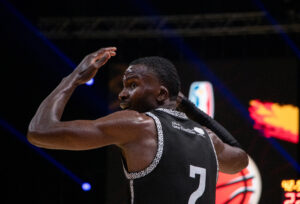
Nino Dim during the BAL 2026 sEASON 6
Nino Dim and his teammates know they have to get their act together. Pictures: The BTO

While the Giants can take credit for the defensive intensity and improved offensive execution that fuelled their comeback, their inability to deliver in the clutch once again proved costly. The late-game struggles – so often the difference in tight contests – left the Johannesburg side winless and anchored in sixth place

Head coach  Ngwenya acknowledged the improvement from the opening game but pointed to key details that ultimately cost his side.

“We showed more fight than in the first game, but it came down to a couple of mistakes,” Ngwenya said. “I thought we prepared well on both defence and offence, but one of the things that disrupted our rhythm was their offensive rebounding. They finished with 15, and that made a big difference.”

However, Giants centre Nkosinathi Sibanyoni delivered a commanding performance on the boards, finishing with 17 total rebounds in a strong individual effort despite the result. Ngwenya admitted the team now faces a shift in approach as they fight to stay alive in the competition.

“The script changes completely now from what we initially planned. We have to go back, reassess, identify weaknesses in the other teams, and prepare properly for the last three games.”

The former Cape Town Tigers coach also highlighted the experience gap between his side and more established opponents.

“We are battle-tested in our own way, but some of these teams come from more consistent leagues. For us, this is the first time playing together at this level in a competition like this,” said Ngwenya. “I believe with every game, we are making progress.”

Florsheim Ngwenya BAL 2026 media day
Coach Florsheim Ngwenya will have to use every trick in the book to revive the Giants’ BAL campaign.

What This Means

With the tournament now entering its decisive phase, the Giants find themselves in a precarious position that threatens to derail their historic BAL debut before it can truly take shape.

At 0-2 and at the bottom of the six-team standings, the South African champions have exhausted their margin for error at an alarming pace – each remaining fixture is now effectively a must-win, with a single defeat enough to end their playoff hopes.

With only three group-stage games remaining and the leading teams beginning to separate themselves, Ngwenya faces the urgent task of restoring the defensive discipline and offensive cohesion that powered their qualification campaign.

Failure to do so could see the Giants’ continental journey end prematurely. For a club that has invested heavily in a professional structure and stepped onto the continental stage within a year of formation, an early exit would represent a significant setback to their broader ambitions.

Can Giants dig themselves out of 0-2 hole? Read More »

The evolution of floor general Dundão

OVER the past two years, you cannot speak about Angolan basketball without mentioning Childe Dundão. During this period, he has become a key figure in the sport, essential to the country’s ongoing success and competitiveness. His leadership and consistent contributions were felt at every level of the game.

At the club level, Dundão has been integral to Petro de Luanda’s achievements in the Basketball Africa League (BAL). His influence was particularly evident during the club’s championship-winning campaign in 2024. His composure, defensive intensity, and game management were crucial throughout the tournament. As the BAL elevates its competitiveness, the focus shifts to whether Dundão can once again lead Petro to the pinnacle of success.

His Development into an Elite Point Guard

Dundão’s career trajectory has been anything but straightforward, highlighting the importance of the current season. Between 2021 and 2024, he established himself as a high-impact two-way guard for Petro, averaging 10-11 points per game. While in the 2021–22 and 2022–23 seasons, he showcased his most effective form, characterised by active defence, confident scoring, and effective management of the team’s offensive flow.

However, the latest season presents a contrast. A decrease in scoring efficiency coincided with an increase in assists, suggesting that Dundão adjusted his role rather than experiencing a decline in effectiveness. Rather than focusing on scoring, he embraced the importance of facilitating for his teammates. In a deep roster such as Petro’s, this shift is a necessity.

Childe Dundao in action at the 2025 BAL
Childe Dundao has transformed his game over the years. Pictures: The BTO

Even within a strong team, Dundao plays a crucial connecting role. While Petro can distribute scoring across multiple players, his unique ability to organise the offence, disrupt opponents on defence, and control the tempo is difficult to replace. His impact may not always appear in the box score, but it is essential to the team’s function.

Growth Amidst Instability

Throughout the past three seasons, Dundao’s fluctuating role, from starter to bench player and back again, has likely affected his rhythm. Consistency is crucial for a point guard, as it influences decision-making, confidence, and overall team leadership. This instability can explain why his offensive progression has not followed a steady upward trajectory.

Nevertheless, this variation may also have expanded his skill set. During his time with Angola’s national basketball team, Dundao has embraced a more prominent role.

His performances at AfroBasket and in the World Cup qualifiers highlighted his growing willingness to take on greater responsibility. He emerged as a more assertive scorer, a decisive playmaker, and a player capable of maintaining confidence under offensive pressure.

International Leadership

Dundao played a critical role in guiding Angola to its 12th AfroBasket title, showcasing composed performances against all competitors. His contributions earned him the MVP award, solidifying his status as one of Africa’s premier guards. This strong performance continued during the recent FIBA World Cup 2027 qualifiers at the end of February, where he demonstrated leadership, composure, and versatility.

The difference in his roles is noteworthy. At Petro, he often adapts to a structured system, while with the national team, he is expected to be the core of that system. This duality, functioning as a facilitator at the club level and a primary driver at the international level, has enhanced his basketball IQ and leadership capabilities.

A Decade of Dundao

Dundao’s story is one of longevity and growing within the structures. He first represented the Angolan national team in 2016 at the FIBA U18 AfroBasket, contributing to the team’s run to the championship. Many of his teammates from that tournament now play at the senior level, strengthening Angola’s teamwork and competitive edge. Over a decade, Dundao has evolved from a promising youth player into a seasoned floor general, with an influence that extends well beyond statistical contributions.

Childe Dundao at the 2027 World Cup Qualifiers
Childe Dundao is a key player for the Angola national team.

Significance of the Current BAL Season

This season marks a pivotal moment for Dundao, as his dual roles are expected to merge. He enters the BAL equipped with three significant advantages:

  • Continuous high-level play through the Angolan league
  • Momentum from national team duty, where he has accepted greater responsibilities
  • Experience across various roles, enhancing his adaptability and leadership skills

While Dundao may not need to be the leading scorer, he is a reliable decision-maker on the court. If he can bring the assertiveness demonstrated with the national team – striking a balance between aggression and playmaking – he can transform Petro into a cohesive unit capable of winning a championship. This convergence makes this season particularly significant for Dundao and Petro de Luanda.

The evolution of floor general Dundão Read More »

Petro de Luanda: A model of consistency in the BAL

SEASON 6 of the BAL tips off with the Kalahari Conference in Pretoria, South Africa. The Big Tip Off’s new writer, Sandisiwe Msibi, analyses the tournament’s ever-present club, Petro de Luanda

Angola’s Culture of Dominance: Petro de Luanda Sets the Standard

For decades, excellence has defined Angolan basketball. Their clubs have consistently placed the Southern African nation on the map. Today, at the centre of that tradition is Petro de Luanda, a model of consistency in the BAL. Since the league’s inception in 2021, Petro has always finished in the top four.

They won the title in 2024. They were runners-up in 2022 and 2025. In addition, they finished third in 2021 and fourth in 2023. Beyond the BAL, Os Petroleos have also enjoyed continental success. They won the FIBA Africa Club Champions Cup in 2006 and 2015, adding to Angola’s rich legacy in the competition.

Therefore, Petro’s repeated deep runs are no coincidence. Instead, they reflect a system built for sustained success.

The anatomy of consistency

What separates Petro from the BAL’s rotating cast of contenders? The statistics tell part of the story. Through five seasons, Petro has compiled a 27-13 record across 40 games, the league’s best winning percentage among teams with multiple appearances. Locally, Petro’s stranglehold on the Angolan league, with six consecutive titles from 2019 to 2025, has ensured annual BAL qualification.

Yannick Moreira of Petro de Luanda
Yannick Moreira brings veteran experience to Petro’s lineup. Picture: The BTO

Four players that define an Era

However, Petro’s success is not just about trophies. It is also about the players who shape the team’s identity. Together, Childe Dundão, Aboubacar Gakou, Gerson Gonçalves and Yanick Moreira provide balance and continuity.

Childe Dundão

At 5ft6, Dundão is the team’s engine. He is also arguably the most impactful undersized player in BAL history. His 2025 season highlights his influence. He helped Petro reach the BAL final. Then, three months later, he won AfroBasket and earned MVP honours.

Moreover, his defensive intensity stands out. He has four All-Defensive Team selections in five seasons. At the same time, he led the Angolan league in assists for three straight years.

Aboubacar Gakou

Similarly, Gakou brings efficiency and versatility. In 2025, he earned All-BAL First Team honours and was named an MVP finalist. During the 2024 title run, he averaged 8.4 points and 5.8 rebounds in just 22.7 minutes. These numbers underscore his impact despite low usage.

Furthermore, as a three-time Angolan League MVP, he represents the modern big man. He is mobile, physical, and disciplined. As a result, he gives Petro defensive flexibility without sacrificing interior strength.

Gerson Lukeny

Every championship team needs a player who can deliver when the moment demands it – for Petro, that role often belongs to Gonçalves. He played a pivotal role in Petro’s 2024 BAL title run, scoring 16 points in the championship game against Al Ahly Libya. Known for his scoring ability, Gonçalves also holds Petro’s club record for the most points in a BAL playoff game with 28.

Yanick Moreira

At 34, Yanick Moreira represents the veteran presence every championship team needs. The 6 ft 10 centre took over as captain in 2025 and provides the defensive backbone that allows Petro’s guards to play aggressively.

Aboubakar Gakou at the 2025 BAL playoffs
Aboubakar Gakou can stretch the floor for Petro.

The 2025 Reckoning: Can Petro Reclaim the Crown?

As Petro prepares for BAL Season 6, which begins with the Kalahari Conference in Pretoria, South Africa (March 27 – April 5), the path back to the championship presents new challenges. They will face stiff competition from the hosts, the Johannesburg Giants, 2024 finalists Al Ahly Libya, DarCity, RSSB Tigers, 

Roster changes

The Angolan club has undergone significant roster changes for the upcoming BAL season. Syrian-American point guard Javion Blake and South Sudanese guard Peter Jok have since joined the club, who represented South Sudan at the 2024 Paris Olympics and the FIBA Basketball World Cup.

Petro de Luanda enters BAL Season 6 not as favourites, but as the league’s standard-bearers. However, if history is a guide, Petro will be there at the end, either lifting the trophy or setting the benchmark that others must try to surpass.

In African basketball, consistency is the ultimate currency. And as a result, no team has accumulated more of it than the Os Petroleos from Luanda.

Petro de Luanda: A model of consistency in the BAL Read More »

Mali’s shaky path to qualifying for Women’s World Cup

THE Mali women’s team probably headed back to Bamako with a great sense of relief. It follows their dramatic qualification for the FIBA Women’s Basketball World Cup in Germany (4-13 September). On their way to reaching a third World Cup, Mali were jittery and then nervously waited to secure their spot.

In Wuhan, results were mixed. An 81–68 loss to China showed inexperience. A 77–64 win over Czechia showed promise. An 81–50 defeat to Belgium exposed gaps. A 76–73 loss to Brazil highlighted fragility. However, a 97–74 win over World Cup Qualifiers debutantes South Sudan kept hopes alive.

A huge favour from EuroBasket champions Belgium was also needed on the final day of the qualifiers. Mali got the job done in their final qualifying game against South Sudan, and Belgium came through for them, beating Czechia (93-50).

While fortune played a hand in getting the Malian women this far, credit must go to the federation. The structures put in place by the federation led to the discovery of star talents such as Maimouna Haidara, Sika Kone, Alima Dembele and Elisabeth Kamite Dabou.

Maimouna Haidara FIBA Women's 2026 World Cup Qualifiers
Maimouna Haidara raised her game at the Women’s World Cup Qualifiers. Pictures: FIBA

Maimouna Haidara

Maimouna Haidara, who had already played in her first senior World Cup in 2022, replicated the form which saw her dominate for Mali at the youth level.

Her production (15.8 points, 6.8 rebounds and 3.8 assists) at the qualifiers was a marked improvement from her previous major tournaments. From the 2021 AfroBasket, scoring in double figures was a struggle for Haidara, whose best scoring average was 6.4. at the next continental tournament in 2023. She also recorded her best rebounding average (6.6) and assists average (2.4) that year.

It was a different story for Haidara at the World Cup qualifiers. Her scoring struggles from past tournaments were a thing of the past as she delivered match-winning performances (24 points, 7 rebounds, 4 assists and efficiency of 25) against Czechia and in their triumph over South Sudan, she again rose to the occasion (19 points, 6 rebounds, 6 assists, and efficiency of 26).

It was fitting that Haidara was an All-Star five at the Wuhan leg of the qualifiers.

Sika Koné

Meanwhile, Sika Koné was a steady presence for Mali. Although she was neither spectacular nor poor, she ranked second in rebounds (8.8) in Wuhan and contributed a solid 11.4 points.

Her best performance was a double-double (20 points and 11 rebounds) in the loss to Brazil. While not at peak scoring form, Mali can still count on Koné to deliver top-notch performances.

Elisabeth Kamite Dabou at FIBA 2026 Women's World Cup Qualifiers
Elisabeth Kamite Dabou played her heart out for Mali.

Elisabeth Kamite Dabou

Elisabeth Kamite Dabou, who graduated alongside Haidara to the senior team, found her footing in these qualifiers. Dabou’s 10.8 points, 4.8 rebounds, and 1.4 assists make her a player to look out for at the World Cup. She made a move to the French club ASA Sceaux Basket last year after cutting her teeth at Senegal’s AS Ville de Dakar.

Dabou was 11/27 (40.7%) from three-point range in the five games of the qualifiers. In Mali’s first group win against Czechia, Dabou (14 points) was 4/6 from three-point range. Additionally, her shooting from beyond the arc was evident against South Sudan, where she went 3/8 from three-point range on her way to a 16-point performance.

Alima Dembele

Alima Dembele maintained her 2025 Women’s AfroBasket scoring form at the qualifiers (10.2 points). Although she slightly upped her production in other departments (4.6 rebounds and 2 assists).

Dembélé delivered an impressive performance in the win over Czechia, finishing with 15 points, 5 rebounds, and 3 steals. She also went 9/10 from the free-throw line, underlining her effectiveness as a strong presence in the paint. It was the same scenario in the victory over the South Sudanese, where Dembele made it to the charity stripe 7/8 times. In her Player of the Match performance against the East Africans, she scored 20 points while adding four rebounds and four assists.

The quartet played a key role in helping Mali progress through a tough qualifying campaign. It will not be easy come September, as Mali have to hit the ground running if they harbour aspirations of going far at the World Cup. They need to tighten every nut and bolt if they want to be competitive when they face the best in the world.

Mali’s shaky path to qualifying for Women’s World Cup Read More »

×