Basketball Africa League

BAL playoffs: Who are the contenders, who are the pretenders?

KIGALI – The highly anticipated BAL (Basketball Africa League) playoffs officially tip off later today (Friday) at BK Arena. The Big Tip Off reflects on the conference play and previews the eight teams ahead of the seeding games.

Cape Town Tigers 

The Tigers had a rocky start to their home debut during the Kalahari Conference, managing a single win against Petro de Luanda in their penultimate game of conference play. In that game (against Petro), the South African champions showed sparks of their potential. The Tigers also shared the ball better and reduced turnovers.

Several players demonstrated they could shoot the ball well and draw contact to put their opponents in the penalty. The Tigers sometimes seemed too reliant on “iso” plays despite it being ineffective in certain stretches of play. They also struggled to defend at the three-point line, and their average of 37.2 total rebounds per game compared to their opponents’ 45.0 total rebounds per game led to them giving up second-chance opportunities to their opponents in the paint.

Samkelo Cele is a vital contributor to the Tigers, and a solid team player when needed to fulfil certain roles. As the leading scorer for the team, Cele showcased his ability with an average of 20.5 points per game. Additionally, he led the team with 2.3 steals per game.

Cape Town Tigers player Samkelo Cele
Samkelo Cele has been the fulcrum for the Tigers in offence and defence. Pictures: FIBA Africa

The Tigers are one of the six teams who have made roster changes ahead of the BAL playoffs. The likes of Billy Preston, co-captain Lebesa Selepe and rookie Storm Gilchrist are no longer with the team. However, the additions of former Dynamo BBC guard Dheiu Deing, former Stade Malien forward Brian Bridgeforth and centre Mouhamadou Ndoye could stabilise the South African team.

AS Douanes 

The Senegal club had a mixed performance throughout the Sahara Conference. A loss of concentration down the stretch in games proved costly as they suffered three losses. However, their three wins, including a buzzer-beater by Mike Fofana with three seconds left in the game against Rivers Hoopers, showcased that the Senegalese champions can compete and win against the best of them.

AS Douanes struggled shooting the ball, averaging 33% from the field and 23.7% from beyond the arc. However, they averaged 16.8 offensive rebounds, giving them second-chance opportunities to put numbers on the scoreboard.

Abdoulaye Harouna was AS Douanes’ key player. Harouna struggled to find his footing in the first game, scoring only eight points, but bounced back with a 35-point performance against US Monastir in their second game. In the end, Harouna led the team with 17.6 points per game. His ability to disrupt the opponent’s defence led to an average of 3.6 steals per game, fuelling some much-needed transition offence in stretches when AS Douanes struggled to convert.

AS Douanes maintained their roster ahead of the BAL playoffs – they have the momentum from the Sahara Conference, but can it lead to an appearance in the final?

Al Ahly Egypt

Al Ahly finished at the top of the Nile Conference once again. But the reigning BAL champs, who have exhibited a composed demeanour found themselves a little shaken on a few occasions, including their upset loss to Uganda’s City Oilers.

To their credit, Al Ahly’s depth and versatility across all positions allowed them to aggressively attack their opponents, giving them comfortable leads in games. The Egyptian giants excelled in rebounding, averaging 43.8 total rebounds per game, indicating strong performance on both ends of the court.

Ehab Amin in action of Al Ahly
Can Ehab Amin lead Egyptian giants Al Ahly to a second BAL title?

The Egyptian Champions’ defence proved effective as they managed to hold their opponents to an average of 78.3 points per game and forced turnovers at a rate of 13.3 per game.

Ehab Amin led the charge for Al Ahly with 13.5 points per game. It may seem like a low number, but it showcased Al Ahly’s depth in offence. Against Bangui Sporting Club, Amin delivered a clutch three-pointer in the final minutes to seal Al Ahly’s 85-79 win. The guard led the team in rebounding.

The reigning champions have replaced Marwan Sahran and Ahmed Moheib with Omar Azab and Seifeldin Saied.

Petro de Luanda

The Angolans had a disappointing Kalahari Conference campaign despite clinching one of the automatic qualifications for Kigali. Petro, usually strong during the regular season, suffered two losses in regular season play.

Historically, Petro is a team that excels at moving the ball well and creating opportunities to showcase their ability to shoot from beyond the arc and stretch the floor. However, this season, they struggled and could not adjust as expected. Despite their offensive struggles, Petro maintained a competitive defensive presence by limiting their opponents’ shooting percentages and rebounding numbers. Their ability to limit opponents’ scoring opportunities and force turnovers contributes to their defensive effectiveness.

Childe Dundao was the standout player for the Angolan side, and his 25-point performance was crucial in their must-win game in the second round against FUS Rabat. The guard averaged 13.5 points per game, 3.5 assists per game, and shot 37% from the three-point line. Dundao, part of last season’s BAL All-Defensive Team, was able to disrupt the opponents’ offence and use his speed to push the ball and create transition scoring opportunities for Petro.

The Angolan champions have possibly made the biggest adjustment to their team, replacing coach Jose Neto with Sergio Moreno. Anthony Nelson and Edmir Lucas were replaced by guard Nicholas Faust and forward Clesio Castro. Castro will help to provide a strong interior presence, while Faust will be an additional scoring option.


View this post on Instagram


A post shared by Basketball Africa League (@thebal)

FUS da Rabat

The Moroccan club were the Kalahari Conference’s most exciting team. FUS showcased their versatility as each player stepped on the floor.

FUS was able to maximise scoring opportunities through their shot selection as well as offensive execution. This is reflected in their 46.4% field goal percentage. The Moroccan champions’ strong rebounding presence at both ends of the floor limited opponents’ second-chance opportunities.

Johnathan Jordan was a factor in FUS’ success. The guard averaged the most minutes played for the team, averaging two personal fouls per game. A good facilitator, Jordan averaged 4.5 assists per game, and his ability to convert, as he led the team’s scoring with an average of 16.3 points.

FUS have made no changes to their team as they will head into the BAL playoffs as they look to continue their dominance.

Al Ahly Libya

Al Ahly Benghazi’s debut in the Nile Conference saw them display individual brilliance and collective effort. Their balanced scoring, efficient shooting, strong rebounding, and disciplined play were hallmarks of their campaign. With solid contributions from their starters and bench, Al Ahly Benghazi showed that they are a well-rounded and resilient team capable of competing at a high level.

Throughout the regular season, Al Ahly Benghazi demonstrated a balanced scoring approach with five players averaging in double digits. This balanced attack made them less predictable and more challenging for opponents to defend. The team’s dominance in rebounding at the offence end provided crucial second-chance opportunities, allowing them to remain a threat in the paint. Al Ahly Benghazi also excelled in maintaining possession, resulting in minimized turnovers.

Jo Acuil was the standout player not only for Al Ahly, but he also gave a standout performance in the final regular season game against the City Oilers. In that game, Acuil set the BAL record for the most points scored (42). Throughout the Nile Conference, Acuil maintained a consistently high level of play, averaging a double-double. His regular season averages were 23 points per game and 10.5 rebounds per game. He is a dual threat as both a prolific scorer and a formidable rebounder, making him an asset for the Libyan club. Acuil is a defensive pillar with great shot-blocking ability, rim protection and can alter shots.

The Libyan champions let go of their primary point guard, Pierre Jackson and Anees Almansouri and brought in Omar Aldirfeeli and Robert Wilson Golden. The loss of Jackson, who was a key contributor in his scoring, pushing the ball up the floor, could prove detrimental to them in the BAL playoffs.

Rivers Hoopers

Rivers Hoopers had a strong debut in the Sahara conference, remaining undefeated in the first round of the competition. But they would suffer two defeats later. The first was a buzzer-beater in a game against AS Douanes and the other because of visible fatigue in the final fixture against US Monastir. The last game saw star point guard Will Perry get a DNP.

At a glance, there is not much difference between the Hoopers’ and their opponents statistically. But it came down to their team chemistry, a component which many other teams have struggled to find so far this season. The Hoopers demonstrated their cohesive team dynamic. They have a balanced distribution of responsibilities and scoring support from Will Perry, Devine Eke, Kelvin Amayo, and Peter Olisemeka, who were able to step up for the team on any given night.

Perry emerged as the primary scorer and facilitator for the team, averaging 18.6 points per game and 5.4 assists. His efficiency in shooting the ball from beyond the arc made him a threat to the opponents but also allowed the Hoopers to spread the floor and make big shots while also getting some good looks for his teammates.

The Nigerian side let go of Michael Daramola and brought Victor Damiola Mohammed. Mohammed is no stranger to the tournament following his time with the Kwara Falcons last season. He will surely look to help the Hoopers as they try to make a deep run into the BAL playoffs.

Chris Crawford of US Monastir
Chris Crawford has led the revival of US Monastir during the Sahara Conference.

US Monastir

The Tunisian club emerged as a phoenix from the ashes to secure their spot in the BAL playoffs. After losing their first three games of the Sahara Conference, Monastir came out swinging in the second round. The Blue Empire won three straight to secure the last third-best place ticket.

While the team struggled in the first round, going 0-3, they showed resilience. Monastir managed to find their identity and corrected their mistakes. The impact of Firas Lahyani on the defensive glass and his steals allowed them to limit the opposition’s offensive opportunities and create opportunities for them to take advantage of their offensive arsenal and convert offensively.

Chris Crawford was the Tunisian side’s offensive catalyst, leading the team with 19.2 points per game. Crawford showcased his versatility in his consistent production on the offensive end, creating opportunities for his teammates. He averaged 8.5 assists per game – the record for the regular season.

Monastir made one change to their roster – the addition of guard Avry Marshall Holmes, who brings experience from South America. He will provide an additional scoring option to the Tunisian side. Holmes replaces Amrou Bouallague.

BAL playoffs: Who are the contenders, who are the pretenders? Read More »

Pedro talks BAL playoffs and the pursuit of a new challenge

JONE Pedro took time to cosy up to basketball despite having a direct line to the game. The fact that his father played the game at the highest level for Angola, did not mean that the sport would be an automatic first choice for Jone. 

The Petro de Luanda player had dabbled in other sports until certain shifts in his life drove him to basketball. He experienced a growth spurt which led to him leaning in on the legacy and later the birth of his younger sister hit him with a dose of maturity.

Pedro, now 34, also explained to The Big Tip Off how his second pro stint in Angola shaped his character and after having enjoyed success at the club level, he is now looking beyond.

Jone, the son of former Angolan player Adriano Pedro, says it was in Germany that he started gravitating towards basketball. 

“Sometimes the ball gets put in your hands because of your family, but in my case, it was me witnessing. So, seeing what my dad was doing at a young age, subconsciously drew me to the game later in life,” says Pedro. 

“My dad played Portugal and later in Germany, where I grew up. When we moved there (Germany), I got exposed to several sports, of course, soccer being the main one. I also played ping-pong,” said Pedro. “By the time I was 13 or 14, I began to notice the height difference because I was not always tall. That is when I decided to try basketball – when I was 14.” 

Jone Pedro
Jone Pedro says the Kalahari Conference was exciting from a fan perspective, but disappointing because of Petro’s results. Pictures: The BTO

Early on, Pedro would have a love-hate relationship with the game. The main reason for his early struggle was his approach toward the game.

“When I started, I was playing for fun. When I switched clubs from my home city (Aachen) to Leverkusen, I still had the same attitude until I realised other players were being pushed instead of me. So I quit,” said Pedro. “When I turned 19, I came to Angola because my dad felt I was not being productive. I spent a season playing in Angola for a team in Lubango (Desportivo de Huila).

“I didn’t like it much because I had grown up in Germany, and it (Lubango) was a different reality. So, after a year, I returned to Germany.”

While in Germany, his sister, already born and growing, made Pedro realise he had different decisions to make. He had to be more serious about his game. Pedro joined then-fourth-tier club Giants Dusseldorf, who went undefeated that season (2011-2012). His successful stint there stint led to a move to Pro A team Gladiators Treves (known as TBB Trier).

“The birth of my sister motivated me to take basketball seriously. By the time she was around three or four, I began to look at the game the right way. I made the decision to pursue a professional career and I have never looked back,” said Pedro. 

The big man has also adopted a mature outlook on life during his 10-year stay in Angola, where he started out for ASA (Atletico Sport Aviacao) and Primeiro de Agosto. While domestic basketball in the Southern African nation had not reached the desired level professionally, Pedro was unfazed by the situation.

“As far as professionalism goes, it was a step back, but because of who I was back then, it was a step up. I was up for the challenge (of playing in Angola), and whatever difficulty I might have, I would embrace it because I could not behave the way I did before. ‘Like, ok, things are not going well here, I quit,” said Pedro. “It was time for me to challenge myself… Find motivation to get through the league and season.”

Apart from growing as an individual, Pedro’s decade in Angola would also yield success on the court. He won two league championships with Primeiro and four with his current club, Petro. It has led to Pedro feeling the time has come for a new career challenge. 

“I come from different habits. I grew up among different African communities in Germany – Ghanaian, Congolese and Guineans. It (Angola) was challenging. It was new, provocative, fun and harsh… A real mix of everything,” said Pedro. “This was a lesson of life. I am happy I made it through while staying sane and being true to myself. I am happy because it was worth it.

“But I think it is important to know when it is time for a new challenge. I am in a position to choose whatever offer may come.”

Pedro played his cards close to his chest on his next move. It is understandable as his gaze is on the Basketball Africa League (BAL) playoffs in Kigali, Rwanda. Despite making it through the Kalahari Conference in South Africa, Petro struggled – their 2-2 record saw the Angolan giants sever ties with Brazilian coach Jose Neto.

While the on-court struggles of Petro were laid bare, Pedro says South Africa was a great setting to start the BAL Season 4.

“Going to South Africa was amazing. It was amazing. It’s the perfect location. The culture there is nice. There was a welcoming atmosphere. And the vibe was just different. It felt like we were in the States, but as far as the team goes, we were on the brink of mental exhaustion,” said Pedro. “When you are used to winning, it becomes hard to stay motivated. It was difficult for us to bring our A-game. So, I think it was time for change, and I don’t mean Neto leaving. 

“I don’t think we performed at 70 per cent of our ability. It was a disaster. I am being straight up. It was obvious that Petro was not Petro. But we made it through.”

Jone Pedro in action Petro
Jone Pedro says Petro will have a different posture for the BAL season 4 playoffs.

Spaniard Sergio Valdeolmillos is the new coach and recently led Petro to a 16th league title. Under him, Pedro feels there has been accountability. According to Pedro, there is a new energy ahead of their clash against US Monastir, a team they lost to in the 2022 BAL final.

“Now that we have a new coach, there is a new mentality. He is doing what needs to be done. He is holding every player accountable. We are more aggressive and physical. We’ve been practising like crazy. It’s unbelievable,” said Pedro. “So I just have to believe in the process. We are here for a reason. The team is ready (for the BAL playoffs). 

“What I can guarantee is that the posture of Petro is going to be different during the playoffs.”

As he winds down the season with Petro, Pedro is thankful for his existence and what it has served, but there is a craving for a little more. 

“Finding my purpose (in life). That has been a great inspiration for me. There’s a difference between what you need to do and what you want to do. For me, I decided I wanted to play basketball and go as far as I can to help and provide for my family,” said the former Angolan international. “And it changes. My sister is about to turn 18, so she is not that cutie that used to motivate me. You always find a new chapter. It can be recovering from an injury or winning a championship. Maybe doubt creeps up, and you question if you won it. So you have to prove yourself again.”

No doubt Pedro and his teammates will have to prove their championship credentials in these BAL playoffs. They are well acquainted with the disappointment of losing and the sweet taste of victory. Hopefully, Pedro can again experience the latter feeling – this time at the continental level. After that, he can ponder on his future.

Pedro talks BAL playoffs and the pursuit of a new challenge Read More »

Amin betting on Al Ahly to do a first BAL title repeat

MANY champions can often recall a particular moment when they knew they were close to achieving their goals. For Al Ahly guard Ehab Amin, the moment came during the fourth quarter of the Season 3 BAL final. 

His recollection of the sequence leading to the defining moment captured the essence of why Al Ahly is a lethal team. The Egyptian club’s ability to quickly capitalize on the defensive mishaps of Senegal’s AS Douanes helped points on board in quick succession in last year’s BAL final in Kigali, Rwanda.

“It was late in the fourth quarter when Corey Webster hit a three in the corner. The other team (AS Douanes) inbounded the ball. I got a steal and hit another three. At that point, it was a five-point game, and then suddenly, it jumped to 11. That possession was exciting and at that moment, we knew that we were going to win the championship. It was our main focus and goal for a long time,” says Amin. 

Following their performance in the recently concluded Nile conference, Al Ahly secured a spot in Kigali for the playoffs at the end of May. The North African giants hope to become the BAL’s first back-to-back champions.

In an interview with the Big Tip Off, Amin reflects on his childhood, the challenges he faced early in his career, and the impact of the BAL on Egypt.

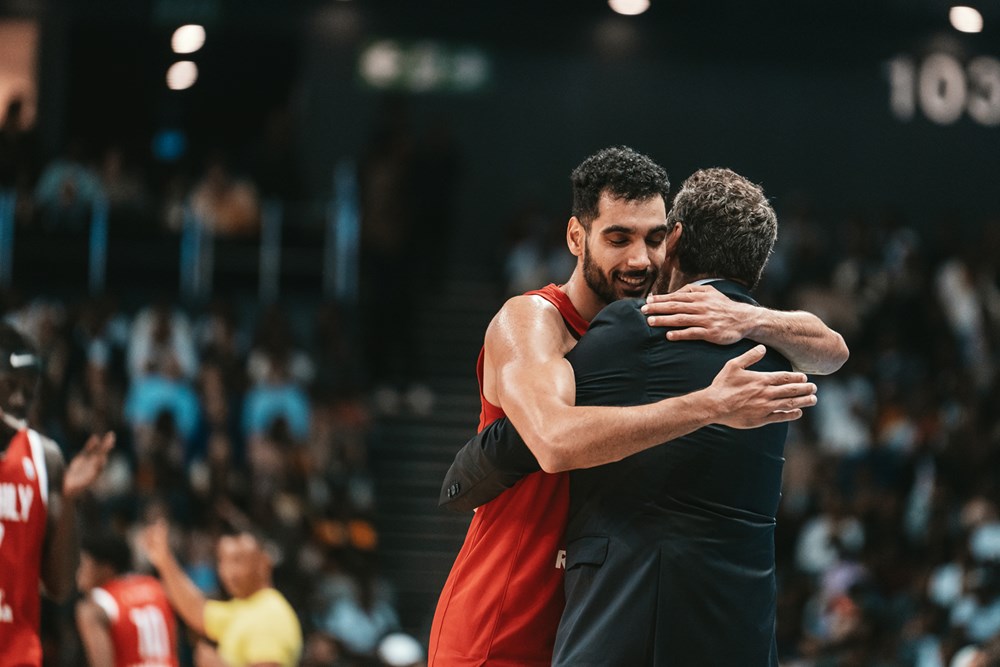
Ehab Amin hugs coach
Ehab Amin embraces coach Agusti Julbe after winning their maiden BAL title. Picture: FIBA Africa

Amin grew up in Alexandria, Egypt, where he started playing basketball aged six for Alexandria Sporting Club. He also enjoyed playing soccer and swimming until he was 11 years old.

“I started playing basketball early in Alexandria. The city and the club I started at [Sporting] were great factors for me to start my basketball career. Basketball was always my favourite, and it was love at first sight. I was good at it, so I kept playing it in school, and my parents supported me when they found out that I wanted to pursue it after school.”

Aged 13, Amin dreamt of studying abroad and pursuing a basketball career in the USA despite the lack of role models from Egypt who had made a similar move. After three years, his dream became a reality as he joined St. John’s Northwestern Military Academy. He then went on to play collegiate basketball at Texas A&M-Corpus Christi and ended his career at the University of Oregon.

“Back then, it was not very popular for Egyptians to go play in the USA, like in high school, college, or even the NBA, I think. So, it was my dream. Watching the NBA and even watching college basketball – the Spurs were my favourite team, and my dream was to play at the highest level. I knew at that time that college could lead me to that, and it was a big step for me. When the chance came, I took it.”

But Amin had his fair share of challenges, especially with injury. First breaking his back, he then sustained a hip injury four years later. There was also adapting to the cultural and environmental changes after leaving Egypt. The 28-year-old credits the support system he had. The former Oregon Ducks player says the people around helped him stay focused and overcome the potential career roadblocks.

“Those challenges built my character. It helped me grow my personality, and helped me be a lot stronger mentally to get to where I am. The people around me at the time also helped me. They knew I wanted to get through those tough times and pursue my dream of playing (basketball),” says Amin. “I knew that I had a long-term goal, and I stuck with it, and that shaped my career after.”

Amin has reaped the rewards of his perseverance and is fulfilling his dream of playing at the highest level in the BAL. He says the competition has helped generate interest in the game in Egypt.

“The BAL has influenced Egypt a lot and in a positive way. It has brought a lot of attention to the game of basketball,” says Amin. “Egypt, like many other African countries, is a very football-dominant country so getting to host the Nile conference has put a spotlight on basketball. I think that is helping the game big time here and it can only go up.”

It is a unique opportunity for Egypt, as the domestic league does not allow spectators at games. As Amin describes it, “It’s fun to play in front of friends, family and players from other sporting codes. And even some celebrities. It’s nice to have them that close to you and it brings the best out of you for sure.”

What makes hosting the Nile Conference extra memorable for Amin is that former mentors and coaches also saw the fruits of their labour in action.

“It’s really special, seeing the old coaches. You get to show them that they did a great job coaching you and they got enjoy that at the arena,” says Amin. “I think they feel like proud fathers. It was great to catch up with them before or even after the games because you don’t get to see them often. Those are moments I enjoy.”

On the court, Al Ahly finished their Nile Conference campaign with a 5-1 record. They suffered an upset defeat against the City Oilers. But the telltale signs began in the game against Central African Republic’s Bangui Sporting Club, where Al Ahly narrowly pulled off an 85-79 win but subsequently fell 82-81 to the Oilers.

“We took things for granted, starting with the game against Bangui. But we managed to come out on top in that game. Against the Oilers we fell into a trap. We thought we could win at any point by double digits,” says Amin. “They deserved to win. They were present the whole game. It was a game with a lot of lead changes and we felt like we could turn it on at any time and win the game. But in the game of basketball, you’ve got to respect the opponent and the game and we made a lot of mistakes at the end of the game offensively and defensively so we paid for that.”

Ehab Amin at BAL season 4
Ehab Amin celebrates winning the BAL Season 3 title with Al Ahly.

Despite the hiccups they faced during the Nile Conference, Amin is confident that in the weeks leading up to Kigali, Al Ahly will improve.

“We are going to get better. There is enough time between now and Kigali to sharpen up. It is just about having everyone on the same page and being cohesive,” says Amin. “We want to be at our peak at the most important moment. That will lead us to our main goal which is to get better and win games.”

Looking beyond the finals, Amin hopes to cement his legacy with Al Ahly on the court. 

“I want to do more than just win titles for Al Ahly. I want help to build a legacy with this team. One that everybody in Egypt or even in Africa will talk about for a long time. A lot of teams have done that before and I want this generation of Al Ahly to be the same,” said the Egyptian international.

Off the court, Amin hopes to create opportunities for kids residing outside of Cairo and Alexandria. He hopes to help them gain access to the same facilities he had growing up.

“I have always wanted to give back to the community… To the kids, especially in places outside of Alexandria and Cairo because we have a lot of clubs, coaches, and courts but there is some raw talent in other cities,” concluded Amin. 

Amin betting on Al Ahly to do a first BAL title repeat Read More »

Miller’s refined skills to help City Boys navigate Nile Conference

THE last time we caught up with Dane Miller Jr, he and the City Oilers were fresh off a successful Road To BAL Elite 16 campaign. They finished second behind the Cape Town Tigers to clinch a ticket to Season 4 of the Basketball Africa League (BAL) behind the moniker the “City Boys.”

After spending time in Indonesia with Prawira Bandung in the Indonesian Basketball League, the forward is back with the Ugandan club. The Oilers will open their Basketball Africa League Nile Conference on Friday (tonight) at 7 pm CAT at the Hassan Mostafa Indoor Sports Complex in Cairo, Egypt.

In an interview with The Big Tip Off, Miller reflected on his time with the Guinean club SLAC and how his time in Indonesia prepared him to take on a leadership role at the Oilers. Miller also spoke about his growth and playing alongside projected 2025 Lottery Pick and Duke commit, Khaman Maluach.

Dane Miller Jr at BAL Season 2
Dane Miller felt like he was in a comfort zone playing for Guinea’s SLAC. Pictures: FIBA Africa

In his first two seasons, he improved from 14.7 points per game, 5.8 assists and 1.5 steals to 21.2 points per game, 7.6 rebounds, and 3.4 steals, an effort which earned him the BAL All-First Team Honours. Coming into this season, Miller feels ready to take things to the next level.

“I feel much more comfortable now. In my first BAL season with SLAC, we had a great team. I made the second team by just waking up off the couch. Honestly, I wasn’t playing anywhere before that. Last year, I played somewhere, and my team allowed me to play. But this year, coming off of playing in Indonesia, my body looks different even when comparing it to the [Road to BAL] qualifiers,” Miller explains.

The 34-year-old spent the window between The Elite 16 and Season 4 playing for Prawira Bandung in the Indonesian Basketball League, an experience which Miller, already a prolific scorer, credits for sharpening his defensive skills.

“Defensively, I’m in great shape due to the role that I played in Indonesia. I was focused and locked in, and I knew that I’d be asked to guard the other team’s best player. I’m more confident now, having played in this league for two years. I feel that I’ve done enough to earn the other team’s respect when I step on the court, which makes me even more confident,” said the American-born player.

The Oilers team has made some changes to their coaching staff with the departure of Mandy Juruni. They have welcomed a new coach, Karim Nesba, a former Moroccan national team player. In addition to the coaching appointment, new players such as Randy Culpepper Sr, Muhammed Bashir Ahmed, and Patrick Ronald Rembert have been acquired. The Oilers have also retained most of the local core from the Road To BAL. After a week of training camp in Cairo, Miller is happy with how the new additions have adjusted.

“We have had good preparation for our upcoming games. Some days we had two practices, while other days we had one. During this time, we have been bonding as a team. We are working hard on different strategies and techniques that we are learning on the fly,” says Miller. “Our coach is putting us in positions that push us out of our comfort zones, but overall, it has been a positive and valuable experience. We feel confident going into our upcoming games.”

The Oilers also welcomed Khaman Maluach, the projected 2025 NBA Lottery pick and Duke commit, who will be an asset to the team.

“Having him on the team is a big advantage. He has a bigger body and can do many things. The last time I saw him, I noticed that he was a great rim protector. Despite being young, he is very competitive and eager to learn. These are the reasons why he is considered an NBA lottery pick,” says Miller.

“I believe we will work well together because passing is one of my strengths. I can teach him different ways to set screens and roll and help him gain confidence on the court. We are counting on him to enjoy the game, be competitive, and contribute to our team. We already have a great team, and he will only add to it.”

The Oilers will have a true test of their strength and preparation tonight (Friday) when they take on the defending champions, Al Ahly Egypt, who are favourites coming into the match. But this task has in no way dulled the Oilers’ confidence.

“The underdog approach I guess is what is sparking some motivation for ourselves, I could say. We have a really good team. I know that everyone is talking about Al Ahly and the other teams and that is okay,” says Miller.

“Bangui Sporting Club is also gonna be tough but it’s okay for those teams to be the favourite – one team is a returning champion and the other team is historically good but it’s still basketball. You still have to go out there and play and figure out who can do what. We’ll see, anything can happen but they put their shoes on the same way we put our shoes on.”

Dane Miller in action at the Road To BAL
Dane Miller says he has refined his skills ahead of the Nile Conference.

As for Miller, he has his eyes set on improving the small details he felt he neglected in last season’s BAL.

“One of the biggest disappointments for me about last year was not making first team all defence. I felt like I deserved that with the stats I had especially on the defensive end. I had the chance to win the scoring title and I lost that on my own. It was the little things like missing free throws,” says Miller.

With the Nile Conference set to start tonight, Miller spoke confidently about the prospects of the Oilers. He feels they will be among the two teams to gain automatic qualification to the playoffs in Kigali, Rwanda.

“When we get to Rwanda I feel like I can lead this team with what we have to a championship and lead a team of rebounders. I just want to be the best leader I can be.”

Miller’s refined skills to help City Boys navigate Nile Conference Read More »

Gatling talks becoming a referee and mentorship of women

IMPRESSIVE crossovers, long-range shooting, dunks, or chase-down blocks are elements of basketball that keep fans on the edge of their seats. Then, there is the part that always divides opinions. It often riles players, coaches, players and fans, but it is necessary for maintaining order in the game. Officiating!

Referee Gerda Gatling has taken on this high-pressure role. She was one of the officials during the recently concluded Basketball Africa League (BAL) Kalahari Conference.

In an interview with The Big Tip Off, Gatling talked about her time as a student-athlete, the importance of networking and relationship building, and the BAL4Her initiative.

Gatling started playing basketball at age seven in Virginia, United States. She was inspired to play by watching her father, one of her first coaches, and older cousin play pick-up games. But she was also an all-state track athlete. It is the sense of community that basketball provided that ultimately won her heart.

“I was naturally good at running track, but I decided to play basketball because it was more of a team sport,” says Gatling. “I liked the idea of working together as a team towards a common goal.”

Gerda Gatling officiating at the BAL
Gerda Gatling left her nine-to-five to become a professional referee. Pictures: Supplied

The idea for Gatling to become a referee took hold during and after her playing days at Stony Brook University, where she graduated with a Bachelor of Science Degree in Economics and Business Management in 2013. That college experience gave her something precious – the ability to handle adversity, a quality key to officiating.

She was also able to build and maintain connections within the Stony Brooks alumni network. She remained a part of the Black and Latino alumni network, even after graduating and starting a career in corporate finance. It is this connection that ultimately opened the door to officiating and also led to her leaving what had become an unfulfilling office job.

“I attended a bi-monthly meeting of the black and Latino alumni group. It was an in-person meeting, and during a conversation with one of the board members (Morgan Cato) about our plans for the weekend, I mentioned that I would be refereeing. Little did I know that she was working on a program within the NBA office,” explained Gatling.

Gerda Gatling at work
Gerda Gatling says basketball and tech go hand in hand.

The conversation proved life-changing, as Gatling signed up for an early career development program (Referee Development Program), which assists former players to become referees. This opportunity allowed her to transition out of corporate and back to the game of basketball.

“It was good to get back on the court but to now be working professionally in a different craft,” says Gatling. “It feels like you are a player because you are constantly working on something. Working on a skill. Whether it’s working on the different roles, on knowledge, positioning, signals, court presence, it was just awesome to get back into that mindset.”

Gatling now works across various competitions including; the G-League, The BIG 3, Athletes Unlimited, as well as Division 1 Women’s Basketball games across the BIG10, The Big East, Atlantic 10, The MEC, The Ivy, The Sun Belt, and most recently the BAL’s Kalahari Conference.

Gatling – who has Nigerian heritage – has paid close attention to Africa’s premier club basketball competition. She says nothing could have prepared her for the experience.

“I did not know what to expect. But my initial expectations got completely blown out of the water. The experience was awesome, the games were competitive and the atmosphere was electric. But what is most exciting is that it is only going to grow bigger and bigger,” says Gatling. “I am grateful that I got to be a part of the South African leg… It’s an honour to get chosen to work at the BAL. It is a great experience and an opportunity to grow as an official.”

During the Kalahari Conference, Gatling was one of 20 mentors who participated in the BAL4Her Career in Sports Workshop. BAL4Her is a platform created by BAL to promote gender equity in the African sports ecosystem.

Gerda Gatling
Gerda Gatling was impressed with the BAL Kalahari Conference. Picture: The BTO

The workshop highlighted opportunities for young women and gave them tools to tackle day-to-day challenges. “There is a lot of opportunity to work in sports and the realm of basketball. And you don’t have to be on the court. A lot of times you do not know what is possible unless you have those conversations, especially with people who look like you and have had those experiences,” says Gatling.

“It is amazing that in year four and even before, it (the BAL) has prioritised giving women the opportunity to engage with other influential women in the space to get that exposure and mentorship.”

The workshop debunked the idea that only sports management degrees can lead to a career in the sports industry. Gatling, a qualified software developer, echoed this point.

“People are multifaceted, and there are multiple things that a person can like. I feel like sometimes we limit ourselves when it comes to our professions and what we do professionally,” says Gatling.

“It is tough to do both at times and it can be mentally exhausting. But I find it important to work in both industries. The tech space is parallel to the sports space in so many ways. Whether it is the on-court stuff that we test at Summer League or what our analytics team does in the office. Just like there is a push for women to be in sports, there is also the same push on the tech side.”

The popularity of women’s basketball has surged in recent years. Gatling hopes that the sport’s popularity will expand to the global stage.

“Women’s basketball is consistently growing. We hope to see more ambassadors like Jewell Loyd, who we had at the recent Kalahari Conference, come to the BAL. It’s crucial to continue expanding the sport, domestically and globally, especially for women. I believe the sport will continue to grow. It’s only a matter of time before it receives the respect it deserves.”

Gatling talks becoming a referee and mentorship of women Read More »

Thunder rocking Kenya and eyeing continental participation

DURING the Cape Town Tigers’ match against FUS Rabat two weeks ago, three men quietly walked into the Sunbet Arena clad in the colours of Kenya’s super club, Nairobi City Thunder.

Sitting courtside at the BAL Kalahari Conference match, the men surveyed the scene, making mental notes of the setting they hope to see their club participate in next year. The Thunder, who came under new ownership last year, have caused raptures in the East African country’s basketball landscape.

Colin Rasmussen, founder and CEO of Twende Sports INC (the company that owns Nairobi City Thunder), Stephen Domingo (co-founder and head of basketball operations of Twende) and team coach Bradley Ibs, who were in South Africa for a couple of days, are spearheading the Thunders’ pursuit for a place in the BAL.

Colin Rasmussen
Colin Rasmussen has lived in Kenya for 11 years. Pictures: The BTO

Rasmussen, born in the US but raised in Pakistan, has called Kenya home for the last 11 years. The lifelong hooper has been active in the basketball scene of that country.

“I love basketball and I am passionate about it. Throughout my time there (Nairobi) I have been involved in the basketball scene. I have built courts and been active in the game from a recreational perspective,” says Rasmussen.

The formation of Twende, which means ” let’s go” in Swahili, has helped Rasmussen and partners do their bit to help transform basketball in Kenya.

“Last year, I decided with my business partners to start Twende Sports – a company dedicated to building the basketball ecosystem and promoting the sport,” said Rasmussen, who is from the streetball circuit. “We believe this is also a unique moment for Africa with the NBA investing in the continent. We are now seeing some of the best players in the world coming from Africa.

“The game is growing on the continent, and we want to support that.”

American-born Domingo has family ties to Nigeria and had the honour of captaining the West African nation’s team during the 2021 Afrobasket in Rwanda.

The 28-year-old former Georgetown Hoyas player says he was searching for ways to give back to basketball on the continent. That is when he met Rasmussen.

“It’s been important for me to figure out how to reinvest in basketball on the continent. Colin and I met in 2022 before I graduated (with an MBA). He was working on another venture. Our focus has been working to grow the game in Kenya, East Africa and we want to achieve success on the continent,” said Domingo.

Rasmussen continued in a similar vein as Domingo. He feels the existence of the BAL has changed the game on the continent, and the aim is for the Thunder to compete at that level.

“I felt this is basketball’s moment with the Basketball Africa League. It’s a new platform, and we aspire to have the best team in Africa. We want to prove that through the BAL,” said Rasmussen. “We have created a professional team, which is a first for Kenya because club basketball there has been recreational. It is a professional environment with contracts for players, with long-term commitments to them, and a proper training environment that enables the existing talent to go to the next level.”

Acquiring top talents like Ariel Okall, Ariel Ortega, Faheem Juma, Fidel Okoth, Griffin Ligare, and Albert Odero has made the club a force. The six Thunder players were also part of the Kenya Morans team that played in the 2025 AfroBasket qualifiers in February.

Rasmussen stressed the importance of supporting the national team.

“Our goal is to elevate the game of basketball. Our investment also supports the national team and the ecosystem in Kenya. So, we encourage our players to be part of the national team,” said Rasmussen. “It also benefits us, because it puts the players on the next level platform.”

Stephen Domingo
Stephen Domingo captained the Nigeria national team at the 2021 AfroBasket in Rwanda.

While Kenyan players are the core of the Thunder, Domingo highlighted the importance of tapping into the expatriate communities for talent.

“Any good roster has a thesis behind it. Ours is that the Kenyan players are the backbone of the team. There is also a large South Sudanese population in Nairobi. Within that community are talented players who are looking for opportunities… So, it’s talent we should not lose out on,” said Domingo.

Rasmussen and Domingo are on track to fulfilling their ambition for the Nairobi-based club. The undefeated Thunder, who have a 16-0 record in the Kenya Basketball League (KBL), are on course to finish top. With a place in the KBL playoffs guaranteed, the goal is to win the league and set themselves on the path to the pinnacle of African club basketball.

Thunder rocking Kenya and eyeing continental participation Read More »

Diarra finally grasps the power basketball has to change his life

FOR many basketball players, the moment that sparked their love for the game might have been a highlight reel dunk or a game-winning shot. Some may reference legendary players like the late Kobe Bryant, Kyrie Irving, LeBron James, or Stephen Curry as their inspiration to play the game.

However, for 22-year-old Aliou Diarra, the beginning of his basketball journey was a little different.

Growing up, Diarra and his childhood friends often visited a large fruit tree in their neighbourhood, where they picked fruit and played games. He was the tallest of the group and could easily reach the fruit, but it wasn’t until a stranger suggested that he try basketball. The chance meeting would later help in evoking his passion for the sport.

Diarra is a long way from picking fruit in his neighbourhood. He is now a grown man who has taken the BAL by storm. The 22-year-old averaged 15 points, 8.5 rebounds, and 2.3 blocks during the recent Kalahari Conference with Morocco’s FUS da Rabat. He has recorded nine double-doubles since his debut in the tournament last year.

Aliou Diarra in action at the Kalahari Conference.
Aliou Diarra has taken the BAL by storm since his debut last season. Pictures: BAL and FIBA

In an interview with The Big Tip Off, Diarra spoke about his time with Stade Malien, the language barriers he has faced, the NBA Summer League and his time with Moroccan club FUS Rabat.

Stade Malien scouted Diarra while playing in the city of Kayes in the western part of Mali. From there, Diarra would go on to have an electrifying 2023 Road To BAL debut with Stade Malien, finishing with a double-double (11.8 points per game and 11.5 rebounds per game). Despite putting up solid numbers for his former club, Diarra had not fully grasped the power that basketball could have in changing his life.

“I did not basketball that seriously until last year in Dakar during the Sahara Conference (last year),” says Diarra. “Once I started putting in an effort, I realized that the sport could be good for me and so I decided to take it more seriously because maybe it could change my life.”

The Cinderella-type performance during their BAL Season 3 led the Malian club to a podium finish after defeating Petro de Luanda in the third-place game behind Diarra’s 25 points and 12 rebounds.

Along with the historic finish of Stade Malien, Diarra was also crowned BAL Defensive Player of the Year and got All BAL First Team and BAL All-Defensive Team honours last year. Diarra had the opportunity to travel to the US for the NBA Summer League with the Milwaukee Bucks, an experience that widened his horizons to what the sport could do for him.

“I learned a lot playing with the Bucks, I had some workouts with professional coaches who saw and believed in my potential. I am trying to implement what I learned in the US with FUS,” says Diarra. “The coaches at the Summer League told me that my future is bright and I trust them. I also trust myself and I am working hard to make that future a reality.”

The experience in the Summer League helped break down the language barrier that Diarra, who speaks fluent Bambara and a little bit of French.

“Last year the language barrier was an obstacle, but going to the USA helped me. I learnt a little bit of English and that gave me the confidence when I joined FUS,” said Diarra.


View this post on Instagram


A post shared by Fadiala Diarra (@fadiala19)

Moving to a different country often comes with challenges, such as adapting to new cultures, societal norms and language barriers. However, Diarra’s time with FUS molded him into a different and much better player than he was in his BAL debut season.

“When I was playing with Stade Malien, I used to do things my way and play the way I wanted. That did not always align with the coach’s and the team’s needs. However, since I started playing with FUS, things have changed significantly,” says Diarra. “I have become more disciplined, taking a more professional approach because I understand that this sport could change my life, and I need to take things more seriously than I did in Bamako.”

FUS concluded the first round of Season 4 by finishing at the top of the Kalahari Conference with a 3-1 record. According to Diarra, the team’s success can be attributed to their cohesion and chemistry. This is something they built over the past six months.

“Since September, we have been training together and playing in the domestic league together. There was never a question about the so-called ‘import’ players because we know each other so well. We know each other’s habits and that makes us a strong team,” says Diarra. “As for myself, I fit well into the team thanks to the experienced players who have helped me learn and grow as a basketball player, but more importantly as a man too.”

Aliou Diarra playing for Stade Malien.
Aliou Diarra, playing in the 2023 Road To BAL, was scouted by Malian club Stade Malien.

To finish top of the Kalahari Conference was the first goal for FUS, now the focus will be on the domestic league until the start of the BAL playoffs in Kigali (May 24 – June 1).

“Qualifying for the playoffs is a very big accomplishment, but this is just the first step for us. We gave our best to come out as the leader of this Conference. Now we look forward. We would like to make it far into the playoffs.”

Two months remain between FUS and their second objective of progressing through the playoffs. As for Diarra, he’ll be refining his skills and hoping they will take FUS to the promised land.

Diarra finally grasps the power basketball has to change his life Read More »

Noah reflects on NBA career and being a BAL investor

JOAKIM Noah may have ended his playing career a few years ago, but he is still a recognisable face. The telling moment came when he was swarmed by autograph-seeking youngsters on the opening night of the Basketball Africa League.

Most of the fans who queued up to take photos with Noah and get his autograph were pre-teens. Some wore jerseys of current NBA stars, but they admired Noah, who was in his prime when they were learning to walk.

Noah retired from the NBA in 2021 after his best years, which included two NBA All-Star selections in 2013 and 2014 and the NBA Defensive Player Award in 2014.

In an interview with The Big Tip Off, Noah reflected on his playing career, his work as a BAL investor, the impact of the BAL on Africa’s basketball ecosystem, and the league’s future.

Joakim Noah at the BAL
Joakim Noah had fun at the Special Olympics during the BAL. Pictures: The BAL

Looking back on a playing career spanning over 14 years on the rosters of the Chicago Bulls, New York Knicks, Memphis Grizzlies, and finally, the Los Angeles Clippers, Noah regrets nothing. While he may not have won a championship ring, Noah left it all on the court throughout his career.

“When faced with adversity, how you handle it is where your power lies,” said Noah.

Noah cherishes the moments he spent with his teammates. For him, winning with his teammates and celebrating with them on the bus are the most memorable moments. “For the highlights, just being retired now – all you have left is your friendships and your memories.”

He now finds happiness in his work with the BAL and witnessing the league’s growth. “It is still the beginning, but seeing the growth, being in South Africa, and seeing the fan interaction… ow excited people are about what we are building here, is something special to me,” says Noah. “A day doesn’t go by where I am not talking about NBA Africa and the work that I am doing in the inner city in Chicago. Those are the things bringing me joy.”

Many retired professional athletes are in the media industry. They have pursued careers as broadcasters, and some have opted to become minority owners in American sports teams.

Noah on the other hand decided to invest his time in African basketball. His decision was easy because of the relationship and trust in BAL President Amadou Gallo Fall’s leadership.

“He is somebody that I trust, a humble warrior who cares about the mission of growing basketball on the continent, and when I knew that he was at the head of this – it wasn’t something to question,” says Noah. “I invested and I am very proud of being able to do this on the continent.”


View this post on Instagram


A post shared by NWE (@nwe)

The standard of work that the BAL has carried out in the first four seasons has catalysed growth across the continent. It has prompted more investment in the sport from the grassroots to the senior level.

“You can see the growth of the leagues all around. I think it’s a great step because it motivates the players across the continent. They know that there’s a league represented by the NBA. The level of excitement in the fans is evident. The players get the chance to play on the same courts as those in the NBA. The are top-notch facilities, sound systems, and everything else that makes the BAL a first-class experience,” said Noah.

A key part of the BAL is the Elevate program. It gives NBA Africa Academy prospects a chance to play for the 12 teams during the competition.

“Being around these young men, seeing their growth and them being able to play on the largest stages of our sport is the most beautiful aspect of the BAL,” says Noah. “They know that when they are stepping onto the court, they are more than just a basketball player. They represent the continent and I think they’ve been doing that well.”

Joakim Noah at the BAL
Joakim Noah sharing a moment with pop artist Sho Madjozi.

At present, four Academy players are competing in the Kalahari Conference. Those are; Aginaldo Neto (Petro de Luanda), Mohammed Sylla (FUS da Rabat), Mohamed Camara (Dynamo Basketball Club), and Yakhia Diop (Cape Town Tigers).

“We are proud of all of them and are proud of the work they are putting in. We acknowledge the sacrifices they made as young men, leaving their families – that is not an easy thing. [The BAL] provides an opportunity for them to speak about their journeys, the hard work that goes into being a professional, and they are almost there. They are coming,” says Noah.

Noah reflects on NBA career and being a BAL investor Read More »

Tigers shock Petro and give themselves a lifeline

SATURDAY’S sold-out match at Sun Bet Arena saw the Cape Town Tigers secure their first Kalahari Conference win after defeating Petro de Luanda 84-78.

The Tigers started the Basketball Africa League encounter with a high level of aggression – which was unusual for them. They were able to match the intensity of Petro in the paint and reduce their turnovers. The Tigers played as a team, shared the ball, and the result saw them lead every quarter for the first time in the tournament.

Cartier Diarra led all scorers in the first half, scoring 12 points and dishing out five assists. Storm Gilchrist shook off his rookie title and made major contributions at both ends of the floor before he sustained an injury.

During the post-match presser, Tigers coach Florsheim Ngwenya noted Gilchrist’s injury as an ankle sprain. In the end, Billy Preston’s 11-point second-half performance sealed the deal for the Tigers.

Ngwenya credited his team’s level of concentration until the final buzzer sounded. “This shows that with the proper preparation, we give ourselves a chance to hang with the best of them,” said the Tigers coach.

Storm Gilchrist injury
Storm Gilchrist clutches his left ankle after injury during the match against Petro. Pictures: The BTO

Dylan Whitbred, who had a 12-point performance off the bench, acknowledged the fans for cheering the team on against the memorable victory against Petro.

“Having the fans here is an incredible experience. I try to tell the guys and remind everyone who comes to watch me play that it is an absolute pleasure to have them in the arena. I do not take that for granted,” said Whitbred. “So we come out with a lot of heart and played for the fans… Because it’s all about them. I am glad we were able to pull out this win.”

Petro de Luanda has had a difficult season, and the outcome of their final conference game reflects this. José Neto, the coach, expressed dissatisfaction with the team’s performance, stating they did not play to their usual standard.

“The team isn’t here. The players are but Petro isn’t here,” says Neto. “Throughout the tournament, different players have stood out but we didn’t play together as a team and that is a surprise to me too.”

Last night’s game was no different. Neto, who took responsibility for the two losses, pointed out that despite the game’s statistics, he believed the Tigers wanted it more.

“The game is not about numbers, it is about who is hungrier and Cape Town [Tigers] were hungrier than us,” said Neto. “The Tigers played well enough to win. The numbers are not that different to me but they had more spirit.”

Petro had many moments where they looked like a shell of themselves and struggled from the three – which has historically been a strong suit of theirs. They were also out-rebounded (50/45).

“We didn’t respect the Tigers enough to show up and do what needed to be done and the results show that,” said Neto.

Tigers shock Petro and give themselves a lifeline Read More »

Loyd talks mentorship by Kobe and her BAL experience

SOUTH Africa has been a vibe in recent months. We have achieved great success in sports, have a rich and beautiful culture, and a vibrant music scene easily discoverable through a simple Google search. However, one thing that may not be so visible is the warmth and kindness of our people.

Jewell Loyd, a two-time WNBA Champion, five-time WNBA All-Star, and the current WNBA scoring title holder and dubbed “Gold Mamba” by the late Kobe Bryant, felt the warmth upon her arrival ahead of the BAL’s Kalahari Conference. This echoed during the opening weekend of games at the Sun Bet Arena in Pretoria.

Jewell Loyd at the BAL4Her
Jewel Loyd is passionate about uplifting women’s sports. Pictures: The BAL

After watching Musa Keys’ captivating halftime performance during last Sunday’s Cape Town Tigers vs Petro de Luanda game, Loyd caught up with The Big Tip Off to discuss several topics. While the BAL topped the list, she also reflected on her relationship with the late Kobe Bryant and the importance of giving back.

The atmosphere in the arena last Saturday was indescribable for Loyd. The action on the court and the passionate fans who filled the arena made the experience unforgettable.

The Parktown Boys’ High School band electrified the arena with popular songs like “Emcimbini” by Kabza de Small and also mixed hip hop with a mash-up between Shack Wes’ “Mo Bamba” and Kanye West’s “Carnival” song.

“The band is awesome, we have to get them back to Seattle because they have been amazing,” said Loyd.

The WNBA star mentioned she had a conversation with someone earlier about integrating dance, music and sport. They discussed how these three elements are universal and allow people to communicate.

“If you want to sing or dance and you have a groove, that brings you together,” says Loyd. “You see that here. While the game is playing people are dancing, singing, and enjoying the game and the amazing atmosphere.”

Loyd couldn’t help but notice the buzz and excitement in the air. And as she looked around, she couldn’t help but smile at seeing THE packed arena. It was a great start to the season, and Loyd felt lucky to witness it all.

“The games are very competitive. You see that there is a need to watch sports, for women, girls, boys, and even the Special Olympics. It’s all here,” says Loyd.

When asked about her favourite team, she promised to reveal that before the championship game in Kigali. She said, “I don’t know if I have a favourite team yet. I need to watch a little more. However, before the championship game, I will be able to tell you who I like. I won’t be a bandwagon fan and hop on after the fact.”

Loyd, the number one overall pick in the 2015 WNBA draft, was also the first female face of her mentor, Kobe Bryant’s signature Nike shoe.

“My relationship with Kobe has been one of the best friendships, and mentorships I have had in my life. The last time we talked, it wasn’t about basketball, a lot of it was about life off the court,” says Loyd.

She remembers two pieces of advice Bryant gave her that helped change her approach to life. “He told me to be epic and to create forever. Those two things have changed the way I go about my business outside of basketball,” says Loyd. “I think that coming here has changed my perspective on what I could do. Hopefully, those two things continue to help me grow as a person and as a player.”

Mentorship has shaped Loyd’s life and she believes it can do the same in the lives of others. “We have so much knowledge and power in our platform which not everyone else has. If I shared one or two per cent of that with someone else, it could inspire hope and that is what everyone needs.”

Loyd is passionate about using her platform to give back to the community. She has partnered with her brother Jarryd to invest in a gym she played in while growing up.

“It is not often that you come back home and find a place where you feel comfortable with people. A space where people look like you. So the opportunity to give back is something super important to me,” says Loyd. “I have been able to get to where I am because someone helped me, so it’s only right that I do the same.”

Jewell Lyod at Special Olympics
Jewell Loyd has enjoyed the atmosphere at the Basketball Africa League’s Kalahari Conference.

Loyd is one of 10 WNBA players who are a part of the Player Marketing Agreement, an initiative aimed at growing the visibility of the league and its players, all while building the personal brands of each player. Loyd was inspired to use this initiative and her platform to shine a light on the BAL and the BAL4Her program.

“Coming here has completely opened my eyes to what needs to be done. I think in the W we get caught up in formulating things and talking, but not knowing what needs to be done. So I have to come here to learn and find out how we can contribute,” says Loyd. “A lot of us don’t have an opportunity to be here to see how we can help to elevate the women’s game. This is one of my passions… To elevate the women’s game and give back as much as I can to the people here.”

Loyd talks mentorship by Kobe and her BAL experience Read More »

×
Verified by MonsterInsights