African Basketball

Prominent figures share their thoughts on BWB 2024

BASKETBALL Without Borders (BWB) Africa is more than a sporting event, it is a once-in-lifetime opportunity for aspiring players. It is a pivotal developmental experience for 60 young athletes from 24 African nations.

With the 20th edition of BWB Africa closing today (Tuesday) at the program’s spiritual home, Johannesburg – some prominent voices in basketball offered their perspectives on the game’s global impact.

Global Influences on a Local Stage

Taking place at the American International School of Johannesburg, the initiative by FIBA and the NBA showcases basketball’s power to bridge diverse cultures and foster talent. “Every year basketball is becoming more and more of a global game,” notes Darko Rajaković, head coach of the Toronto Raptors. “The NBA and FIBA are doing an outstanding job of developing the game, which is now being played in every part of the world.”

Darko Rajakovic at BWB
Toronto Raptors coach Darko Rajakovic says South Africa has a lot of potential. Pictures: NBA Africa

Building a strong basketball culture

Rajaković also shared insights on how South Africa could build a robust basketball culture, drawing from his experiences in Yugoslavia and Serbia. “Yugoslavian and Serbian basketball have a long tradition of success, starting back in the 70s and 80s. We were able to continue a system of work by starting to work with players at a very young age… That is the biggest thing – how to organize youth programs and engage young people to join basketball from a very young age. If you do that, you will be unstoppable, and there is so much talent in South Africa, so it is very amazing.”

Leadership and learning

Rajaković, who completed his first year as NBA head coach, is impressed with how the game has grown to other parts of the world. “It’s amazing to see how talent is growing worldwide,” said the Serbia-born coach.

The former Memphis Grizzlies assistant coach emphasized which areas of the game young players should focus on. “It always starts with passing and playing without the ball. How you move. How you cut and how you space. It is about really playing unselfishly. All young players need to understand how to play the game… Yes, everyone plays to win, but there are those small things that are needed. I hope all campers can leave here with those lessons,” said Rajakovic.

Empowering women in basketball

Two-time WNBA champion Sylvia Fowles brought a unique perspective to the camp. The former Minnesota Lynx star stressed the importance of personality and finding joy. “To be yourself. To have fun, and to soak up as much information as possible,” said Fowles, a four-time Olympic gold medallist.

Her (Fowles) presence, while inspirational for the campers, also highlighted the growing influence of women in basketball. She encouraged all campers to embrace and learn from diverse experiences and viewpoints.

“We are multifaceted people. We bring so much to the table outside of basketball,” said Fowles, acknowledging the broader life lessons the camp imparts. Reflecting on women’s basketball and its state, Fowles says, “It’s a big buzz right now. Women’s basketball has always been it. But for some reason, we weren’t getting as much attention as we are now. I must say, I am excited. We’re growing in the right direction and these young women are getting the attention they need. I hear there is a lot of good talent here so I am excited about that.”

Sylvia Fowles during BWB
Sylvia Fowles believes women’s basketball is headed in the right direction.

Local Representation

The camp also featured strong local participation with South African prospects, including Lana Schreyer, Reatlegile Taukobong, Ntokoza Thonga, Snquobile Thwala, Tinyiko Makhubela, and Ikechukwu Ejike. Their attendance showcases the talent pool within the host country and provides them with a platform to learn from some of the best in the world.

Reflecting on the Impact and Future

Amadou Gallo Fall, President of the Basketball Africa League (BAL), offered his thoughts on the program. “Over 1,600 campers have passed through the Basketball Without Borders Africa camp since 2003 and 13 of them have excelled playing at the highest level in the NBA. Sixty-three have featured in the Basketball Africa League in the last four years. Joel Embiid, a Cameroonian camper in 2011 went on to become NBA Most Valuable Player in the 2022-2023 season. Khaman Maluach, the Basketball Without Borders Africa 2023 MVP, played for South Sudan at the Paris Olympics,” he excitedly stated.

For the BWB campers, every drill, game, and interaction is an opportunity for growth. The program also lays a foundation for young athletes to become better players and global ambassadors for the sport. As they continue to train and learn, the spirit of Basketball Without Borders remains a guiding force, promising a bright future for basketball in Africa and beyond.

Prominent figures share their thoughts on BWB 2024 Read More »

Davids talks CUCSA Games gold and hopes for her women’s team

THESLINE Davids is one of South Africa’s most visible coaches on the sidelines. It shows up in her display of passion and celebration when a play she’s drawn out is executed to a tee by her players or a great defensive effort at the other end of the court.

While leading the national student women’s team to the 2024 CUCSA Games victory at the University of Pretoria (TUKS) the previous week, the Cape Town-born coach barely sat on the South African team bench, preferring to stand and eck her team as they marched from one victory to the next until the gold was secured.

Davids, who also coaches Tuks, says her energetic displays on the sidelines have been part of her DNA since she could play the game.

“I am a passionate coach. I played basketball. And because I love it so much, I celebrate every small or big thing we do on the court. What you saw at that tournament (CUCSA Games) was what I would do at a junior tournament. It’s all heart. And it means more when you do these things for your country,” said Davids.

“I am genuinely always locked in and showing my kids that I am with them every step of the way. When they take a charge, draw a foul or get a bucket, I celebrate that, but I am also hard on them. I also pick them up when they need a lift during games.”

The experienced coach continued: “That’s who I am. I am a passionate coach. I love my kids, basketball, and my country.”


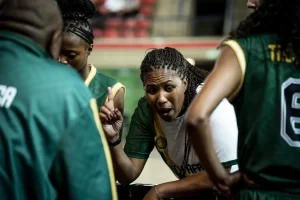
Thesline Davids during a time out
South African team coach Thesline Davids built her team into a cohesive unit. Pictures: The BTO

The feeling of being a champion will take time to wear off on Davids, who listed a few adjectives to describe her jovial state. Winning the tournament at home also made it that extra special.

“It was emotional. I was happy. I was grateful and excited to see my kids achieve the goal. From the first camp, we set ourselves the goal of winning here at home. There is a certain feeling that you get when you play these competitions at home,” said Davids.

“Before, we were competing in Botswana, Zambia, or Malawi. So, this was the first time I got to coach a national team and have a home-court advantage. Also, going undefeated was massive for us. It spoke volumes about our commitment and heart. The kids put in a lot of work to get us over the finish line.”

What impressed Davids more about her team’s achievement was that despite most of them being rookies on the international stage, they acquitted themselves well.

“We have done exceptionally well given most of these girls have never played international basketball. I only had one player who played in AfroBasket qualifiers at the under-16 level in Botswana a few years ago,” said Davids.

“The rest of the players did not understand how this competition works. Playing at the CUCSAs meant so much because people could now see that kids who did not get these opportunities when they were younger compete and deliver for South Africa.”


View this post on Instagram


A post shared by CUCSA (@cucsa_region5)

Talita Memani, crowned basketball tournament MVP, and national team captain Ulwethu Vacu, who earned All-Star honours, earned praise from Davids for contributing to the team’s success.

“Olwethu is the heart of the team. She drove us. It was awesome to finally get a chance to coach her rather than against her. She led by example. Whether it’s diving for the ball, fighting for a second possession or scoring a tough basket, she led by example. She made it easy for us because she is a great leader,” said Davids about the Vaal University of Technology point guard. “When she got the All-Star, I knew she would get it because she worked hard and everybody saw it. The number of bruises she had from the tournament when I last saw her showed what she was willing to do.”

Davids felt a sense of pride about the University of Western Cape centre Memani’s achievement as they both hail from the same city.

“Talita… I think she is just a special kid. I come from Cape Town. So, having her in the national team was a proud moment,” said the former University of Cape Town coach excitedly. “Seeing her footwork and her being in control of everything was incredible. She got double-doubles in every game and out-rebounded other bigs. She inspired the other post players to do better.”

CUCSA Games 2024
Thesline Davids was proud of the achievements of team South Africa captain Olwethu Vacu and Talita Memani during the 2024 CUCSA Games.

The former Hershel Girls School coach felt bigs in the country are unappreciated and felt the tournament was the right platform to put their talents on a pedestal.

“This tournament was not about our guards. This tournament was about our post players. Also, remember here in South Africa, we do not respect our post players enough. So, I gave them a chance to show what they can do,” said Davids. “Her (Memani) backups like Chi (Eneanya), Nyeleti (Nyathi) and Umtha (Sibam) made a difference when they came in. Yeah, but Talita was the fire in the team… It was awesome to coach her.”

The future is bright for this group of players, says Davids. She hopes there will be exposure to more opportunity in the coming year.

“I hope this encourages people to see that more competition is needed for the national team. I hope we can get to the World Student Games in Germany next year,” said Davids. “If we expose these kids to more basketball, they can only get better. Most of the players are under the age of 23… So they have a lot years to give to us. They have put in the work. Hopefully, they will continue to inspire the next generation to do the same.”

Davids talks CUCSA Games gold and hopes for her women’s team Read More »

Matsie, Kweyama focus on big picture ahead of CUCSA Games

TSHEPO Matsie and Thanda Kweyama usually sit at opposing ends of benches during basketball games. Still, for the next couple of days, the two men will work hand in hand to plot South Africa’s success in the 2024 CUCSA Games starting on Monday in the country’s capital, Tshwane.

Matsie, head coach of the Tshwane University Technology (TUT) men’s team and Kweyama, who sits at the helm of rivals University Pretoria, have fought many battles against each other on the court.

But on Sunday after a scrimmage game against Egoli Magic at the University of Pretoria’s Rembrandt Hall, both men sang from the same hymn sheet about the national cause being a priority. National team head coach Matsie says he and his assistant Kweyama have a friendship off the court.

“We both understand what is required… Despite the basketball stuff, he and I (Kweyama) are actually good friends off the court. Apart from that, USSA has appointed us to lead the team, so things like rivalry must be put aside. Right now the focus is to represent the country to the best of our abilities,” said Matsie.

Tshepo Matsie
Tshepo Matsie will rely on the experienced heads of his team for this year’s CUCSA Games. Pictures: The BTO

Kweyama noted that while the coaches are from opposing institutions – it is the same for the players. He also pointed out that they are learning from each other.

“We are working towards a common goal, so there is no clash of egos… Like ‘You beat me or I beat you this many times’. There is a common goal,” said Kweyama. “Also, most of the guys here are from rival schools, so it’s a good learning experience and where we get to share ideas and impart wisdom.”

Kweyama, a former TUT student and Pretoria Boys High School pupil will be experiencing his first taste of international basketball. He described getting the opportunity as a “dream come true”.

“It’s a dream come true. As the saying goes, patience is a virtue, so when you quietly and eagerly wait, these opportunities will come at the right time. So this is exciting for me,” said Kweyama.

“This is a learning process and I am getting used to the requirements at this level. So, this is also a humbling moment.  

Matsie, while a first-time head coach, has had experience at the international level. The former Tshwane Suns player was an assistant to Mandla Ngema during the FISU World Student Games in China last year.

South African team assistant coach Thanda Kweyama
South African assistant coach Thanda Kweyama is excited to coach the CUCSA Games.

The two-time BNL champion says the Games in China were an eye-opener for him and gave him important insights on where South Africa needs to focus on, in its development curve.

“The level of basketball played around the world is different. Knowing what the international standards look like was great and when we returned home, we knew the adjustments we needed to make,” said Matsie.

“If you looked at the game we played (against the Magic), the intensity was high, meaning we can play at this level. It’s also good we have players who have competed at that level (FISU Games) returning to the team. We need that experience and it’s a big plus for us.”

Basketball in South Africa has been experiencing somewhat of a revival. Having hosted one leg of the Basketball Africa League and with the U18 AfroBasket for men and women coming to the country in a couple of months, it is clear that basketball in South Africa will be the big winner.

“This is huge for us. I think we are at a point where basketball is growing in the country. Hosting these kinds of tournaments will give confidence to players who play and those that aspire to play the game. They will see that there is an outlet for them,” said Matsie. “We are hosting the CUCSA Games now. Soon we will be hosting the U18 AfroBasket. From a basketball perspective in our country, we need this.”

The last word went to Kweyama. “It’s exciting times. I wish this happened every other year. People have the opportunity to see the value of the sport. If we can build on this momentum then we can have more people invest in basketball in the country,” concluded Kweyama.

Today’s games:

Women: South Africa vs Malawi at 6 pm (South Africa time)

Men: South Africa vs Zimbabwe at 8 pm (South Africa time)

Matsie, Kweyama focus on big picture ahead of CUCSA Games Read More »

Can Côte D’Ivoire rise to the occasion in Olympic qualifiers?

CÔTE d’Ivoire has established a strong tradition of basketball excellence on the continent over the past three decades.  They will begin their quest for a first-time appearance at the Olympic Games, by trying to qualify through the FIBA Olympic Qualifying Tournaments in San Juan, Puerto Rico.

Team Profile: The West African nation won two FIBA African Championships (AfroBasket) in 1981 and 1985 and earned four silver medals, with their most recent medal (again silver) coming at the 2021 edition. Les Éléphants have consistently demonstrated their determination and competitiveness, solidifying themselves as a formidable basketball nation.

Solo Diabate
Solo Diabate will look to crown his career by helping Cote d’Ivoire qualify for the Olympic Games. Pictures: FIBA

The team will participate in the Olympic Qualifying Tournament games in San Juan, Puero-Rico (2-7 July). They are in Group A alongside Mexico and Lithuania.

Star Players: Côte d’Ivoire will rely on veteran point guard and floor general, Souleymane Diabaté. Diabaté, who made three clutch free throws in Les Éléphants’ sole win over Iran at the 2023 World Cup, concluded the recent BAL season as runner-up with Al Ahly Benghazi, where he averaged 11.3 points, 4.7 rebounds, 5.8 assists, and 1.8 steals per game. Diabaté is a dependable scorer and facilitator who will also offer Les Éléphants perimeter defence in the upcoming games.

Since wearing the Orange vest of the Côte d’Ivoire Jean Phillipe Dally has been an important cog for the Les Elephants. Dally’s ability to score and crash boards have made him a constant feature for his country.

During the FIBA World Cup, averaged 10.8 points per game and 2.4 rebounds per game, and at the recent 2025 AfroBasket qualifiers, the shooting guard numbers jumped to 12 points per game and 5.3 assists per game.

Coach: Spanish coach Natxo Lezkano, who was with the team from 2011-2015 and returned in 2020, will be the head coach. Lezkano’s familiarity with the team will help identify areas for improvement as they analyze results from preparation games leading up to their first match in San Juan.

Jean Phillipe Dally
Jean Phillipe Dally has been a key contributor for the Elephants in major tournaments.

The team has undergone preparations for the OQT without recording a win but has significantly improved, reducing the scoring margin from their first loss against Belgium (88-63). In their second game against the Dominican Republic, they lost 69-67 despite Mo Bamba’s 12 points, six rebounds, and three assists. In their final encounter against Portugal, they lost 91-84.

Les Éléphants have proved themselves as a strong outfit in continental play but have yet to find their footing on the international stage. The team struggled to find their offensive footing during the World Cup, but can they come together in Puerto Rico to make Paris 2024 a reality?

Can Côte D’Ivoire rise to the occasion in Olympic qualifiers? Read More »

Can Rödl’s Olympic experience rub off on Egypt in qualifiers?

EGYPT has a storied basketball history, marked by their triumphs in the FIBA Africa Championships (AfroBasket). The country’s competitive domestic league, sports governance and top-notch facilities have made it a hub for the Basketball Africa League.

While their presence on the global stage is still growing, their performance at the 2023 FIBA World Cup, where they secured two wins out of five, was a promising start. They narrowly missed direct qualification to this year’s Paris Olympics after a close 88-86 loss to New Zealand at the World Cup.

To stamp the ticket to Paris, the Pharoahs must now journey through the Olympic Qualifying Tournaments, scheduled for Tuesday (2-7 July). Greece, one of four host countries of the qualifiers, is where Egypt will begin their quest to end a 36-year Olympic hiatus.

Leading the Pharoah’s hopes of a long-awaited appearance at the Games is German coach Henrick Rödl, who previously led his home country to the Tokyo Games. Rödl boasts an impressive CV as a player and coach, so the Egyptians will feel comfortable that their German mentor is well-equipped to lead the Pharaohs to success.

In an interview with The Big Tip-Off, Coach Rödl, an NCAA champion during his playing days at North Carolina University and a German Cup trophy as coach of ALBA Berlin, gave insights on Egypt’s team chemistry and their aspiration of making the Olympics.

Henrik Rodl
Former Germany coach Henrik Rodl says it was an easy decision to take up the Egyptian coaching job. Pictures: FIBA

Rödl was already coaching in Egypt when he took over from Roy Rana at the start of the year. The two had a history together as Rana served as Rödl’s assistant coach during the Tokyo Olympics.

“When I heard that the head coach position for the national team was open… It didn’t take me very long to decide. I know the people there and most of the players I have worked with. I feel very comfortable with the players and the staff,” said the former Al Ittihad Alexandria coach.

On the tactical side, his (Rödl) collaboration and shared philosophy with Rana made the transition into the national team smooth for Rodl. The German explained, “A lot of the stuff that I emphasize, they have already heard from coach Roy Rana. We have a very similar system, especially at the defensive end.”

To qualify for Paris, Rödl will bank on the synergy the players built through competing against one another over the years in domestic competition.

“I think that is the big advantage of this group… They are very familiar with each other. They know each other, they like each other, and they play well together,” Rödl said.

Preparation for the tournament, although brief due to varying season lengths, has been focused on reinforcing the team’s core fundamentals.

“Right now the first sessions have been about us trying to implement the base, offensively, defensively and just the ground rules. The fine-tuning has to come from playing,” explains Rödl.

Egypt has played preparation games against Cameroon, Latvia and Georgia. Unfortunately, the Pharaohs went winless, going 0-3 in their fixtures. Reflecting on the loss against the Indomitable Lions, who notched a 78-74 victory, Rödl felt the friendly games were primarily about refining their base strategy, identifying areas for improvement, and adapting to different opponents.

“Cameroon was a tough opponent for our first game. They are a strong, athletic team that plays hard defensively. This made it difficult for some of our players to get into their offence. This is the kind of challenge we can expect in the qualifiers,” said Rödl. “Transitioning from practice to a game is never flawless, but it’s not supposed to be. It’s a time to identify the areas that need work.”

Looking ahead to Greece, Group B presents a formidable challenge for Egypt, with matchups against Greece and the Dominican Republic. The top two teams advance to the next round to face the top two from Group A, which includes Croatia, New Zealand, and Slovenia.

Despite Egypt being underdogs, a situation familiar to Rödl, the team remains focused. The experienced coach’s approach is based on executing game plans effectively, capitalising on strengths, and leveraging tactical advantages in each match.

“Qualifying for Tokyo with the German team, we were not the favourite by far because we were missing many players. This (Olympic Qualifiers) is somewhat similar, where we know we are the underdogs in most of the games. But we have a very good spirit, a fighting spirit. We play hard and we play together. If we do this, then good things can happen,” said Rödl. “The first game is important for both teams – the Dominican Republic and us. So, we will try to prepare the best we can to give ourselves a chance to win. And if that can happen, we have another chance to win (against Greece).”

Henrik Rodl leading Germany
Henrik Rodl says being part of the Olympic Games was a special moment.

Egypt’s greatest strength is its collective spirit, resilience, and determination to succeed. Their performance in last year’s FIBA World Cup marked the beginning of a new chapter for the North African nation. Their story will continue this week as they strive to secure a spot in the 2024 Paris Games.

Rodl, already well-versed in the Olympics experience reflected on what he called a “special event”. 

“It is an honour to be in this Olympic Qualifying tournament. It is an honour to be part of the Olympic spirit. Being in the Olympics is perhaps the most special feeling. This is one of the most special events in the world of sports. We are lucky to be there, as coaches and athletes,” said Rödl.

Egypt is undoubtedly a talented team and they will be hopeful that Rödl has the right formula to mastermind a successful qualifying campaign for the North Africans in Greece. 

Can Rödl’s Olympic experience rub off on Egypt in qualifiers? Read More »

Egypt’s Pharoahs will fancy their chances in tricky group

EGYPT will be one of Africa’s representatives in one of the legs of the Olympic Qualifying Tournaments starting on Tuesday. The North Africans will compete in Piraeus, Greece from 2-7 July for a ticket to the Paris Games.  

Team Profile: Egypt

Egypt has a strong basketball tradition in Africa. Nicknamed the Pharaohs, Egypt has achieved significant success on the continent, including the best result of any African basketball team at the Olympics. They have won the second most FIBA Africa Championships, also known as AfroBasket, with five titles, trailing only Angola.

Egypt’s basketball team achieved their best Olympic result by finishing ninth in 1952. However, they have not participated in the Olympics for 36 years. Their last appearance was the 1988 Summer Games in South Korea.

Ehab Amin in action for Egypt
Ehab Amin has been a star of the Egyptian team. Pictures: FIBA

After an impressive performance at the 2023 World Cup, where they narrowly missed qualifying directly for the Olympics, Egypt is now preparing to compete in the Olympic Qualifying Tournament in Greece for their chance to secure a spot.

Star Players: Abdel Nader, a star in the NBL, will be making his national team debut. With experience in both the NBA and the G-League, his addition to the team will provide an extra scoring option and second-chance opportunities. He averaged 14.4 points and 3.0 rebounds per game while playing with the South East Melbourne Phoenix this past season.

The Pharaohs will also benefit from the existing team chemistry, particularly from the Al Ahly players who just concluded the BAL season together. Ehab Amin and Patrick Gardener will be crucial pieces for the Pharaohs.

Amin will play a prime role in the team’s success. Averaging 19.4 points, 5.6 assists, and 4.6 rebounds per game at the FIBA World Cup last year, he will be crucial in providing perimeter defence to limit the three-point threat of Greece and the Dominican Republic – teams that boast NBA talent.

Egyptian American forward Gardener, at 6ft 11, will bring versatile scoring to the team. He shoots well from behind the arc and has a soft touch at the rim. His physical presence will be crucial in contests in the paint.

Patrick Gardner in action for Egypt
Patrick Gardner’s versatility as a scorer makes him a threat for Egypt.

Group B Match Ups & Outlook: Egypt will face Greece and the Dominican Republic – possibly a tricky group for the Pharaohs.

Following the loss against Cameroon in the friendly preparation game last week, the Egyptians will have to work on plugging the holes in their armoury. Amin did not suit up for the encounter against the Indomitable Lions, who took advantage of that, making their bread and butter from the three-point line as the North Africans struggled to adjust.

The biggest challenge for the Egyptians could be Giannis Antetokoumpo and Greece. Antetokoumpo, known as the Greek Freak, will pose a threat at both ends of the paint, with his height and length. The North Africans could believe they have a slight edge over the Dominican Republic, who will be without Karl Anthony Towns and Al Horford. Should Egypt advance out of their group, they will likely face Ivan Zubac and Croatia, Luka Dončič and Slovenia or New Zealand.

Egypt’s Pharoahs will fancy their chances in tricky group Read More »

Indomitable Lions will bring their physicality to Olympic qualifiers

CAMEROON could have the element of surprise on their side when they begin their FIBA Olympic Qualifying Tournament journey in Riga, Latvia (2-7 July). The Indomitable Lions, an unknown quantity, surprised many by getting this far, but can they go further in this year’s qualifiers?

Team Profile: Cameroon

The Indomitable Lions will be regarded by many, including their opponents and neutrals, as the underdogs of the FIBA Olympic Qualifying Tournament (OQT). But this crop of Cameroon players will be unbothered by the tag of underdogs as they vie for a ticket to the Paris Games (26 July – 11 August).

It will be Cameroon’s second attempt at qualifying for the Games after having a dismal campaign in 2008 OQT, where the Lions could not win a single fixture.

Jeremiah Hill of Cameroon
Cameroon’s star player Jeremiah Hill will be expected to raise the bar in the Olympic Qualifying Tournament. Pictures: FIBA

Star Players: Cameroon will lean on the talent of naturalised point guard Jeremiah Hill, who helped the Central African nation secure their ticket in the pre-qualifiers in Nigeria last year.

Hill’s 18 points per game, three rebounds per game and 9.3 assists helped contribute to Cameroon’s unbeaten run in the pre-Olympic Qualifiers. In a recent interview with FIBA Africa, Hill said the Lions will bring their “own African style” in the qualifiers.

“It will be hard… But they are players like we are players. We will bring our own African style. We are going to have to be physical. I think that will be our biggest advantage. Hopefully, it will go well,” said Hill.

Another key player for Cameroon is Jordan Bayehe of the Italian club New Basket Brindisi, who made his presence felt for the Lions with 13.8 points per game, eight rebounds per game and 1.5 assists per game in the qualifiers.  

Samir Gbetkom became a key contributor to the Lions during the pre-Olympic qualifiers with 11.5 points per game, 2.3 rebounds per game and 3.5 assists per game. Gbetkom, who plays in the French Pro-B, has made a huge leap for Cameroon since playing in the 2021 AfroBasket and 2023 FIBA World Cup qualifiers.

Coach: Alfred Aboya, a former national team player, will remember the disappointing campaign of 2008. Having helped Cameroon successfully navigate the pre-qualifier hurdle, Aboya could see these Olympic Qualifying tournaments as his shot at making amends for missing out on the Games 16 years ago.

Alfred Aboya coaching Cameroon
Cameroon coach Alfred Aboya is familiar with the Olympic Qualifying Tournament terrain.

Group B Match-Ups: Cameroon will face a strong Montenegro team in their opening group game and South American juggernaut Brazil, two-time World Cup winners. 

The Cameroonians will have received a significant confidence boost going into the qualifiers after defeating Egypt and Georgia in friendly games. But the true test of Cameroon’s character will be in their two Group B Games. 

Outlook: It would be much easier to write off the chances of Cameroon in the upcoming qualifiers because of their lack of experience, and even if their task looks impossible, this group got this far by doing the impossible.

Indomitable Lions will bring their physicality to Olympic qualifiers Read More »

Can Angola end their 16 year Olympic Games absence?

WE share insights on Angola’s chances at the upcoming FIBA Olympic Qualifying Tournaments (2-7 July). The qualifiers will take place in four cities (San Juan, Puerto Rico; Riga, Latvia; Valencia, Spain and Pireuas, Greece).

Team Profile: Angola

Angola used to be the epitome of success in African basketball. The 11-time African champions regularly participate in global competitions like the FIBA World Cup, but the Olympic Games have become a different story.  

Africa’s most decorated team last graced the Games 16 years ago (2008) and will try to end the dry spell when they begin their Olympic Qualifying Tournament campaign in Spain, which serves as the qualifiers for this year’s Game in Paris (26 July and 11 August).

Jilson Bango playing for Angola
Jilson Bango was a star performer for Angola in the 2025 AfroBasket qualifiers. Pictures: FIBA

Star players: The Angolans certainly do not lack in the talent department. With a strong contingent of internationally based players, Angola can lean on the likes of NBA player Bruno Fernando, Greece-based Silvio de Sousa and Jilson Bango, who plays his basketball in Germany.

Bango was in impeccable form during the 2025 AfroBasket qualifiers – averaging 18 points and 7.7 rebounds in Angola’s first three matches. The Angolans will rely on the forward to bring the same form with him to Spain.

De Sousa and Atlanta Hawks player Fernando had solid performances in last year’s World Cup and will provide Angola with muscle in the paint.

Of the local contingent, the trio of Childe Dundao, Gerson Goncalves and Abubaker Gakou, who were part of the Petro de Luanda team that won BAL Season 4, will give Angola an added shot in the arm following Petro’s continental triumph.

Dundao, a star performer for Angola at the FIBA World Cup (14 points and 5.2 assists), has been a model of consistency for the national team. The pint-sized floor general’s 15 points per game and 6.7 assists per game in the 2025 AfroBasket qualifiers is a testament to him being an asset to Angola.

Childe Dundao in action for Angola
Childe Dundao has been consistent for Angola in international competition.

Group A Match-Ups: Angola will take on two-time FIBA World Cup champions, three-time European champions and Olympic Qualifiers host Spain and Middle East nation Lebanon.

Angola will likely struggle against the highly successful Spanish team and fancy their chances against the Lebanese.

Outlook: The Southern Africans will most likely get past the group stage of the qualifiers. But Angola will struggle in the knock-out phases as they will face strong competition from any opponent that makes it out of the Group B leg in Valencia.

Can Angola end their 16 year Olympic Games absence? Read More »

Time for Cele and Sibanyoni to make the most of their careers

SAMKELO Cele and Nkosinathi Sibanyoni have established themselves as basketball stars in South Africa and Africa. The Cape Town Tigers duo have had an exceptional BAL Season 4 – especially from a statistical perspective.

Small forward Cele, who attended college in the US, plays with enthusiasm and energy on the court. He also exudes confidence and is not afraid of the big moment. In the quarter-final of Africa’s premier club competition against FUS Rabat, the tenacious Cele took it upon himself to make a contested buzzer-beater three. This sent the game to overtime, where the Tigers eventually won.

His boisterous celebrations after every highlight reel dunk or shot made with a degree of difficulty make Cele one of a kind in the South African game.

Samkelo Cele in action for the Tigers
Samkelo Cele made it to the All-BAL Team and All-BAL Defensive Team this year. Pictures: FIBA and BAL

Cele, one of two All-Americans from South Africa, has seen increases in some of his production this season compared to last year’s BAL. His points per game jumped from 13.5 to 21. His assists per game went slightly up from 2.5 to 2.7, while his steals per game shifted from 2.2 steals to 2.4. He also returned to the All-BAL Defensive team and debuted in the All-BAL First team.

Power forward, Sibanyoni is the polar opposite of Cele’s on-court persona, in that he quietly goes about his grind. Last season, with Rasheed Hazzard at the helm, Sibanyoni suffered a dip in minutes (9.4) and production (2.2 points per game and two rebounds). It comes against the backdrop of the 26-year-old, averaging 21.7 minutes per game, 4.6 points per game and 7.2 rebounds per game in his BAL debut (in 2022).

Under Florsheim Ngwenya this year, Sibanyoni has thrived, posting 30.9 minutes per game, 9.4 points per game, 1.6 assists per game, 1.3 steals per game and 0.8 blocks per game.

But, the one aspect of his game – which saw a dramatic increase – is his rebounding, his strongest asset. The 2.08m big man, who ranked second behind South Sudan prodigy Khaman Malauch in crashing boards, averaged 12.4 rebounds per game. Sibanyoni also owns the BAL rebounding record after grabbing 25 boards vs FUS Rabat in the quarter-finals. 

Part of the reason Cele and Sibanyoni had a successful BAL Season 4, especially in the playoffs, was the inclusion of point guard Dhieu Deing and big man Abdoulaye Ndoye. South Sudanese player – Deing, along with Cartier Diarra, took some of the scoring load and playmaking pressure off the shoulders of Cele. Ndoye provided rim protection and shot-blocking at the centre position, which allowed Sibanyoni to play his role at the four.

Nkosinathi Sibanyoni of the Tigers
Nkosinathi Sibanyoni was ranked number 2 in rebounding in Season 4 of the BAL.

The duo have had a career season for the Tigers and are still in the prime of their playing careers. Could it be time for the duo to expand their horizons beyond South Africa? Both players have spoken about this desire at different stages. Recently, Cele told Newzroom Afrika about his ongoing wish and dream to play in the NBA. But at 26, is there a market for his services in the elite league, or does Cele see himself playing in another league?

In Season 3 of the BAL, Sibanyoni told The Big Tip Off he wants to play outside of South Africa. “I have seen how guys play in other parts of the world, and I believe I have the potential to get where I want to be. It’s a matter of working on my game more and being able to advertise my ability,” said Sibanyoni. “In the next two to five years, I would like to see myself play in different countries and learn from other coaches and players. That way, I will mature as a player.”

In the troubled context of South African basketball, Sibanyoni and Cele have exceeded expectations. Given their career aspirations and exploits in the recently concluded BAL, both players are perfectly positioned to explore playing opportunities outside the country. Hopefully, with the right representation and advice, teams from lucrative leagues in Africa or elsewhere will line up for their services. It would be a just reward for their talents.

Time for Cele and Sibanyoni to make the most of their careers Read More »

Eke banks on Hoopers’ BAL run to lift image of Nigerian basketball

FOLLOWING the Rivers Hoopers’ BAL third-place final game win against the Cape Town Tigers, which earned them a podium finish, the post-game press conference started unconventionally.

Guard Devine Eke initiated his own press conference while waiting for coach Ogoh Odaudu to emerge from the locker room with his Coach of the Year trophy. He posed questions to the media for about 2 minutes before jokingly concluding the short proceedings, saying he should stop before he gets into trouble upon Odaudu’s return.

Eke’s energetic presence provided insight into the team dynamic, balanced by a laid-back atmosphere and mutual respect. This has defined the team’s DNA in the Cinderella story for the Rivers Hoopers this season.

In an interview with The Big Tip Off, Eke discussed his initial impressions of the league and the team’s goal for the season.

Devine Eke at the BAL
Devine Eke led the Hoopers to a third-place finish in Season 4 of the BAL. Picture: The BAL and X Ball

Eke, who joined the team in February, admitted he was initially sceptical about the readiness of the league. However, after having a superb BAL tournament, he acknowledged his misconceptions about the BAL were incorrect.

“I didn’t think the BAL was ready yet, but man, I was wrong. This league is amazing, and I love it. I’ve met so many great people. My expectations were wrong. Everyone who told me to come was 100% right… I’m happy I listened to those who advised me.”

Hoopers, returning to the BAL since last appearing in 2021, wanted to shift how Nigerian basketball is viewed, especially after the national team’s dismal performance in the first round of AfroBasket qualifiers in February.

“The goal coming here was changing the narrative of our country’s basketball. We want the next time a Nigerian team comes here to believe they can do what Rivers Hoopers did or even better.”

From the first game, it was evident that it was a different team. Over and above the obvious changes made to the roster and additions to the coaching staff, there was a strong sense of unity that is often scarce amongst teams in this competition.


View this post on Instagram


A post shared by G A T S I N Z I (@gatsinzi__dan)

Eke, who made the All-BAL Second team, pointed to chemistry and a selfless desire to win, as the North Star that guided them to their Cinderella run.

“I think our team chemistry is one of a kind. From the local players to import players, everybody had the same goal. So when you have a team that has the same goal, it’s easy to bond, it’s easy to win, it’s easy to just be successful,” said Eke.

“Everyone had the same goal of winning, nobody cared about scoring. Nobody cared about their minutes. Nobody cared about rebounds or assists. We all just came together as a collective and wanted to win. And that made it easy.”

This unity began at the top, from the coaching staff and management led by Odaudu. From the outside looking in, it would have been easy to perceive Odaudu’s impact on the team as purely tactical. But to Eke, his coach had a far-reaching effect. Each player was encouraged to keep taking shots and find the open man, whether they had a lead they were trying to maintain or cut down on one.

“He gave us confidence and faith, and he believed in us. There were a lot of times during the games – obviously, you guys don’t see it… But there’s been a lot of times during the games when guys had their heads down, even myself, but the way he encouraged us was just tremendous,” explained Eke. “Having coaches that encourage you and don’t just bring you down because you’re missing shots or bench you when you turn the ball over, that’s something really big.”

Devine Eke believes the best of Rivers Hoopers is still to come.

After the Hoopers lost to Al Ahly Benghazi in the semi-finals, they identified the key areas that needed to improve to clinch a podium finish.

“I think we improved our rebounding and limited our turnovers. When we look at the games we lost, it’s because of rebounding and turnovers. And when we focused on that, we could win,” said Eke. “We focused on ourselves, we wanted to keep having fun. You know, from the beginning like, the reason why we were winning was because everyone was having fun. Everyone was touching the ball, everyone was swinging a ball, everyone was scoring, and our bench was going crazy. So we just wanted to keep the same mindset that we had in Dakar.”

Reflecting on his BAL debut, Eke says the tournament has improved his skill level and raised his stock.

“There is a lot of amazing talent in this league, everybody is strong, skilful and physical. This helped me because I had to really think the game through. There are a lot of great players coached by great coaches and this helped my game a lot,” said Eke.

He also hopes the Hoopers will improve on this season’s BAL performance.

“We just want to grow from this season. See what we did wrong, what we did right and just keep striving for greatness,” said Eke. “The main goal is to come back next year. We want to put Hoopers somewhere special. This year we finished third, but we want to be able to win the BAL.”

The Rivers Hoopers’ goal for next season is ambitious but achievable. With no back-to-back champions yet, three new teams in this year’s semi-finals, a team from the Road to The BAL making it to the finals and the crowning of a new champion, the evidence is clear that the championship is anyone’s for the taking.

Eke banks on Hoopers’ BAL run to lift image of Nigerian basketball Read More »

×
Verified by MonsterInsights