African Basketball

Slimane defying father time as passion for playing keeps burning

NOT many ballers in Africa embody what success looks like in basketball than Tunisia’s Sekka, officially known as Radhouane Slimane. Be it in the red vest of Tunisia or at the club level, Slimane, one of the greats of the African game has won it all, and at 44, is still going.

While many of his contemporaries have already hung up their sneakers and possibly sought out alternative careers, Slimane continues to defy the age narrative. So, what keeps him on the hardwood? Well, Slimane, who has shed many drops of sweat on many a court, gave a simple answer to his long-standing devotion to basketball.

“It’s for the love of the game, a love of the game. I am healthy and enjoying the game. I have sacrificed for this game and if I have more years to give, then I will give them,” said Slimane, speaking to The Big Tip Off.

Slimane’s longevity has brought positive yields for the clubs he has played for and the Tunisian national team. With the latter, the Carthage Eagles, he won three AfroBasket titles, and at the club level, he captured the Basketball Africa League (BAL) trophy with US Monastir. In the coming months, Slimane faces a hectic playing schedule, starting in April with the BAL and later the AfroBasket (August 12-24) in Angola. Both Monastir and Tunisia will cross their fingers that their maestro remains healthy for the two tournaments.

Radhouane Slimane of US Monastir
Radhouane Slimane believes the experience in US Monastir can take them far in this year’s BAL. Pictures: FIBA.

The nine-time Tunisia Championnat Pro A winner, Slimane and the Blue Empire will journey to Dakar, Senegal, for their Sahara Conference (26 April – 4 May) of the BAL to face AS Ville de Dakar, BAL champions Petro de Luanda of Angola and debutantes Kriol Star from Cape Verde.

Before speaking on Season 5 of the BAL, Slimane recalled Monastir’s maiden title win (against Petro) in the second instalment of the NBA-backed league in 2022. He explained that the loss to Zamalek in the inaugural BAL made them a tougher team.

“It was our revenge season. We had a great team, with several international players (in Season 1), but it was not a great final for us, and we lost,” said Slimane. “Season 2 was amazing for us, we deserved to win the title. We came back a tougher and more focused team. It was an incredible tournament for us. It was an unbelievable edition because all the teams came back stronger. I think every year, the BAL is becoming harder to win. So for us to win it was amazing.”

While Slimane did not explicitly say the aim is to go for the title this year, he believes they have the playing personnel to go the distance in the BAL.

“We are playing in the playoffs (of the domestic league) as I speak… It should prepare us well for the BAL. We have a good opportunity. We have a good roster. There is a good mix of local talent and import players. I believe we have the potential to go far in this season’s BAL,” said Slimane.

Experience will count in Monastir’s attempt to capture a second BAL trophy, and the additions of veteran players Mourad Al Mabrouk and Mokhtar Ghayeza bring together an unmatched basketball IQ.

Slimane concurred. “They have a lot of experience… You need that in big games. The young players are talented, but in difficult match situations, talent is not enough. You need smart players – Players with a good IQ,” said Slimane. “It’s not only about having quick feet, you also have to use your head.”

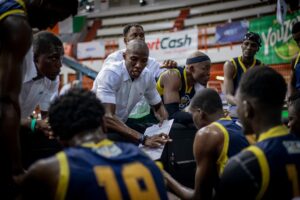
As Slimane leads the team on the court, Walid Zrida, recently hired as coach, will give instructions from the bench. The veteran player says the returning Zrida is a “child of the club”. He is also a coach the players are familiar with, which is a big plus for Monastir.

“We won two championships and two cups with him. So we know him and enjoyed success with him. We know how he wants us to play, and the team understands his philosophy. There is chemistry between us and him, which will make things easy. That is why he was hired (as coach) because he knows everything about Monastir. He is a child of the club,” said Slimane.

Focusing on this year’s AfroBasket, Slimane is one of the great sons of his country’s basketball and has already contributed to all three of Tunisia’s continental titles (2011, 2017 and 2021). Does he have another title run in him?

Slimane in action for Tunisia
Radhouane Slimane says defending the AfroBasket title will be tricky this year.

Having won back-to-back AfroBasket gold, Slimane, who helped Tunisia qualify for a 23rd tournament last month, took a pragmatic tone about talk of a threepeat.

“Staying at the top will be more difficult. We are in transition. It is not the same generation of players. Three players remain from the old generation – myself, (Makrem) Romdhane and Ghayeza,” said Slimane. “New players are coming in, but they lack experience. We have to be there to guide them… Maybe we will achieve something, but it will be difficult.”

The upcoming BAL and AfroBasket bring different challenges for Slimane, but being a seasoned campaigner, this is not new to him. You can expect his on-court wisdom to shine through in the two competitions. And you can expect him to give his all for as long as his mind and body allow him to.

Slimane defying father time as passion for playing keeps burning Read More »

Mothiba ready step into bright lights and action of the BAL

FRIDAY, 28 February, was a day of contrasting emotions for South African certified baller and legend Neo Mothiba. On that day, while looking forward to what he termed a grudge match against his former club Jozi Nuggets, the draw for the much anticipated Season 5 of the Basketball Africa League (BAL) took place a few hours earlier.

Mothiba was probably feeling the anticipation too when the draw formalities had ended. His was the anticipation of taking another step towards finally getting a crack at the BAL.

As the reality playing in the BAL sinks in, Mothiba’s team MBB will travel to Kigali, Rwanda in two months to compete in the BAL’s Nile Conference (17-25 May) against home club APR, Al Ahli Tripoli of Libya and Kenya’s new giants, Nairobi City Thunder.

Speaking a day after the draw, Mothiba told The Big Tip Off that MBB’s ICSL (Inner City Super League) clash against the Nuggets is one of many matches that will prepare the wild card entrants to the BAL for potentially gruelling battles in the Nile Conference.

“What a time to be alive,” said Mothiba, a day after the 73-58 win over the Nuggets, a club he served with distinction as captain. “It was a grudge match… It was in preparation for the bigger picture of the BAL. We needed games like that. It was a close one.”

Neo Mothia in action for MBB
Neo Mothiba says MBB will be competitive in the Nile Conference. Pictures: FIBA

Turning to the BAL, Mothiba’s journey to getting there was arduous. As a player for the Nuggets, he experienced disappointment, first at the Road to BAL in 2019 and consecutive national championship losses (2021 and 2022) to the Cape Town Tigers. The veteran player for iTeam yase dladleni, as MBB is known, even began to wonder if the BAL was becoming a far-fetched dream.

“To tell you the truth, I thought the window had closed. It was one of those things where I thought this opportunity would never come,” said Mothiba. “On the flip side, I knew I had to stay working hard, so when the opportunity arrived, it found me ready.

“The fact that MBB made it is a dream come true. It’s also one of the things I have always wanted to do – play on the biggest stage. BAL is the biggest in Africa right now.”

Mothiba relishes the upcoming duels in May against APR, Al Ahli and City Thunder, and while he feels MBB is not highly favoured, they are not at all deterred by the opposition.

“It’s going to be tough. If it wasn’t, everybody would be doing it (playing in the BAL),” said Mothiba. “We are excited. Obviously, we are the underdogs, but we will give our best shot and see what happens.”

For Mothiba and his teammates to have a chance at being competitive at the BAL, incoming coach Sam Vincent will be the man drawing up the X’s and O’s that hopefully march the Blue Soldiers to the battlefield of success.

The former Tshwane Suns captain says the experienced Vincent, current coach of Beacon College in the United States, will bring the energy of college basketball to MBB’s play, something Mothiba seems to ascribe to.

“From having conversations with Coach Vincent, I think we are all on the same wavelength in terms of professionalism and the game plan,” said the former South Africa captain. “We want to play at a high tempo, be in guys’ faces, and he believes in that. I think once the guys understood his plans, they bought in. It was interesting to see the guys get into that competitive mode over the past three weeks. It’s like college basketball: high tempo, high pressure, good defence and execution on offence.”

Mothiba says Vincent, a former Nigeria Olympic team coach, has also worked on the players’ attitudes and approaches ahead of the tournament.

“Most important is our psyche… He has been working on our mindset and reminding us that we are a professional setup, which means everyone has to take care of their body and ensure they are ready. When we go out there and compete, teams should beat us with special stuff and not things you can control,” said Mothiba.

Neo Mothiba
Neo Mothiba has pushed the ethos of hard work in the MBB camp.

If anyone is well-versed in continental competition and its challenges, it’s Mothiba. Having five AfroBaskets under his belt, his less experienced teammates will do well to pick his brain on what to expect at the BAL.

Aside from tapping into his knowledge well, Mothiba has been impressed with how MBB players have treated the pending mission with the seriousness it deserves.

“The message I have pushed is hard work. You can be the most skilled player ever, but if you are not going to work hard, all that can come to nothing. Luckily, the guys know my resumé, and if I tell them something, they’ll likely encounter it down the road,” said Mothiba. “What has been interesting to watch is the guys getting into it (training). On the team WhatsApp group, guys post their 5 am workouts, putting up shots during their breaks. These are the little sacrifices that build morale.

“When you know the guy next to you is working as hard as you are, it means something. The way we are doing things is unprecedented for a South African team. We are all professionals and that is how we are carrying ourselves.”

Mothiba’s long wait to play in the BAL has ended. Listening to him, he is ready to lace-up his sneakers against some of the best on the continent. As soon as the Nile Conference action tips off in May, one of South Africa’s finest and his teammates will look to make a splash in Kigali.

Mothiba ready step into bright lights and action of the BAL Read More »

Almeida shaping Kriol Star and CBL to be shining lights in Africa

JOEL Almeida has entered a phase of his life and career where legacy has become paramount, and making a meaningful contribution to Cape Verde’s basketball ecosystem has become a part of that mission.

Almeida, 39, is an influential figure in Cape Verdean basketball, and he has used that virtue to effect change for the island’s youth.

In addressing the future needs of basketball in his country, Joel and his younger Ivan founded the now 10-year-old Kriol Star, a development foundation that evolved into a club just last year. Since then, it (Kriol Star) added another first for Cape Verde’s basketball reputation – qualifying for the Basketball Africa League (BAL).

Kriol Star's Joel Almeida
Joel Almeida says Kriol Star came to the Road to BAL in Kenya with a mature perspective. Pictures: FIBA

Another pioneering effort by Joel was starting the Cape Verde Basketball League (CBL), which began in 2023. These are significant milestones, but Almeida sees Kriol Star and the CBL as his way of contributing to the game’s growth and ensuring an outlet exists for talent to develop.

Speaking to the Big Tip Off, Almeida cited Cape Verde’s debut at the 2023 World Cup and Kriol Star’s qualification to the BAL as signs that he should invest more in his country of birth.

“I wouldn’t say they are milestones. It’s giving back to the country and setting up a legacy for the next generation,” said Almeida. There is a great amount of talent in Cape Verde and it needed a platform to showcase it.

“We are able to prove that we belong on the world stage by qualifying for the World Cup. We have also proven it at the club level with Kriol Star qualifying for the BAL. So that’s why it was important I implemented those two projects.”

Looking back at Kriol Star’s BAL qualification, a stroke of fortune would play its hand after they faltered in the preliminary phase of the Road to BAL Division West and finished winless in the group phase in Tripoli, Libya, last year.

Almeida felt the initial Road to BAL experience was a reality check for a club formed a few months before the qualifying tournament for Africa’s elite league.

“We learnt lessons… Tough ones. Kriol Star is a team that was formed in less than two months and went to compete,” said Almeida. “For us to be there was good. We didn’t have bad games, but the process of having experience and playing together counts a lot.”


View this post on Instagram


A post shared by Road To BAL (@roadtobal)

His focus turned to Kriol Star’s wild card entry to the Elite 16 Division East in Nairobi, Kenya, which led to its historic qualification to BAL Season 5.

“The second time around, we were like ‘Yes, this is our chance to prove what we are really about’ and to show that we belong on this stage,” said Almeida, a semi-finalist with Cape Verde in the 2021 AfroBasket. “We took this with a great sense of responsibility. There was also a sense of relief that we got a second chance.

“We fought tooth and nail to build the roster and to create the logistics to be there. All we had to do was go out there and proving it on the court and we did that.”

Having played in Season 2 of the BAL with Cameroon’s FAP, Almeida, who averaged 8.2 ppg, 3.5 rpg and 1.8 apg at the Road to BAL, described getting to qualify for the tournament with a club from his country as “special”.

“It feels special… So special. I am extremely proud of what we achieved. A club from Cape Verde has never competed at the Road to BAL. Last year was the first time. A club from Cape Verde has never qualified for the BAL. Last year was the first time it happened,” said Almeida. “I feel a sense of pride… To be part of this big stage in African club basketball and putting my country on the map. Great things are coming, but this is just the first step. We are hungry for more.”

Joel Almeida in action for Kriol Star
Joel Almeida feels proud of Kriol Star’s achievement in qualifying for the BAL.

The accomplished Almeida elaborated on his desire for more from CBL and Kriol Star.

“I see Kriol Star as a permanent participant in the BAL and achieving great success at the highest level. I want to see more growth for the CBL… To see it developing Cape Verdean talent and seeing more African talent in the league,” said Almeida. It can be a point of reference for Africa on what is possible when you invest resources, knuckle down and work. The CBL is something the African continent can duplicate to help elevate talent. I believe in it because I see Africa as the next frontier… Many entities come to the continent to extract talent. So why not have a platform where that talent can grow.”

Almeida shaping Kriol Star and CBL to be shining lights in Africa Read More »

Mali and Diarra face uphill battle to qualify for AfroBasket

THE final window of the 2025 Men’s AfroBasket qualifiers will have begun on Friday, and Mali enters this phase with significant pressure to win every game. The Sahel nation is up against some of the continent’s toughest teams: South Sudan, ranked No.1 in Africa; the Democratic Republic of the Congo, undefeated in the previous qualifying window; and Morocco, always a formidable contender.

Fifteen spots are up for grabs for the tournament in Angola (12-24 August), and the stakes have never been higher.

In an interview with The Big Tip Off, floor general Cartier Diarra, a recent addition to the team, discusses the energy within the squad, his role in the revamped roster, and the team’s strategy for the upcoming qualifiers. The 27-year-old also hinted at a potential return to Stade Malien, where he showcased his skills during the Road to BAL.

Mali Team Cartier Diarra
Mali and Cartier Diarra, bottom row third from left, have to make their games count in the final window of the AfroBasket. Picture: FIBA

Diarra, currently on the books of Spanish Segunda FEB club Teknei Bizkaia Zornotza, is known for his pass-first mentality and ability to shift momentum with his scoring. His recent stint with Stade Malien, where he averaged 8.5 points, 5.2 rebounds, and 3.8 assists, enhanced his capacity to facilitate play while also creating scoring opportunities for himself.

A key roster addition: Cartier Diarra

Reflecting on how his recent experiences prepared him for the qualifiers, Diarra says building a bond with teammates has given him insight into how they play. “In preparation, it made me more connected with the guys. I’m playing with a good number of them right now, and I understand their games better – knowing where they like to catch the ball,” said Diarra. “The assistant coach here, Boubacar Kanoute, was the head coach of the Stade Malien team. So just having that familiarity helps because he knows me. A lot of playing time depends on the coaches trusting you.”

A winning mindset and strategic blueprint

Diarra’s commitment to winning is evident. “I’m just here to do my job, which is to influence winning in any way I can. That’s my approach, to show consistency and demonstrate that we can win,” said Diarra. Although another victory against Morocco would greatly aid their qualification, Diarra emphasised that winning the first game is essential. “Winning the first game is crucial because Congo didn’t lose a game in the last window,” said Diarra. “The key will definitely be fewer turnovers, better spacing, more shots, and playing together. It’s about ensuring we get the best available shot each time.”

Diarra also highlighted the importance of playing with confidence and trust in their game. “We have a different squad in comparison to the last window, and I believe everyone here wants to win every game. They all believe that we can execute,” said Diarra.

A unified, unyielding spirit

Mali set a positive tone for the upcoming matches by securing a victory over Gabon in a practice game. Diarra stated, “The energy is great. Everybody’s super focused.” He also noted that the team’s leadership had instilled a strong sense of purpose even before they arrived in Rabat: “The captains have reminded everyone how important these games are, making it clear that we are here to win every game – not just to qualify, but to dominate this window. We’re not satisfied with merely qualifying; we want to prove to ourselves and the world that Mali is a team to watch.”

The road ahead

With the final qualifying window now underway, every game is critical for Mali. The rematch against DR Congo presents an opportunity to set the right tone, while a victory over Morocco could provide the momentum needed for qualification. The revamped roster, featuring strategic additions and an emphasis on consistency, signifies a promising shift in the team’s approach.

As Mali embarks on these decisive matchups, all eyes will be on their ability to execute the refined strategy. The coming days will reveal whether these changes, combined with a renewed mindset, can help Mali turn past setbacks into a new era of success on the African basketball stage.

Stade Malien and Cartier Diarra
Cartier Diarra has hinted at a possible return to Stade Malien for the BAL.

Looking to the future: BAL and Stade Malien

While focusing on securing a spot in AfroBasket, Diarra has another eye on the future, specifically, the Basketball Africa League (BAL). He is considering a return to Stade Malien for the league’s fifth season.  “I would love to return, and if everything aligns, you’ll see me with them,” said Diarra.

Although his immediate focus is on the qualifiers, Diarra is preparing for the next phase of his career. “I’m with a club right now, so it’s going to come down to that and being able to transition and get ready for the BAL,” he explained. Diarra also discussed the evolution of the BAL, particularly the caravan-style format, which involves teams travelling to multiple locations and playing between 6-10 games, depending on playoff progression. He believes having more games will enhance the league’s credibility and provide a better evaluation of players. “More games make the league more credible, when you play 30-plus games, that’s when people can evaluate you,” Diarra stated.

Diarra has a full plate of basketball and the first portion to bite on is helping Mali secure their place at AfroBasket 2025 and proving that the team can rise to new heights.

  • At the time of publishing, Mali lost (66-59) their first game of the final AfroBasket qualifying window on Friday to the Democratic Republic of Congo.

Mali and Diarra face uphill battle to qualify for AfroBasket Read More »

Chona holds off retirement talk for shot at BAL qualification

CHONGO Chona pictured Season 5 of the Basketball Africa League (the BAL) as the stage where he would bid goodbye to his playing career, but it was not to be as the proverbial needle burst that bubble. 

Last year’s Road to BAL Elite 16 expedition in Nairobi, Kenya, was disappointing for Matero Magic and left 34-year-old Chona with a chip on his shoulder, which led to him doing a U-turn on retirement and vowing to make things right. Fortunately for Chona, the Tamanga Boys will have another run at the Road to BAL later in the year, after clinching a 12th domestic national championship.

Chongo Chona says teams always get better at the different stages of the Road to BAL. Pictures: FIBA

Chona, known as Stizzy in Zambian basketball circles, says consistency has been key to Matero’s success. They have also adapted after losing their bigs in previous seasons.

“It’s all about consistency and hard work… Never ever being complacent. Twelve titles are a lot, especially considering the past two seasons. We have lost some players in the last two years. Our centres Douglas (Kandulu) and Miles (Ndalama) got contracts after past Elite 16 competitions. We had challenges in the local league following the departures of those players,” said Chona. “… But getting the 12th title for Matero is an amazing feeling. A feeling of what hard work and consistency can achieve.”

The former UNZA Pacers player credited Manuel Silva, Matero’s coach in last year’s Road to BAL, for setting them up for success for the remainder of the domestic season. Chona says another ingredient that led to the championship was trust among teammates.

“We relied on each other (this season), especially given the challenges we faced with the playing personnel. Matero Magic has always been a dominant team in the post position in the league, but with the two bigs gone, we had to rely on each other more,” said the former Zambia international.

Chona expanded on what Angolan coach Silva left behind during his brief stay at the Tamanga Boys.

“I think Manuel Silva’s influence still impacted the team. He was with us from the Road to BAL first stage in Zimbabwe and the Elite 16 in Kenya,” said Chona. “I feel the knowledge he gave and being able to execute what he taught changed things for us. He elevated our game by introducing cardinal things like discipline, how to play better as a team, respecting the game and most importantly, enjoying it. So, those are the lessons we took, and they led us to this championship.

“He (Silva) may not have been there for the title run… But he was there in spirit. He is a good coach. I am glad I got a chance to work with him.”


View this post on Instagram


A post shared by Matero Magic (@materomagicbasketball)

Recalling the Road to BAL, Chona believes teams always strive to improve at every stage of qualification which was not the case with the Zambian club. Matero finished the preliminary stages with an impressive 5-0 record but bowed out winless in the Elite 16.

“We have played Urunani and Oilers before, and the losses were close. When we played both teams last year, we lost by huge margins. It shows that every year is different in Road to BAL… Teams are always improving – it’s rare that they do not upgrade,” said Chona. So you can’t say we played Urunani last year and lost by nine. We almost had them. Complacency cannot be a factor at any level. Every game (in the Road to BAL) must be approached as a final.

“So complacency crept in because we looked at previous results, and we had an upgraded roster, so we thought things would be easy, but it wasn’t. We have to play like it is the last time we will play in these tournaments.”

Given Chona’s latter statement and how he imagined hanging up his sneakers not coming to pass, he feels he has enough in the tank to have another go at trying to help Matero qualify for the BAL.

“This was supposed to be my last season with Matero Magic and basketball. I wanted to take a different role, maybe in management, to see how I can continue impacting the game, not only for Matero and the country too,” said Chona. “After what happened at the Elite 16, a part of me says I am not done.

Chongo Chona did a U-Turn on his decision to retire after last year’s disappointing run at the Elite 16.

Chona says along with the physical toll the continental competition took, it also drained him emotionally and he questioned whether it was still worth it to continue playing.

“I didn’t have a good run in Kenya. I got injured in the first game against Urunani. It changed the tournament for me. I felt like I let down my club, teammates and country,” said Chona. “I felt like it was time for someone else to take the baton. So when we came back (from Kenya), I missed a couple of games in the season.

“I think I had to ask myself why I am playing. I also got messages from young kids telling me they were proud of the team for getting to that level. So I had to ask myself, ‘I know what I did to get my body right for this competition, am I willing to do it again and do it way better and at a higher level than last year?'”

Following the introspection Chona decided to make some changes to his game and reiterated that his career is far from done.

“Even when we got the (domestic) playoffs, I decided to take a different role… Everybody wants to score, but we can do other things like going for that rebound, making that stop or that extra dish to a teammate in a better position to score. So those are the things I tried, and things turned out great in the playoffs. So, as things stand, I want to give the BAL another go. Job not done,” concluded Chona.

It’s impressive to see Chona feeling more motivated and matching that motivation with the work needed to be successful. As Matero plot their qualification to the BAL, they will need players like Chona, who put the team first and can adapt to change when necessary.

Chona holds off retirement talk for shot at BAL qualification Read More »

Phiri, Matero eyeing ZBF title to ease sting of Elite 16

LAST year in October, Saul Phiri and his Matero Magic teammates looked unstoppable in the early stages of the Road To BAL – their unbeaten campaign in Zimbabwe held a lot of promise – it looked like they would be the first from Zambia to qualify for the Basketball Africa League.

Somehow, in Nairobi, Kenya, at the Elite 16 stage, the wheels came off for the Magic. The promise they had dimmed as they got bounced out of the Elite 16 without a win to their name.

Saul Phiri Matero Magic
Saul Phiri feels Matero belong in continental competition. Picture: FIBA

According to 28-year-old Phiri, a player no stranger to continental terrain, the Kenya experience quickly went south due to a lack of preparation.

“Being a guy who has been to this stage a couple of times, I feel I know what to expect and tried to prep everyone for how tough that next round will be. It’s the BAL before the BAL… At that stage, every team has a good chance of qualifying, and we had to put our best foot forward and give it all we have,” said Phiri, a former La Salle University player. “Our first game, I think a lot of people were shocked at the atmosphere and the stage we were on. It’s a big stage. We played a lot of good teams like the club from Burundi (Urunani). They came undefeated (from the preliminary stages). That’s what we want. We wanted to compete against the best, but it was a tough adjustment.”


View this post on Instagram


A post shared by ERICKSON 🇨🇩 (@itserickson_)

That Elite 16 nightmare is in the distant past. Tamanga Boys’ focus is on the ongoing three-match National Club Championship final, which will feature them and the army club Green Buffaloes. Matero already has the advantage with a 91-67 over their adversaries.

Before their Game One victory over the Buffaloes last Sunday, Phiri, who joined Matero in September, was impressed with his teammates’ performance in reaching the finals.

“I did come in a little late in the season, so the team held down the fort. I think before I arrived, we had lost only one (league) game, so my teammates had done an incredible job, and I feel I came into a great situation,” said Phiri. We dropped to more (league) games after the BAL qualifiers… There was fatigue when we came back (from Kenya), but we were still first (in the league), so we stayed positive.

“We have built momentum going into the finals, and we just have to keep it up so that we can go back to the BAL (qualifiers). We want avenge what happened at the Elite 16… It still stings because we could have played better. We are preparing for a war since we are playing the army guys… We will stick to our gameplan to get the job done.”

Phiri, who has roots in Zimbabwe and Zambia, has enjoyed playing in the Zambia Basketball League and the physicality. He has also felt at home with the Magic and the family atmosphere within the club.

“The thing I like about Zambian basketball is everyone here is tough. In the league, there are no pushovers. Players here play with pace. They will run up and down or play slow,” said Phiri.

Saul Piri Matero Magic
Saul Phiri says nerves got the best of some Matero players at last year’s Elite 16.

On Matero, he said: “It is the family aspect that I like about them, the support you get from management to the fans, everyone involved with Matero Magic feel like family. That is a big thing for me. Every time I come here I feel like I am at home. I am grateful for that.”

Phiri and Matero have two more games to secure a 12th ZBL title. For the forward especially, bringing home the trophy would be a show of gratitude to the club and its fans for making him part of the family.

Phiri, Matero eyeing ZBF title to ease sting of Elite 16 Read More »

Selepe embraces inner coach and leading MBB to the BAL

DURING his playing days at Jeppe High School for Boys, Lebesa Selepe says he learnt he had an inner coach in him, something he took time to warm up to. In a full-circle moment, Selepe has embraced his ability to impart basketball knowledge from the sidelines at his former school.

The MBB player explains that he is not new to the stressful job of being a coach, which has formed part of his love for the game.

“I have coached basketball before in 2009, 2010, and 2011. So I can say is it feels good to be back (to coaching),” said the former Jeppe High pupil. “It feels good to be back at my old school because of the passion I have (for the school) and the game. It’s an emotional thing and I can feel my blood pressure boiling on game day.”

Lebesa Selepe Road To BAL
Lebesa Selepe believes the Road To BAL gave pertinent lessons. Pictures: FIBA

The 33-year-old Selepe is not sure when the coaching bug bit – what he does remember is his love for executing the plan and coaches telling him he can become one. “I don’t know exactly… Whenever I play, I am the type of player who implements whatever the coach wants us to do. Also, some of my coaches used to say to me I am one of those guys who can be like a player/coach… I can’t say this is when the bug bit… Maybe it’s something I have always had in me,” said Selepe.

The South African international says he is in coaching for the long haul and has also taken to being a mentor to the younger players.

“Coaching and commentating are things I see myself doing when I stop playing basketball… I am enjoying it. When I was younger I did not like it as much as I do now,” said the South African international. “I think I have a lot more to teach now than back then. I definitely want to do it for as long as possible and to keep on imparting knowledge given the different levels of basketball I have played.”

Selepe is a seasoned hooper. He played for South Africa in the 2017 AfroBasket. Before joining last year’s national champions MBB, he had already played in two Basketball Africa League (BAL) tournaments in the colours of the defunct Cape Town Tigers.

This year, he will make a third appearance at the BAL in the Blue of MBB, and what makes the journey fulfilling for Selepe is that he is achieving his milestone with a South African-owned outfit.

“It feels great. MBB is a South African product, a homegrown club and they are also close to my heart. So going there (to the BAL) with them is absolutely amazing,” said Selepe.

MBB got a taste of things to come in the BAL during the Road To BAL Elite 16 in Nairobi, Kenya, last year. iTeam Yase Dladleni (The Home Team) managed one victory in the group stages and did not progress to the next round.

Jeppe coach Lebesa Selepe
Lebesa Selepe has embraced being a coach at his former high school.

Reflecting on his fourth Elite 16 tournament, Selepe cited administrative matters and a lack of preparation as MBB’s stumbling blocks. Despite the challenges, the former Jozi Nuggets player believes things will improve.

“The two games we lost, one against the hosts Nairobi City Thunder – in that game, we did not have enough depth because some of our players could not play because of registration, so we were thin (in the game against the Thunder) and ran out of gas. The lesson there is to make certain the house is in order in terms of paperwork and admin and to ensure our conditioning is at a higher level,” said Selepe. “Against Kriol Star, I think it is a game we should have won. We had numerous opportunities to win that game. So we have to stay locked in to win basketball games.

“The results may not look that way, but we were competitive as MBB… We are on the right track.”

Having the evergreen Neo Mothiba and the battle-hardened Pieter Prinsloo in the team solidifies the spine, and a good run of preparatory matches will see MBB raring to go.

MBB's Lebesa Selepe
Lebesa Selepe has enjoyed many battles alongside Neo Mothiba, left.

Selepe spoke on teaming up again with his 2017 AfroBasket teammates. “Neo Mothiba is a warrior. You can go to war with him any day. He is ageing in reverse. It’s always great to play with him. He is a super leader, a guy that commands a lot of respect. He plays the game at a high level despite his age so that is the type you want to go into battle with,” said Selepe. “Pieter is a high-calibre player. He is a 6-foot-10 guy who can knock down the three and secure the middle. He is a treasure to have on any team.”

For Selepe and Co. the work to be ready for the BAL continues. Hopefully, by the start of the tournament, the Blue Soldiers will be well-armoured for continental battle.

Selepe embraces inner coach and leading MBB to the BAL Read More »

SA coaches cry foul over non-payment for U18 AfroBasket

FOUR months have passed since the U18 AfroBasket (for men and women) ended on South African shores. However, some of the rubble from the chaotic way Basketball South Africa (BSA) organised the tournament remains.

The national federation appointed technical staff for the U18 teams at the eleventh hour and agreed on payments for the two-week tournament in the South African capital, Tshwane. Sadly, long-time servants of South African basketball Florsheim Ngwenya, Nosipho Njokweni and Craig Gilchrist say they and their colleagues have yet to receive their payments.

Njokweni (coach of the women’s team) and Gilchrist (assistant to the men’s team) expressed their frustration with the national federation. The former national team players intimated that this was an age-old issue, which had become worse under the current executive, stewarded by Sanele Mthiyane.

BSA took their calls, but they have now gone quiet

Gilchrist says the lack of professionalism has long been the modus operandi of BSA. “First of all, there was no direct communication with me about coaching the under-18s. I found out about it (my appointment) on a social media post on Facebook, which I do not use. My wife showed me the post saying Florsh (Ngwenya) and I had been named coaches,” said the former national team captain. “I then tried to get hold of Sanele to find out if it was fake news. He said it was not and that the secretary general (Sibongile Fondini) would get a hold of me, but he did not. Curtis (Van Wyk), the team manager, called me to make the travel arrangements, and I just got on the plane and arrived there (in Tshwane).

AfroBasket Craig Gilchrist
Craig Gilchrist says BSA has always operated haphazardly. Pictures: FIBA

Gilchrist says they met with the federation’s leadership before the AfroBasket tipped off to thrash out payment matters. “Towards the end of the camp, Sanele and Sibongile (Fondini) met with the technical staff, and they said we would be paid for our time,” said Gilchrist.

Asked if they were presented with documents to sign, Gilchrist said the following: “There is never anything signed with BSA. In all my dealings with them since 1997 as a player, I have never signed anything with BSA.”

The former senior national men’s team coach says others who also served at the tournament are in a similar boat. He also says Fondini has stopped taking their calls regarding payment.

“None of the coaches, managers and medical staff have been paid from AfroBasket. Initially, the SG (Fondini) responded to our questions but has since gone quiet. We are all in the same WhatsApp group. A week ago, I got hold of Sanele and asked him (about payment). He gave me the same old political response, ‘Your message has been received and I will revert to you as soon as possible’,” said Gilchrist. “So it’s clear they are not going to pay us.”

Despite challenges with previous BSA administrations, Gilchrist says the current one has proven extremely difficult to work with. “In the nineties, we were frustrated with BSA because we felt they were not doing a proper job. If I compare that to now, they were doing a phenomenal job, there were IPTs for under-18s and 16s, national club championships that lasted longer than a week and national teams travelled regularly. They were doing way better than the current executive,” said Gilchrist.

Njokweni says things are much worse

Njokweni spoke in the same vein as Gilchrist regarding the state of the federation. “The things that happened when I was a player are still happening now since I have become a coach and it has become worse,” said Njokweni. “For the last four months, we have been asking about our payments, and their (BSA) response to us was they are waiting for money from the government. So we are still waiting and we don’t know how long that will take.”

SA coach Nosipho Njokweni
Nosipho Njokweni did not have her full technical staff during the U18 AfroBasket.

Njokweni recalled the rushed appointments and how BSA promised contracts that never materialised. Also after fulfilling their mandate, they are still to get a cent from the federation. “Two things happened. When they (BSA) asked us to take up the (coaching) job, it was the night before (the start of the AfroBasket). The second thing, during the camp, we were told (by BSA) that we would get contracts with a specified amount of money… It was Sibongile who showed us on his laptop what the contract would look like, but to this day nothing has happened (about payment),” said Njokweni.

She lamented the state of the game by comparing the time she was a player and the present condition. Njokweni says previous administrations did try to do right by them despite the inadequacies of the time.

“I feel the federation has taken advantage of a lot of things. I’ll tell you why. Twenty years ago, I was a player too. When I was with the national team, and we were playing away, I would get $100. If we were in the country, I would get R50,” said Njokweni. “The coaches would get their contracts, sign them and even if they did not get their money immediately they would get it soon after the tournament. So at least something was happening at that time. As much as we were not happy a lot was happening. Right now nothing is happening.”

Ngwenya feels there is a loss of trust

Like his two colleagues, Florsheim Ngwenya, coach of the U18 national men’s team at AfroBasket, has experienced various BSA administrations. He believes one thing has remained the same – unchanging operational habits.

“There is a payment structure that BSA agrees on with coaches and technical staff, but (BSA does not honour that),” said Ngwenya. “It’s sad that when you enter into an agreement and the one party breaches it. It is frustrating that we are still here today.”

Florsheim Ngwenya SA coach
Florsheim Ngwenya is disappointed at BSA’s treatment of coaches and technical staff.

Ngwenya stressed the need to work in a trustworthy environment in the future, as the current way of working was not palatable. “If you come back to me and tell me ‘we need your services’. I will ask what is going to be different this time around. It’s not about financial rewards. It is about trust. If the organisation is not able to meet its obligation they have to explain why,” said Ngwenya.

The senior national team coach says what makes him sad is the federation’s failure to acknowledge the sacrifices made by the coaches and technical staff.  “It was disappointing because we were handling the administration for the kids. When you receive such a huge task, you do not want to moonwalk through it. You expect that they will appreciate you. It has not been the case. Even a thank you… Or a letter of acknowledgement for the work we put in. It’s not great, but it would have been ok. All we have gotten is dead silence and that is disappointing,” concluded Ngwenya.

At the time of publishing, the BSA had not responded to our requests for comment.

SA coaches cry foul over non-payment for U18 AfroBasket Read More »

Heavyweights to do battle in Group B of the Elite 16

GROUP B in the 2025 Elite 16 Division East promises an intense battle as Matero Magic, the City Oilers, Urunani, and Fox Basketball Club vie for the two remaining spots in the landmark fifth season of the Basketball Africa League (BAL). With everything on the line, each team must bring their best to ensure they make it to the tournament’s final game and secure their place on Africa’s grandest basketball stage.

While most teams in this group have been battle-tested in the first round, the stakes are higher than ever. Every possession will matter, as the relentless pressure and rising expectations will test their resilience and readiness at every jump ball. This group is poised to deliver thrilling matchups and showcase the competitive spirit of African basketball.

Matero Magic (Zambia)

Matero Magic is one of Zambia’s most successful basketball teams, with 11 national championships. Known for their powerful offensive play and being defensively astute, the team has built a formidable reputation in their domestic competition. During the recent Road to BAL, Matero looked a more organised outfit, which showed in their play on the court.

Matero Magic Elite 16
Can Saul Phiri help lead Matero to a successful Elite 16 campaign? Pictures: FIBA

Recent Performance:

The Tamanga Boys’ flawless 5-0 record in the 2025 Road to BAL qualifiers demonstrated their excellence with notable wins over Costa do Sol and Basket Hounds.

Key Players:

Saul Phiri and Elijah Mukelabai were crucial to Matero’s dominance, with the former leading scoring and the latter adding consistent playmaking. The leadership of veteran Chono Chonga also ensures they have the experience to handle high-pressure moments.

Outlook:

With a perfect qualification record, Matero Magic enters the Elite 16 full of momentum. Their offensive firepower, led by Phiri and Mukelabai, and Chonga’s leadership, positions them as a contender in Group B.

City Oilers (Uganda)

The City Oilers are a powerhouse in Uganda, dominating the National Basketball League with an unmatched winning streak. Over the years, they have become a regular fixture in the BAL Qualifiers. As a team that understands what is required to thrive in the Elite 16, the Oilers will be determined to secure a spot in the BAL.

Recent Performance:

Last season, the City Oilers came second in the Elite 16 Division East and qualified for the prestigious Season 4 of the Basketball Africa League (BAL). Their strong performance throughout the campaign showed their competitive edge, and this qualification has fueled their hunger to go further this year. With a renewed focus, the Oilers are eager to build on last year’s success and continue making a statement on the continental stage.

Key Players:

Israel Otobo, a standout in the 2023-24 BAL Qualifiers for Burundi’s Dynamo, will reinforce the Oilers’ frontcourt. His rebounding dominance and scoring efficiency (14.0 points and 13.1 rebounds per game) will be crucial. Perry Petty is a seasoned point guard capable of controlling the game and providing vital leadership. Falando Jones, a proven two-way threat, adds depth to the team with his scoring and defensive abilities.

Falando Jones Elite 16
Falando Jones’ experience can benefit City Oilers in a difficult Elite 16 Group.

Outlook:

With their strong track record and success in last year’s Elite 16, the City Oilers are poised for another compelling campaign. Key additions like Otobo complement the experience of stars like Petty and Jones, giving them the balance needed to compete at a high level. A strong campaign could secure their place in the BAL’s fifth season and cement their reputation as one of East Africa’s premier basketball teams.

Urunani (Burundi)

Burundi’s Urunani BBC has quickly gained recognition in BAL qualifiers with their high-energy, physical play. Known for their dominance in the paint and second-chance opportunities, their stacked roster combines experienced players and rising stars, making them formidable. Competing in the Viva Basketball League (VBL), which has drawn top talent from across Africa, Urunani benefits from a highly competitive domestic platform that enhances its edge on the continental stage.

Recent Performance:

Their qualification for the Elite 16 shows their progression and increasing competitiveness. Urunani has focused on blending local talent with international experience, establishing themselves as a team capable of upending more established sides. Their performances in the Road to BAL demonstrated strong team chemistry and determination.

Key Players: Jean-Jacques Boissy

Jean-Jacques Boissy has proven to be a pivotal player for Urunani, showcasing his clutch leadership and playmaking ability under pressure. His knack for pouncing on second-chance opportunities and crashing the glass helped keep Urunani in contention during scoring struggles, indicating his value to the team’s success.

Jean Jacques Boissy Elite 16
Jean Jacques Boissy’s scoring will make the difference for Urunani in the Elite 16.

Outlook:

Their rebounding, particularly on the offensive glass, allows them to control the tempo and gain second-chance points, making them a challenging opponent. For Urunani to excel, they must improve shooting efficiency and sustain defensive intensity in tight games. With key contributions from the arsenal of players they possess, Urunani’s depth and physical edge position them as strong contenders for a deep run in the BAL qualifiers.

Fox Basketball Club (South Sudan)

Fox Basketball Club is new on the continental scene with a fast-paced and dynamic style of play. The South Sudan club has experienced players and exciting young talents – contributing to their rapid ascent in continental basketball.

Recent Performance:

Fox Basketball Club’s performance in the 2025 Road to BAL qualifiers was impressive, highlighted by a dominant 89-60 win over Basket Hounds. The team’s balanced offence, strong defence, and depth across positions were key to their qualification for the Elite 16. They demonstrated efficient shooting and superior rebounding, which will serve them well in this tougher stage.

Fox Basketball Elite 16
Fox Basketball Club will try upset the form book in a tough Group B.

Key Players:

Stephen Garbrah has been a leader in scoring, while Makuei Puondak’s presence inside and Aluk Lual Adub’s all-around play have made Fox a formidable opponent. The sharpshooting ability of Gob Makuac and the rebounding strength of Mayom Garang has added more dimensions to their already competitive team.


Outlook:

With their aggressive playing style and a team built around strong contributors at every position, Fox Basketball Club is a team that will push the pace in Group B. They possess the depth and versatility to challenge any opponent and make a serious run at a spot in the BAL.

Heavyweights to do battle in Group B of the Elite 16 Read More »

New kids on the block to fight for supremecy in Group A

GROUP A of the Basketball Africa League (BAL) Elite 16 sets the stage for a thrilling showdown as Nairobi City Thunder (Kenya), MBB (South Africa), Bravehearts Basketball Club (Malawi), and Kriol Star Basketball Club (Cape Verde) battle for a spot in the landmark fifth season of the BAL.

All four teams have one thing in common – they will experience the Elite 16 for the first time. So, the teams will aim to have a memorable debut at this level of The Road To BAL.

Nairobi City Thunder (Kenya)

Founded in 1998 and became Nairobi City Thunder in 2010, the team from the Kenya capital rapidly established itself as one of the East African nation’s premier basketball clubs. They came to the Road To BAL after winning their domestic league with an unbeaten record.

Path to the Elite 16

The Thunder qualified for the Elite 16 by delivering a dominant performance in the BAL qualifiers, showcasing a blend of international talent and experienced leadership. With several key additions to their roster, they enter the competition as one of the favourites in Group A.

Tylor Ongwae ahead of Elite 16
Nairobi City Thunder player Tylor Ongwae has a versatility that can help the host club’s Elite 16 ambition. Pictures: FIBA

Key Players to Watch

Tylor Ongwae is a versatile defender and vocal leader who will be essential in shutting down opposing players due to his ability to guard multiple positions. Derrick Ogechi is a dynamic offensive player with the skill to break through defences and create scoring opportunities, making him a vital part of the Thunder’s offensive strategy.

Additionally, Abdoulaye Harouna and Ater Majok bring significant experience and physicality to the team. Majok excels in rebounding and shot-blocking, while Harouna enhances the defence and leadership, adding depth to an already strong roster.

Outlook

With a balanced roster and the advantage of playing at home, Nairobi City Thunder can dominate Group A. Their success will depend on their defensive performance and ability to execute under pressure. Maintaining consistency throughout the competition will be crucial to their success.

MBB (South Africa)

Founded in 2020, MBB is a relatively new basketball club that has quickly risen to prominence in South Africa. Following the Cape Town Tigers’ withdrawal from the domestic competition in South Africa, MBB seized the opportunity to represent the country on the continental stage.

Path to the Elite 16

MBB earned their place in the Elite 16 by winning the 2024 South African National Club Championship. Their success can be attributed to their strong cohesion, as they primarily rely on local talent, with a few experienced players providing leadership and tactical insight.

Key Players to Watch

Neo Mothiba, a seasoned veteran, brings essential leadership, scoring, and stability to MBB. With his wealth of experience in high-pressure situations, Mothiba is an invaluable asset in Group A of the competition. His ability to remain composed and make critical decisions under pressure will be crucial for the team’s performance.

Lebesa Selepe, a former player for the Cape Town Tigers, adds another layer of depth to MBB’s roster, bringing with him valuable experience from his time in the Basketball Africa League (BAL) and a deep understanding of the tactical nuances required at this level of competition. His insight into the strategies of top-tier teams will be instrumental in shaping MBB’s approach.


View this post on Instagram


A post shared by MBB Blue Soldiers (@mbb_basketball)

Outlook

As newcomers to the Elite 16, MBB faces a steep learning curve, but their chemistry and disciplined play could surprise more experienced teams. Their teamwork and resilience will be essential as they compete against some of the best clubs on the continent.

Kriol Star Basketball Club (Cape Verde)

Cape Verde’s Kriol Star Basketball Club surprisingly earned a wild card entry to the Elite 16. They had a 0-2 record in the Division West preliminary qualifiers, and they will hope for a better showing in Kenya.

Path to the Elite 16

Early strong performances showcased their abilities, but losses to top teams like Stade Malien and Al Ahli Tripoli ended their interest in the competition. Nonetheless, the team’s wild card entry presents an opportunity to prove themselves.

Key Players to Watch

Dieudonne Ndayisaba Ndizeye, a standout player for Kriol Star, brings exceptional athleticism and defensive skills, making him a vital contributor, especially in rebounding and disrupting opposing offences. Kclejuan Brown’s presence in the paint and ability to control the boards are crucial to Kriol Star’s defensive strength, though improving his shooting efficiency will be critical.

De Angelo Stewart, a versatile scorer, can light up the scoreboard, but consistency in his shooting will be essential for the team’s success. Abdelali Lahrichi, as the playmaker, provides vital vision and passing to maintain Kriol Star’s offensive rhythm, though he must focus on reducing his turnover rate to avoid costly mistakes.

Abdelali Lahrichi of Kriol Star Elite 16
Can Abdelali Lahrichi make Kriol Star’s second chance count in the Elite 16?

What the stats say

Shooting Efficiency: Kriol Star struggled with shooting accuracy during the qualifiers, posting a field goal percentage of only 37.3% against Stade Malien and 38.2% against Al Ahli Tripoli.

Turnovers: The team faced challenges with ball security, committing 18 turnovers against Stade Malien and 19 against Al Ahli Tripoli.

Interior Defense: Kriol Star allowed opponents to score heavily in the paint – particularly during their losses to Stade Malien, they surrendered 42 points inside.

Outlook

To succeed in the Elite 16, Kriol Star must strengthen its transition defence, limit turnovers, and improve shooting efficiency if they are to emerge from these qualifiers.

Bravehearts Basketball Club (Malawi)

Malawian club Bravehearts Basketball Club has rapidly established itself as one of the leading clubs in the country. Founded in 2015, the club has achieved significant success in national and regional competitions. Their historic qualification for the Elite 16 in the Basketball Africa League (BAL) qualifiers was the stuff of dreams. This accomplishment marks a significant milestone for Malawian basketball.

Path to the Elite 16

Entering the qualifiers with only eight registered players, Bravehearts defied expectations. They overcame early setbacks to secure their spot in the Elite 16. Their resilience was particularly evident in their thrilling 73-71 victory over Costa do Sol in the preliminary qualifiers and indicative of a team that can handle pressure.

Key Players to Watch

Harrison Banda is the beat of Bravehearts. His leadership and experience are invaluable to the team. Standing at just 6ft7, Banda defies expectations on the court, particularly with his impressive scoring and rebounding abilities. His standout performance against Costa do Sol – scoring 16 points and 13 rebounds – highlights his exceptional two-way capabilities and ability to outwork taller players. Banda’s experience in multiple BAL qualifying campaigns with different teams has sharpened his skills and mental fortitude, making him a crucial asset in high-stakes situations.

While Banda provides stability, younger players like Faad Billy and Ian Limbe were key contributors. Billy showcased his versatility against Costa do Sol, contributing 17 points, nine rebounds, and five assists, while Limbe added a much-needed scoring boost with 15 points.

Ian Limbe ahead of 16
Ian Limbe is one of the key factors in Bravehearts’ progress to the Elite 16.

Outlook

Bravehearts has demonstrated they can compete at a high level despite facing challenges. With a limited rotation and a lack of depth, their focus will be on maintaining energy, teamwork, and resilience. They will rely on their strong defence and the ability to execute under pressure, which has been central to their success.

Conclusion

Group A is set to deliver thrilling matchups, with every team possessing the potential to shake up the competition. Nairobi City Thunder will look to dominate on home soil, while MBB aims to prove themselves in continental basketball. Kriol Star will fight to overcome their previous struggles, while Bravehearts, with their resilience and heart, will continue to defy expectations. This group is poised for an exciting and unpredictable run to the BAL playoffs.

New kids on the block to fight for supremecy in Group A Read More »

×
Verified by MonsterInsights